Introducing the new Fisher Investment Series, comprised of engaging and informative titles written by renowned money manager and bestselling author Ken Fisher. This series offers essential insights into the worlds of investing and finance.
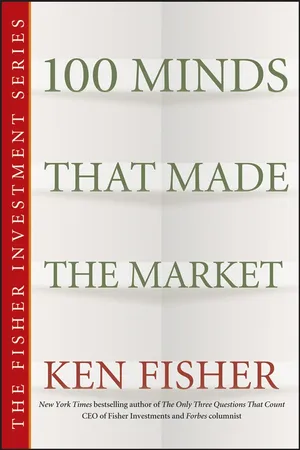
Over the course of nearly two centuries, the innovations, mistakes, and scandals of different market participants have played an important role in shaping today's financial markets. Now, in 100 Minds That Made the Market, Ken Fisher delivers cameo biographies of these pioneers of American financial history. From Joe Kennedy's "sexcapades" to Jesse Livermore's suicide, this book details the drama, the dirt, and the financial principles of an amazingly inventive group of financial minds. Fisher digs deep to uncover the careers, personal lives, and contributions of these individuals, and leads you through the lessons that can be learned from each one. Here you have 100 of the best teachers -- some you already know, some you will feel you know, and some you may not have previously discovered -- whose experiences will undoubtedly enhance your understanding of the markets.
With a few pages dedicated to each person, 100 Minds That Made the Market quickly captures the essence of the people and ideas that have influenced the evolution of the financial industry.
- English
- ePUB (mobile friendly)
- Available on iOS & Android
eBook - ePub
100 Minds That Made the Market
CHAPTER ONE
THE DINOSAURS
BIG AND RUTHLESS WHEN THAT WAS ALL THAT COUNTED
Before civilization, dinosaurs roamed the earth, doing as they pleased. They could do whatever they wanted back then; there were no rules to follow, no structure to live or work within and nothing bigger than they were. The only thing governing them was their environment, and because of their intimidating size, they were able to dominate that with unquestioned power.
The Rothschilds, Stephen Girard, John Jacob Astor, Cornelius Vanderbilt, George Peabody, Junius Morgan, Daniel Drew, and Jay Cooke are our financial Dinosaurs. They operated prior to order and organized structure within the capital markets. They too dominated their society through their magnitude and ability to simply surpass the rest of the population.
In creating the basis for our capital market system, they were viewed as ruthless, lawless and merciless. With a single, foreboding footstep, they were able to crush lesser creatures sometimes without really intending to. Like dinosaurs, they were big and awkward and not really civilized—at times completely unaware of their strength and the effects it had on others—whether for better or worse.
Astor, Vanderbilt, and Drew were perhaps the most notorious Dinosaurs, infamous for their foul treatment and manipulation of others. Regardless, during his lifetime, Astor became the “landlord of New York” and amassed a fortune. Vanderbilt pioneered transportation, building up the shipping industry and a railroad empire to accommodate the country’s growth. Drew was the father and most rigorous practitioner of stock “watering.”
You might view these three men as carnivorous dinosaurs. Each relied on another bite of flesh to build his immense fortune (and then lose it, in Drew’s case). But another group of Dinosaurs created and built an economic society without directly harming anyone in particular. The Rothschilds, Girard, Peabody, Morgan, and Cooke might be considered the vegetarians. They were much more gentle and docile in their way of promoting progress—but certainly no less effective.
The Rothschilds, father Mayer and son Nathan, were workhounds who emerged from the German Jewish ghetto to become the first power in world banking. They financed kings, princes, foreign countries, European industry and, when the time was right, America’s gradual transformation from an agricultural society to an industrialized nation.
Girard, who really was a vegetarian, financed America’s earliest trade endeavors, becoming America’s first richest man. He was a mercantile trader who financed import-export voyages and was among the first to support central banking in America (long before its time). Cooke financed the Civil War, becoming the first American to make large underwritings—and their sale—possible.
Peabody and Morgan, both based in London, took up what the Rothschilds started, becoming links between an economically advanced Europe and a cash-needy, emerging America. Peabody was the first to funnel European capital to things like state governments and early forms of industry; Morgan financed our railroad boom starting in the 1860s.
Morgan was perhaps our most important link to modern capital markets in America. His railroad financing sparked a flurry of economic progress, and he funneled much of that progress to his son and American business contact, J.P. Morgan. Young Morgan, whom you can read about in Chapter Three in his role as an investment banker, emerged as a Dinosaur-like power in his own right. Back when Wall Street was little more than a dirt path, young Morgan ruled the road with an iron fist. He was bigger than society and larger than the law, creating structure with each new idea he initiated. Instead of being described in the investment banking section, J.P. Morgan could as easily have been included in this section, as the last of the Dinosaurs, and perhaps the greatest and most powerful of them all.
Despite their larger-than-life personifications, the Dinosaurs didn’t live forever. They couldn’t. The very structure they created dated them, made them obsolete; the social response to their very existence outlawed them and eventually destroyed them. The progressive era, for example, coming at the height of Morgan’s power, was a direct reaction against decades of Dinosaurs and aspiring Dinosaurs who thought they could do as they saw fit in society. The Dinosaurs could. With the rise of the Progressive movement, Roosevelt, Wilson and the income tax. and all the rest of the evolution that ran through the eventual creation of the SEC, no one would ever again have so much total financial autonomy.
It’s hard to truly get a feel for the Dinosaurs today, while viewing them from our world—one that evolved through decades of innovation and Dinosaur-bashing and still more innovation and decades where Dinosaurs have since become nothing but memories. Yet, through their existence they provided us with the very beginnings of financial order—when there had been none. With their mass they tromped down the vegetation to make the first crude paths through the financial wilderness. They fought financial battles of a magnitude that could only be viewed as we now would view prehistoric dinosaurs in battle. And from the backlash of those battles came trends to follow and to buck just as early mammals learned to get out of the way of prehistoric dinosaurs and to scavenge their left-behinds. Finally, Dinosaurs gave us the beginnings of a loose set of ethics (both by positive and negative role models). For decades, good and bad would be defined in terms of the Dinosaurs’ actions. Men would aspire to emulate their successful market actions, and the outraged would create social foment aimed at early governmental control.
The Dinosaurs will never return. Occasionally a mutation occurs that attempts to be a Dinosaur. But that wanna-be can’t survive for the same reason prehistoric dinosaurs can’t survive now—regardless of climatic conditions. Simply put, human society wouldn’t allow it. Today we have a well defined civilization oriented toward protecting our social order, including the weak and unfortunate. And our social order won’t allow Dinosaur-like action. To wit, we have Michael Milken, who came as close to a Dinosaur as anything we’ve seen in decades. Note how easily the government put Milken in jail on violations which were miniscule relative to the overwhelming mass of his overall junk bond financing activity.
If somehow the Loch Ness monster were to come out of the lake and start strolling in toward town, our authorities would find immediate justification to take action and control it long before it ever got close to population centers. A big wild thing just can’t be totally free now, and what is a Dinosaur but a big wild thing? It’s actually been a fairly long time since you could be a little, wild thing. Think back to 1911, when Ishi, the last of the wild native American Indians, came in from the woods to give himself up. We took him captive and put him on display in a museum, and in a few years he died of diseases he had never been exposed to in the wild. Our modern societal need to control freedom—lest something damaging occur—will never again allow the evolution of men like the Dinosaurs depicted in this section.
So enjoy these big and wild Dinosaurs. They were among the very first minds that set the market on the path to what it has become.

MAYER AMSCHEL ROTHSCHILD
OUT OF THE GHETTO AND INTO THE LIMELIGHT
Deep in the dank, damp and cramped Jewish ghetto of Frankfurt on the Main in the late 18th century, a nondescript, dark-eyed pawnbroker named Mayer Rothschild created a financial dynasty that grew to finance the development of western civilization. Because of Rothschild and the banking house he built with his five sons, money flowed throughout Europe with ease, enabling the industrial revolution to take place and lift Europe from the dark ages. As a direct result, America—then practically a Third World country compared to prospering Europe—received the financing it needed to transform itself from a provincial, largely agricultural country into a great industrial nation.
Mayer had begun his career by age 10, discovering the ins and outs of money at his father’s pawnshop and money bureau. Currency during the 1740s was quite complex, as each of the hundreds of states comprising Germany (still the Holy Roman Empire) minted its own coins. Being astute, he caught on quickly and soon could translate gold and silver into coin and calculate exchange rates with lightning speed.
Orphaned at age 11 in 1755, Mayer followed the sound of clinking coins rather than his parents’ idea that he become a rabbi. Over the next decade, he ran a small trade business and pawnshop, selling tobacco, wine, and cloth in exchange for coins. And knowing what a royal connection could do for his career, Mayer courted the business of a numismatic prince—not just any prince, but one of Europe’s mightiest and richest, the billionaire Prince William. Mayer sold him his antique coins at ridiculously low prices for years—foregoing immediate profits for long-term favor. He had no intention of staying a small time pawnbroker the rest of his life!
Back then, being a pawnbroker-merchant was one of the only career options available to Jews. Thanks to a papal decree centuries earlier, usury laws forbade Christians from lending for profit. So Jews took over the money-lending trades, becoming pawnbrokers, small trade merchants, and wizards of finance. By the 18th century, it was tradition to trek over to the Jewish ghetto when you needed to pawn a possession for cash or to buy trinkets or second-hand goods. Had Mayer been content with his common role, it’s unlikely the Rothschild name would mean what it does today in the financial world.
Tall, black-bearded, with an odd, quizzical smile and a ghetto dialect of Yiddish-Deutsch—Mayer produced 20 children with his wife, Gutle, between 1770 and 1790, with only five girls and five boys surviving. Despite Gutle’s harsh life, she was tough, and lived to age 96—which was exceptionally old back then. Seeing the future in his boys, Mayer taught them to buy cheaply and sell dearly before they could walk, and when they reached age 12, he put them to work in the family business. Ultimately, it was through his sons that Mayer realized his ambitions.
Operating from his house, Mayer and sons Amschel, Salomon, Nathan, Carl, and James built the business into a strong importing house. This was at the turn of the century, when dry goods were hard to get in Germany unless someone imported them—and that someone was Mayer. Foreseeing the demand for cotton—and perhaps the expanse of his later empire, Mayer sent Nathan to London to make sure cotton shipments reached Frankfurt.
As a big wartime supplier, the Rothschilds piled up the profits. Mayer, still not content with the excess, next began operating a money exchange bureau in their yard. What’s considered the very first Rothschild bank appeared to be a nine-square-foot hut—but things weren’t quite what they appeared to be. Mayer installed a large iron chest that, when opened from the back, revealed a stairway leading to a secret storage cellar.
Mayer’s scheming finally paid off when Prince William of Germany, the man to whom he’d been selling coins, gave him the business he’d been hoping for all along. It started with Mayer acting as the prince’s independent agent in an anonymous loan to Denmark. He was the prince’s chief banker in 1806 when the prince was forced to flee in exile, leaving his fortune in the Rothschilds’ hands.
In the following years Mayer had his sons fan out across the European continent: James went to Paris, Salomon to Vienna, Carl to Naples, Amschel remained in Frankfurt, and of course, Mayer’s successor Nathan stayed in London. Each son followed in Mayer’s footsteps, courting profitable royal connections, and later each made his own mark by financing kings, wars, and Europe’s first railroads. Ultimately, the Rothschilds united to form a sturdy, efficient moneychain across Europe that financed its industrial revolution, creating a common money market for the first time.
By Mayer’s death in 1812, his ghetto hopes and ambitions had been realized through his sons, who were well on their way to becoming the world’s largest private bank. Without his sons, Mayer might have wound up wealthy, but never world renowned. Why is it that in a book of American financial biographies and American markets there is mention of this European? Simply put, at a time before America had developed its financial markets, the financing of American commodities and government bonds would have been impossible without the flow of funds from Europe. The House of Rothschild, derived through Mayer, was the center of Europe’s money markets. Without Mayer and his generational empire, it is unclear that America would ever have developed its own industrial revolution or financial markets. His genes were the seeds through which America’s industry got its original lifeblood. In that respect, the seminal tinkling of this German pawnbroker’s coins and the thinking that went on behind it are every bit as important to the evolution of American financial history as the life of any American.

NATHAN ROTHSCHILD
WHEN CASH BECAME KING—AND CREDIT BECAME PRIME MINISTER
Money became king when Nathan Rothschild rose to power over Europe in the 19th century, forcing people to recognize finance over divine right. More powerful than monarchs, Nathan masterminded the Rothschild money-factory by sparking Europe’s industrial awakening. He financed governments, wars, railroads—anything that stood for progress. At his death in 1836, he left an undisclosed fortune (secrecy was a Rothschild trademark), a legacy of Rothschild bankers, and most importantly, the earliest and most abundant source of credit for a burgeoning America via his American agent August Belmont.
Although banking was then still in its rudimentary state, Nathan fully understood the interplay between finance and economics, the effects of political news on the stock exchange, the quickest way to bull or bear a market, and how gold reserves affected the exchange rate. Born in Frankfurt, he founded London’s N.M. Rothschild and Sons. He spent half his day at the bank and the other half at the Royal Exchange leaning against the same pillar, knowing he was the center of attention. While brokers watched his short, stout figure, hopeful for a sign or a gesture that might foretell his next move, Nathan kept an utterly blank expression—his hands thrust inside his pockets and his hat pulled over his eyes.
Round-faced, red-headed with pouty lips, a sour personality, and arrogant manner, at age 33 Nathan built the family fortune in a single move at the Royal Exchange—with a prince’s royal booty! His father, Mayer Rothschild, had advised a German prince to buy British consols (English government bonds) and to use Nathan to do so, since Nathan was in London and would only charge a tiny brokerage fee of one-eighth of 1 percent. The prince agreed and sent Nathan the equivalent of $5 million—which was a lot of money back then—all earmarked for oodles of consols, priced at 72.
Quick-thinking Nathan eventually bought the prince his consols, but he first used the money to successfully speculate in gold bullion, making a killing and a reputation for himself in the London exchange. That would be considered highly unethical today because using a client’s money for your own benefit is dishonest and generally slimy. But in those days, notions of highly unethical behavior didn’t exist. Had Nathan’s gold speculation failed, we wouldn’t be reading about him now.
When the prince grew impatient for his securities, Nathan simply bought the consols at 62, making another killing by charging the prince the expected 72 and pocketing the difference! Amazingly, it was three years from the time the prince first advanced the money that Nathan actually got the consols for him—1809 to 1812. For three years Nathan used the money, interest free, and from it made two fortunes. If a broker did that today, he would be banned from the industry for life. Nathan just might have been the first of the big-time brokerage scoundrels. Yet five years, later, at 38, he was banker-in-chief to the British Government.
By the 1820s, Nathan and his four brothers were operating from five capitals, creating a financial network that sprawled throughout Europe like never before. Cultivating Europe’s wealthiest as clients, Nathan masterminded the family’s coups while his brothers successfully carried them out. For instance, Nathan concocted a loan—carried out by brother James in Paris—to finance the return of Bourbon Prince Louis XVIII to the French throne. When Naples was overcome by a revolution, Nathan dreamed up the loan that financed a military occupation by the Austrian army—and brother Carl saw it through.
With communication systems practically nonexistent except for word of mouth, the Rothschild brothers stayed in touch via their famously efficient private courier system that c...
Table of contents
- Title Page
- Copyright Page
- Dedication
- PREFACE
- Acknowledgements
- Foreword
- Introduction
- CHAPTER ONE - THE DINOSAURS
- CHAPTER TWO - JOURNALISTS AND AUTHORS
- CHAPTER THREE - INVESTMENT BANKERS AND BROKERS
- CHAPTER FOUR - THE INNOVATORS
- CHAPTER FIVE - BANKERS AND CENTRAL BANKERS
- CHAPTER SIX - NEW DEAL REFORMERS
- CHAPTER SEVEN - CROOKS, SCANDALS, AND SCALAWAGS
- CHAPTER EIGHT - TECHNICIANS, ECONOMISTS, AND OTHER COSTLY EXPERTS
- CHAPTER NINE - SUCCESSFUL SPECULATORS, WHEELER-DEALERS, AND OPERATORS
- CHAPTER TEN - UNSUCCESSFUL SPECULATORS, WHEELER-DEALERS, AND OPERATORS
- CHAPTER ELEVEN - MISCELLANEOUS, BUT NOT EXTRANEOUS
- CONCLUSION
- APPENDIX - BIBLIOGRAPHIES
- INDEX
Frequently asked questions
Yes, you can cancel anytime from the Subscription tab in your account settings on the Perlego website. Your subscription will stay active until the end of your current billing period. Learn how to cancel your subscription
No, books cannot be downloaded as external files, such as PDFs, for use outside of Perlego. However, you can download books within the Perlego app for offline reading on mobile or tablet. Learn how to download books offline
Perlego offers two plans: Essential and Complete
- Essential is ideal for learners and professionals who enjoy exploring a wide range of subjects. Access the Essential Library with 800,000+ trusted titles and best-sellers across business, personal growth, and the humanities. Includes unlimited reading time and Standard Read Aloud voice.
- Complete: Perfect for advanced learners and researchers needing full, unrestricted access. Unlock 1.5M+ books across hundreds of subjects, including academic and specialized titles. The Complete Plan also includes advanced features like Premium Read Aloud and Research Assistant.
We are an online textbook subscription service, where you can get access to an entire online library for less than the price of a single book per month. With over 1.5 million books across 990+ topics, we’ve got you covered! Learn about our mission
Look out for the read-aloud symbol on your next book to see if you can listen to it. The read-aloud tool reads text aloud for you, highlighting the text as it is being read. You can pause it, speed it up and slow it down. Learn more about Read Aloud
Yes! You can use the Perlego app on both iOS and Android devices to read anytime, anywhere — even offline. Perfect for commutes or when you’re on the go.
Please note we cannot support devices running on iOS 13 and Android 7 or earlier. Learn more about using the app
Please note we cannot support devices running on iOS 13 and Android 7 or earlier. Learn more about using the app
Yes, you can access 100 Minds That Made the Market by Kenneth L. Fisher,Ken Fisher in PDF and/or ePUB format, as well as other popular books in Business & Finance. We have over 1.5 million books available in our catalogue for you to explore.