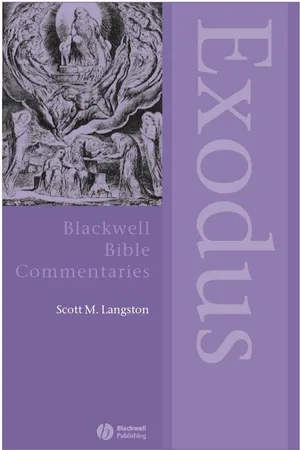
- A bible commentary tracing the reception history of Exodus from Old Testament times, through the Patristic and Reformation periods, to the present day.
- Considers the ways in which Exodus has influenced and has been influenced by history, religion, politics, the arts and other forms of culture in Jewish, Christian and secular settings.
- Looks at how Exodus has served as a tool of liberation and tyranny in a variety of settings.
- Shows how Exodus has been used to shape the identities of individuals and groups.
- Discusses the works of current and past poets, musicians, film-makers, authors and artists influenced by Exodus.
- Addresses uses of Exodus related to American and European history such as the Glorious Revolution, colonialism, the American Revolution, Civil War, Civil Rights Movement, African-Americans, and Native Americans, as well as uses by prominent and little-known historical figures
- Considers the impact of the Ten Commandments and other laws, in legal, political and religious contexts.
- The Blackwell Bible Commentary series is supported by a website at www.bbibcomm.net
- English
- ePUB (mobile friendly)
- Available on iOS & Android
eBook - ePub
Exodus Through the Centuries
About this book
This bible commentary looks at how Exodus has influenced and has been influenced by history, religion, politics, the arts and other forms of culture over the ages.
Information
Edition
1Topic
Theology & ReligionExodus 1–2
The book of Exodus begins with a paradoxical struggle between life and death. The multitude of descendants resulting from the promises made to Abraham (Gen. 13:16; 15:5) had now become the basis for exterminating the Hebrew people. The more the Egyptians tried to decrease their number, however, the more the Hebrews increased. Pharaoh ultimately decreed the murder of all male Hebrew infants, but his own daughter subverted the process by saving the Hebrews’ future leader. The birth of the Hebrew nation began with death. These paradoxes flow from a series of vignettes that move the reader quickly from the suffering of the Hebrews to the introduction of their human savior, Moses. Within a matter of verses, Moses grows from an infant to an adult, and the Hebrews’ groaning has captured the attention of their God. The first chapter recounts the general suffering of the Hebrews and their responses to Egyptian aggression. The second chapter focuses on Moses and sets him within the context of the broader action.
While perhaps not as influential as passages recounting the burning bush, the plagues and the exodus from Egypt, the Ten Commandments, or the golden calf, these opening stories of suffering and resistance to oppression have sparked the imaginations of interpreters throughout the centuries. They have been a source for theological, social, political, ethical, and historical reflection, as well as emotional expression. They have also moved people to action.
These readings reveal that Exodus 1–2 is concerned with more than questions regarding its historicity, the identification of its original context and personalities, or the ancient meaning of certain words and phrases. It also invites consideration of issues such as suffering, oppression, power, hope, gender, race, and class. Subsequent readings illustrate how easily the biblical text is re-contextualized in different settings. They touch on features only hinted at within the biblical text, but nonetheless present. Such aspects, once unearthed, take on new life and even new forms in the world of the interpreter and demonstrate the elasticity of the text.
1:1–14 The Israelites’ Suffering
Ancient explanations
One of the first interpretations of this passage comes from a biblical hymn. Psalm 105 encourages the Israelites to give thanks and praise to YHWH, using the exodus to illustrate his faithfulness to the covenant. Two verses recalled the sufferings of Exodus 1. Whereas in Exodus the Hebrews multiplied and as a result provoked cruel measures by the Egyptians, in Ps. 105:24–5 Yahweh precipitated these events to demonstrate that he remembered the covenant. The psalmist makes explicit what in Exodus had been either implied or completely omitted.
The events in Exodus 1, however, garnered little attention from other Hebrew Bible authors. Likewise during the Hellenistic and Roman periods, writers often either skipped over or condensed these events, preferring to explain why the growth of the Hebrews threatened the Egyptians. For the author of Jubilees, Egyptian oppression resulted from a Canaanite victory over Egypt: pharaoh subsequently enslaved the Hebrews to prevent them from joining with Egyptian enemies. (Jubilees also has them rebuilding all the walls and ramparts destroyed in Egypt [46:11–16, in Charlesworth 1985: vol. 2]). Pseudo-Philo in his Biblical Antiquities (Liber Antiquitatum Biblicarum [Charlesworth 1985: 2. 297–377]) moves directly from Joseph’s death to the pharaoh’s plan to throw the male babies into the Nile. The Egyptian people responded by asking the pharaoh to give the Hebrew female infants to their slaves as wives, which would in turn produce more slaves (9:1–5, in Charlesworth 1985: vol. 2). Philo also begins his life of Moses with the infanticide, explaining that the males posed a military threat, whereas the females did not, because their “natural weakness” made “a woman inactive in war” (1935: Life of Moses 1.8). The writer of Acts summarizes the Hebrew oppression in one verse, mentioning only the infanticide in Stephen’s speech before the high priest, while quickly moving to Moses’ birth (7:17–20).
Interpreters explained the Hebrews’ suffering as either unjustly caused by the Egyptians or as fit punishment for Hebrew misdeeds. Josephus attributed the oppression to Egyptian laziness and envy. When the Egyptians saw that the Hebrews had prospered because of their virtue and love of work, they devised numerous building projects, including cutting river channels and building walls and ramparts, as well as pyramids (1974b: Antiquities 2.9.1). (Explaining how a pharaoh could not know Joseph, the Targum Onkelos, along with Targum Neofiti I and Targum Pseudo-Jonathan, contended that the new king did not fulfill the decrees of Joseph [1.8]; that is, he likely knew Joseph, but chose not to follow his policies.) The Midrash Rabbah: Exodus, however, blamed the Hebrews, asserting that they abolished circumcision after the death of Joseph in order to be like the Egyptians. Therefore, God made the Egyptians hate the Hebrews (1.8). This explanation continued into the modern period, with only slight modification. According to Saul ha-Levi Morteira, a seventeenth-century Sephardic rabbi in Amsterdam, the Hebrews thought of Egypt as their homeland, became arrogant, and provoked the Egyptians. Using Exodus 1 as a paradigm to account for subsequent Jewish persecution, he explained that Jews had arrived in other countries as destitute refugees, eventually prospered, and then became arrogant and indulgent. The native-born inhabitants then expelled the Jews out of disgust. Morteira then encouraged the Jewish community to behave properly, by living less ostentatiously and serving God (Saperstein 1989: 274, 284–5).
To the ancient rabbis, the nature of the oppression in 1:10–11 demonstrated the Hebrews’ degradation. Whereas the Masoretic Text made the object of the action in these verses singular (“let us deal shrewdly with him … they set taskmasters over him”), the Septuagint as well as Targum Onkelos translated the objects as plurals referring to the Hebrew people (“let us deal shrewdly with them … they set taskmasters over them”). The Babylonian Talmud, however, found in the singular of verse 11 a reference to the pharaoh (b. Sotah 11a). The pharaoh had a brick mold hung around his shoulders. Whenever the Hebrews complained of being too weak to fulfill his commands, they were asked, “Are you weaker than the pharaoh?” Thus he compelled them to work harder by asking a question that could hardly be answered negatively. Additionally, the rigorous work mentioned in verses 13 and 14 referred to the pharaoh compelling the men to do women’s work and vice versa (b. Sotah 11a). Such work resulted in an oppressive and unjust degradation. In this way, the rabbis encouraged their Jewish readers to contemplate the plight of their predecessors.
Modern oppression
Modern readers have also related the story to contemporary oppression. George Lockhart of Carnwath (1681–1732) used the reference to a pharaoh who did not know Joseph to reflect upon the union of the British and Scottish crowns and the subsequent Treaty of Union, which formed Scotland and England into one nation in 1707. Almost a century before, Scotland’s King James VI had also become king of England (James I). This boded well for Scotland, but the Scottish Parliament did not provide for the separation of the crowns upon James’s death. This failure led, Lockhart complains, to Scotland’s oppression. The Parliament failed to realize that a king might come to power who would not treat the Scots favorably. Under subsequent rulers, who did not hold James VI’s concern for the Scots, Scotland suffered (1995: 247–8).
Whereas Lockhart alluded to Exodus to criticize oppressive national relations, Benjamin Morgan Palmer (1818–1902), pastor of New Orleans’ First Presbyterian Church and a highly influential southern clergyman, used it to argue against freedom for African-American slaves, to cast slavery in a positive light, and to boost southern morale. Preaching a fast-day sermon before the South Carolina legislature in December 1863, Palmer warned that freed slaves would confront “taskmasters more unrelenting than those of Egypt” (1864: 16). His analogy suggested that the supposed freedom for slaves sought in the United States would actually result in an exodus-like bondage. Unlike African Americans who appealed to the exodus story in order to validate change, Palmer used it to maintain the status quo.
In Franz Kafka’s novel Amerika, the increased workload of the Hebrews illustrated the degradation wrought by modern society. The novel was published after his death in 1924, and was later made into two movies, Klassenverhältnisse (Germany, 1984) and Amerika (Czechoslovakia, 1994). According to Robert Alter, Kafka, a native of Prague, paradoxically employs biblical allusions in which America, conceived as the New Eden and the Promised Land, ultimately becomes “a modern manifestation of the Egyptian house of bondage.” Compulsive and incessant work becomes a type of modern enslavement. When the main character, Karl Rossmann, comes to America from Europe, he experiences various types of bondage, most evident when he is employed, working hard and long, at the Hotel Occident, located in the town of Rameses (cf. Exod. 1:11). Kafka, according to Alter, finds in the Bible “a resonant structure of motifs, themes, and symbols to probe the meaning of the contemporary world.” While not a “fixed source of authority,” the Bible demanded that he “make sense of his world through it.” In this instance, the land of promise and freedom became a land of slavery through its constant demands for work (Alter 2000: 15, 18; Kafka 1946).
Readers continue to find in the oppressive nature of the new pharaonic rule an interpretive lens. A recent historian has characterized the deployment of South Korean troops during the Vietnam War at the behest of the United States as being “in the service of Pharaoh” (Sarantakes 1999). The fact that the phrase is employed in the title of the article without any reference to Exodus indicates how commonly Israel’s enslavement has been used to describe oppressive relations. Similarly, another author uses the reference in Exod. 1:8 to “a pharaoh who did not know Joseph” to describe potential pitfalls in US President George W. Bush’s proposal to use federal money to fund certain faith-based social programs. The writer warned that just as a pharaoh arose who was not sympathetic to the Hebrews, so faith-based programs that accept federal funding might one day find themselves subject to an unsympathetic government (Rager 2001).
1:15–22 Attempts to Kill Israel’s Male Infants
The midwives
THEIR ACTIONS
Most interpreters have focused on the oppression that follows the forced labor of 1:11–14, probably because it connects directly to the birth of Moses (2:1–10). Often discussed are the midwives, Moses’ mother, and the pharaoh’s daughter. Although some ancient accounts do not mention the midwives (for example, Ezekiel’s Exagoge, Jubilees, Pseudo-Philo, and Philo), others conflate into one event the two orders: to the midwives to kill the infants and to the general populace to throw the infants into the Nile. In the process, Moses’ birth takes on added significance. Josephus recorded a message relayed by a sacred scribe predicting to pharaoh that an Israelite child would be born who would weaken Egyptian power and strengthen the Israelites. He would exceed all people in terms of virtue and be remembered forever. The pharaoh so feared this prediction that he commanded all Israelite male babies to be drowned and the midwives, who according to Josephus were Egyptians, to lend assistance (1974b: Antiquities 2.9.2). Targum Pseudo-Jonathan gives a different version of this legend. Pharaoh dreamed that the land of Egypt and a lamb were placed on a scale; the lamb weighed it down. His chief magicians, Jannes and Jambres, told him that this meant that a child born among the Israelites would destroy Egypt. The pharaoh then ordered the midwives (who were Jewish) to kill the male babies. Both accounts enhance Moses’ role, since his birth becomes the reason for the infanticide rather than its product.
Were the “midwives of the Hebrews” Egyptians or Hebrews? In the Septuagint, as in Josephus, they were Egyptians. In the Talmud, however, they were Jewish. One Talmudic tradition, also followed by Targum Neofiti I and Targum Pseudo-Jonathan, identified Shiphrah as Jocheved, Moses’ mother, and Puah as Miriam, his sister. The other understood the midwives to be Jocheved and Elisheba, the wife of Aaron (b. Sotah 11b). Exodus Rabbah agreed that they were Hebrew and recorded numerous explanations of their names. Their ethnicity made a difference to the story. As Egy...
Table of contents
- Cover
- Table of Contents
- Series Editors
- Title
- Copyright
- llustrations
- Series Editors’ Preface
- Preface
- Introduction
- Exodus 1–2
- Exodus 3–4
- Exodus 5–10
- Exodus 1:1–13:16
- Exodus 3:17–15:21
- Exodus 5:22–18:27
- Exodus 19–31
- Exodus 32–40
- Epilogue: A Personal Word
- Bibliography
- Biographies and Glossary
- Index
- Subject Index
- End User License Agreement
Trusted by 375,005 students
Access to over 1.5 million titles for a fair monthly price.
Study more efficiently using our study tools.
Frequently asked questions
Yes, you can cancel anytime from the Subscription tab in your account settings on the Perlego website. Your subscription will stay active until the end of your current billing period. Learn how to cancel your subscription
No, books cannot be downloaded as external files, such as PDFs, for use outside of Perlego. However, you can download books within the Perlego app for offline reading on mobile or tablet. Learn how to download books offline
Perlego offers two plans: Essential and Complete
- Essential is ideal for learners and professionals who enjoy exploring a wide range of subjects. Access the Essential Library with 800,000+ trusted titles and best-sellers across business, personal growth, and the humanities. Includes unlimited reading time and Standard Read Aloud voice.
- Complete: Perfect for advanced learners and researchers needing full, unrestricted access. Unlock 1.5M+ books across hundreds of subjects, including academic and specialized titles. The Complete Plan also includes advanced features like Premium Read Aloud and Research Assistant.
We are an online textbook subscription service, where you can get access to an entire online library for less than the price of a single book per month. With over 1.5 million books across 990+ topics, we’ve got you covered! Learn about our mission
Look out for the read-aloud symbol on your next book to see if you can listen to it. The read-aloud tool reads text aloud for you, highlighting the text as it is being read. You can pause it, speed it up and slow it down. Learn more about Read Aloud
Yes! You can use the Perlego app on both iOS and Android devices to read anytime, anywhere — even offline. Perfect for commutes or when you’re on the go.
Please note we cannot support devices running on iOS 13 and Android 7 or earlier. Learn more about using the app
Please note we cannot support devices running on iOS 13 and Android 7 or earlier. Learn more about using the app
Yes, you can access Exodus Through the Centuries by Scott M. Langston in PDF and/or ePUB format. We have over 1.5 million books available in our catalogue for you to explore.