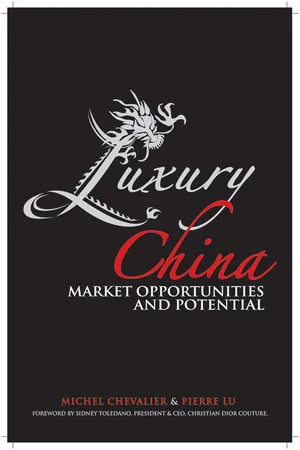
China's growing consumer base and expanding economy means more disposable income for more Chinese citizens. The Chinese market for luxury goods is expected to expand from $2 billion this year to nearly $12 billion by 2015. Today's biggest global luxury goods retailers expect China to make up a large and ever growing portion of their customers, and those businesses are responding with new stores and investments in China. Luxury China gives readers–particularly professionals in advertising, marketing, and the luxury brands industry–a deep look into the future of the Chinese luxury goods market and shows them how to tap into China's tremendous market potential.
- English
- ePUB (mobile friendly)
- Available on iOS & Android
eBook - ePub
CHAPTER 1
Challenges and Market Size
To understand the challenges of luxury activities in China, one must look at the total size of the business worldwide and then, for each sector of activity, analyze the size of the Chinese market.
While many economists believe that China is the third-largest luxury market in the world, after the United States and Japan, the situation for individual brands is quite different. For example, for Italian fashion brands, Italy remains the primary market, with Japan in second place and the United States in third. When China develops, it will become fourth or fifth. For French fashion brands (with a few exceptions such as Louis Vuitton) the French market remains number one, with China often in fourth or fifth place—which is already quite a performance. For the industry as a whole, Korea is also very strong and profitable, as soon as a critical mass is reached, constituting the fourth-largest market for many brands.
A 2006 study by IPSOS, Paris found that the Chinese market is the fourth-largest in the world behind Japan (40%), the United States (20%) and Europe (17%). Of course, the figures need to be treated with some caution because they appear to be related to the ready-to-wear area rather than considering the luxury market as a whole. Nevertheless, they do give an indication of China’s importance in the field.
In global terms, Chinese economists used to include the figures for Hong Kong, Macau and Taiwan in their analyses. These three markets have been developing now for almost 30 years and have reached very high volumes and a high degree of sophistication. Hong Kong’s duty-free status enables it to benefit from a large number of tourist purchases, particularly from Japanese and American nationals. Taiwan, while not a duty-free territory, has limited duties and also constitutes another large market of luxury products sold to domestic customers and tourists.
So, when these three territories are included, China is the third- or fourth-largest luxury market in the world. However, it is also important to note the incredible growth that luxury products are experiencing in mainland China.
Also, one should add to such figures the market potential presented by Chinese tourists purchasing luxury products abroad. In 2006, some 35 million mainland Chinese traveled abroad and it is estimated that this figure will reach 100 million by 2015.
To understand the situation one has to start with an evolution of the general worldwide market before studying the specific market situation in China.
The size of the global market
A recent study places the value of the worldwide luxury market at close to US$265 billion at wholesale or corporate value.1 A breakdown by category is shown in Table 1.1.
TABLE 1.1: Value of worldwide luxury market by category, 2008 (US$)
| Ready-to-wear | 30 billion |
| Leather goods and accessories | 24 billion |
| Fragrances and cosmetics | 41 billion |
| Spirits, champagnes and still wines | 107 billion |
| Watches | 16 billion |
| Jewelry | 40 billion |
| Others (including Tableware) | 7 billion |
| Total | 265 billion |
The size of the Chinese mainland market
A breakdown of our estimates of the figures for the Chinese mainland market is given in Table 1.2. The estimated amount of US$15 billion, representing 5.5% of the worldwide market, is very much in line with the figure of US$6 billion produced by the investment bank Goldman Sachs for 2004, taking into account the present growth rate of luxury goods in China, which, for all luxury categories, can reach 25% a year.
TABLE 1.2: Value of luxury market in mainland China by category, 2008 (US$)
| Ready-to-wear | 1.5 billion |
| Leather goods and accessories | 1.6 billion |
| Fragrances and cosmetics | 4 billion |
| Spirits, champagnes and still wines | 4 billion |
| Watches | 1.3 billion |
| Jewelry | 1.3 billion |
| Others (including Tableware) | 1.3 billion |
| Total | 15 billion |
If the figures for Hong Kong, Macau and Taiwan were included, the total for 2008 would probably amount to US$27 billion, or 10% of the worldwide market, but this figure would be skewed by double counting (many products sold in mainland China are imported through Hong Kong and may have been registered at export prices in Hong Kong and then at wholesale or retail prices on the mainland).
While we have mentioned an estimated average yearly growth rate of 25%, the actual figure is very difficult to come by because it depends very much on the sub-categories of luxury products that we may consider.
What is known for sure, however, is that many “iconic” brands were growing at around 30% in their existing stores and were expanding the number of stores by about 20% each year between 2001 and 2007. Together, they provided an additional annual sales growth of 50%. If they wanted to maintain their market position, and if they compare themselves to Prada, Louis Vuitton, or Gucci, they had to invest and keep growing at this rate.
Even if the current growth rate decreases, mainland China’s share of the luxury market will reach 15% in 2015. Add in Hong Kong, Macau and Taiwan and it will account for between 20% and 25% of worldwide sales. In categories like fashion and accessories, China and Japan (with approximately 20% of the world’s population) between them will represent 50% of the worldwide volume—a clear indication that what happens in these two countries is essential in this business field.
For the past five years, China has, along with Russia, been the fastest-growing market in the world. But whether it is profitable is another issue, and one we will discuss later in this chapter.
The outlook for different market segments
The analysis must now go one step further and look at each product category.
Fashion and accessories
Our estimates for fashion and accessories are still limited, as we are talking of a total of only US$2.6 billion. This market has probably been growing from anywhere between 20% and 30% a year and is very much an “El Dorado” for the very top brands.
This is also the only market in the world where ready-to-wear products for men sell more than ladies’ wear. This is of course due to the very keen interest in luxury products among men, and the fact that men control their own budgets, while only women with an active business life have clear financial autonomy.
Brands such as Louis Vuitton, Chanel, Gucci and Salvatore Ferragamo have different profiles. Louis Vuitton has 21 stores, Chanel three stores, Gucci 17 stores, and Salvatore Ferragamo 23 stores. Other brands which are perhaps not very well-known in Europe (the Canadian brand Ports 1961, for example) are developing very rapidly.
In fashion, the merchandise sold in the various stores is very dependent on the profiles of their clientele. In China, men are buying more often than women. This is why in the merchandise mix, accessories form the majority of sales, and in ladies’ fashion, simple tops are purchased more often than sophisticated dresses. However, as men may buy fashion goods from the same brand from the same store at the same time for their tai tais (wives) and for their er tais (“second wives”/girlfriends)—a traditional style for one and a flashier look for the other—there is a need for very diversified merchandise.
The fact that men are important customers for luxury products to an extent that is rare in other countries provides an additional opportunity for men’s lines. The clearest case of this is Ermenegildo Zegna, whose 52 Chinese stores (including franchises) make China one of its most important markets.
Another problem for luxury fashion products in China is that the large price difference between, for example, a branded luxury jacket and a jacket purchased for a few dollars in an open-air market is huge. There is a need for basic training so that the consumer can understand the difference and feel confident about such products. In some cases, for example, the consumers don’t want to buy a dress simply because they are afraid of giving it to their local dry-cleaner with a pile of standard dresses.
In the ready-to-wear category, Chinese men (like their Japanese counterparts) like basic colors for their suits, and have a strong preference for white or light-blue shir...
Table of contents
- Cover
- Contents
- Title
- Copyright
- Dedication
- Foreword
- Introduction
- Chapter 1: Challenges and Market Size
- Case Study 1: Alfred Dunhill
- Chapter 2: The Chinese Luxury Client
- Case Study 2: Shanghai Tang
- Chapter 3: Chinese Consumer Attitudes Toward Luxury
- Case Study 3: Rolex in China
- Chapter 4: How to Distribute in China
- Case Study 4: Shiatzy Chen
- Chapter 5: Retailing and Licensing in China
- Case Study 5: Louis Vuitton in China
- Chapter 6: Communication and Advertising
- Case Study 6: The War of the Spirits
- Chapter 7: Brand Protection and Counterfeit Activities
- Case Study 7: Liuli Gongfang: Breaking into Luxury by Way of Glass
- Appendix A: China: A Collection of Markets
- Appendix B: A Profile of China’s Leading Cities
- Appendix C: China’s Magazine Market
- Appendix D: National Television Audience Ratings (as at 24 September 2008)
- Appendix E: Brands with Approved Well-Known Trademark Status
- Bibliography
- Index
Trusted by 375,005 students
Access to over 1.5 million titles for a fair monthly price.
Study more efficiently using our study tools.
Frequently asked questions
Yes, you can cancel anytime from the Subscription tab in your account settings on the Perlego website. Your subscription will stay active until the end of your current billing period. Learn how to cancel your subscription
No, books cannot be downloaded as external files, such as PDFs, for use outside of Perlego. However, you can download books within the Perlego app for offline reading on mobile or tablet. Learn how to download books offline
Perlego offers two plans: Essential and Complete
- Essential is ideal for learners and professionals who enjoy exploring a wide range of subjects. Access the Essential Library with 800,000+ trusted titles and best-sellers across business, personal growth, and the humanities. Includes unlimited reading time and Standard Read Aloud voice.
- Complete: Perfect for advanced learners and researchers needing full, unrestricted access. Unlock 1.5M+ books across hundreds of subjects, including academic and specialized titles. The Complete Plan also includes advanced features like Premium Read Aloud and Research Assistant.
We are an online textbook subscription service, where you can get access to an entire online library for less than the price of a single book per month. With over 1.5 million books across 990+ topics, we’ve got you covered! Learn about our mission
Look out for the read-aloud symbol on your next book to see if you can listen to it. The read-aloud tool reads text aloud for you, highlighting the text as it is being read. You can pause it, speed it up and slow it down. Learn more about Read Aloud
Yes! You can use the Perlego app on both iOS and Android devices to read anytime, anywhere — even offline. Perfect for commutes or when you’re on the go.
Please note we cannot support devices running on iOS 13 and Android 7 or earlier. Learn more about using the app
Please note we cannot support devices running on iOS 13 and Android 7 or earlier. Learn more about using the app
Yes, you can access Luxury China by Michel Chevalier,Pierre Xiao Lu in PDF and/or ePUB format, as well as other popular books in Business & Retail Industry. We have over 1.5 million books available in our catalogue for you to explore.