![]()
I
Bratty Behavior
TERRIBLE OFFICE TYRANTS (TOTS) are at their most terrible when they behave like all-out brats. When your boss morphs into monster mode, you can count on a bad day . . . or a bad week.
Some of the most striking parallels between toddlers and TOTs are, well, also the most obnoxious. A boss who wants a report “Now!” bears an uncanny resemblance to an unruly little kid in the supermarket candy aisle.
A child who bullies others because he’s bigger and tougher can be seen in a manager who constantly reminds his team “who’s in charge.” And yes, both TOTs and toddlers can pitch a whopper of a tantrum, although unfortunately, your boss isn’t as likely to throw himself on the ground and cry. (One can dream, though!)
Like small children, bosses like to get their way. That often involves acting out in ways that you thought were limited to little kids faced with a plate of vegetables or the threat of no more video games. To make things worse, a petulant TOT, unlike a child, has direct authority over your livelihood. That’s when Bratty Behavior is no longer just annoying ... it can be life changing.
By understanding what’s behind the bluster, you can usually tame your TOT—or at the very least, mitigate unpleasant situations. You might sometimes feel inclined to fight fire with fire, but all that does is get you fired. So be creative and “manage up” when the Terrible Twos appear in the corner office.
Inside this section of Tame Your Terrible Office Tyrant, you’ll learn how to recognize the telltale signs of an impending brat attack—as well as how to deal with one. Each chapter includes a look at how TOTs and toddlers act out in common, a real-life story about how an employee like you dealt with a challenging boss, and a set of helpful TOT Taming Tips.
![]()
1
Bragging
About Bragging
IT’S A BIG DAY in the office because the CEO is dropping by. You’ve not only worked 24/7 for the past three weeks to cut marketing spending as much as humanly possible—but you’ve also prepared a detailed presentation, even cleaned the office, and made snacks for all the head honchos.
Now your Terrible Office Tyrant (TOT) saunters in with Big TOT (his boss), and, the CEO. You can’t believe your ears. In under 30 seconds, your TOT has taken credit for the reduced budget, the slide presentation you slaved over, the office’s pristine look, and—oh no, he didn’t—your snicker-doodles?
Before you can register your disbelief (or even introduce yourself to the CEO), your glory hog TOT has planted the big boss in his office—and snagged all of the treats to boot. During the closed-door session, you hear phrases like: “When I saw we could cut . . .” and “Then I thought of an amazing, much cheaper way to achieve . . .,” punctuated by loud praise from the CEO, “Excellent! You are running a tight ship.”
By the time they emerge to go eat sushi, it’s hard to believe you even exist. Your boss has taken credit for everything. In fact, he’s painted himself to be the only functioning asset in the office.
“Yikes,” you think, “He’ll claim he invented the Internet by the end of lunch.”
But Why?
What just happened here? You realized that your boss is either the Most Powerful Man in the Universe—or the Biggest Hype in Town. When it was showtime at your office, your boss blew his own horn—at everyone else’s expense.
Self-promoting TOTs are everywhere. It’s a common trait in the working world, especially when the need to sell goes into overdrive. Talking yourself up is necessary, but, of course, there are some TOTs who escalate self-promotion, trying to elevate themselves above the rest of the world.
Often, their behavior has no ill intent—this kind of TOT simply wants attention or validation. For the most part, bragging bosses are more of a nuisance than a threat. Sometimes, though, TOTs deliberately put down others to bolster their own egos—or ensure their perception of worth in the eyes of their TOT. Like kids who shout, “Your painting is stupid, mine is better,” the worst of the blustering bosses leave a trail of hurt feelings and ill will in their wake. Even then, it’s still more hot air rather than an egomaniacal power trip.
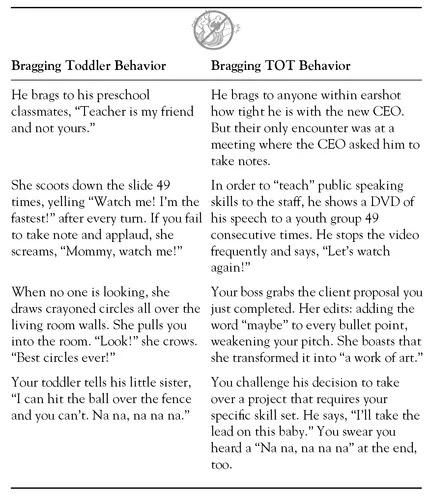
Let’s look at the parallels between braggart bosses and kids who sing their own praises:
Mild gloating is usually tolerable. We all have egos and a little positive self-promotion can be a boost. Bragging only crosses the line when the frequency or volume gets ratcheted up—or when reality starts to distort.
You may find yourself wincing every time your boss struts in your direction to name-drop his many “connections” up the corporate ladder, not to mention politics and Hollywood.
You may cringe when the laundry list of notable career achievements gets further inflated, thinking: “Wow, if he won ‘Employee of the Year’ as often as he said, he must have started here in kindergarten—or maybe he’s actually 112 years old!”
But your irritation might finally morph into fury when his boasting comes loaded with poisoned arrows aimed your way—or even worse, when he claims your accomplishments as his own. That’s the point at which you have to stop tuning out your TOT, and start building a defensive shield.
(For help dealing with true center-of-the-universe TOT behavior, check out Chapter 7 on Self-Centeredness.)
Bragging begins in late toddlerhood and is a normal developmental stage. The child learns she can do something new, and her excitement spills over into what sounds boastful, but might simply be celebration.
When she says “I made the picture,” she’s displaying pleasure and enthusiasm in her discovery that she can create something. And when she compares herself favorably to her peers—”I’m bigger/smarter/prettier than you are”—she’s working out exactly who she is. She doesn’t necessarily want to make others feel small and ugly—she just hasn’t discovered the harm her words create nor does she have the capacity for empathy yet.
Most kids figure out early that nobody likes a show-off, so they learn to temper their boastful behavior, but only after testing it. At some point, kids learn that more frequent or louder boasting works even less effectively than regular bragging. They dial it down and keep the big boasts in check.
“Tell Me I’m Great!”
TOTs who brag like toddlers have never resolved their identity issues or developed a capacity for empathy. They also have never figured out that most people want to crawl under a rock when listening to them.
Most likely, they didn’t receive enough reassurance growing up, and so they’re still seeking it. They brag in order to find out if you actually do appreciate or respect them. They need to hear, “Yes, you are the most brilliant negotiator on the crew,” because at age seven, they didn’t hear “You are the best kickball player” often enough. The trouble is that many braggart TOTs seem to have an endless need for reassurance, and you can’t make up for their childhood deprivation. (Check out Chapter 19 on Neediness for more ideas on dealing with deprived TOTs.)
The problem increases in competitive situations, where the TOT feels threatened. He fears looking bad next to colleagues, so he tries to convince you that he’s better than they are, and better than you are.
True TOT Tales
Par for the Course
Selma works for a small computer software firm in Denver. If her boss ever heard a rumor that he was a big braggart, he’d probably freeze in his wingtips from surprise, because the behavior has become so ingrained. Here’s Selma’s story.
My boss has no shame. He’s a big golfer and a bigger showoff, and I’m sick of hearing him cock-a-doodle-do about how great he did in his latest game. He sneaks out at 4:00 PM every Wednesday to play golf, which annoys me because I’m working 14-hour days just to keep my job intact. Then he justifies it by saying he makes all these great connections, and that golf is “integral” to his sales numbers.
Thursday morning is when the golf gloating starts. I know nothing about golf, but he makes me listen anyway. Then, in the usual “the golf course is my office” riff, he goes on about the deals he clinched and who he bonded with the day before. I know deals get done over golf, ...