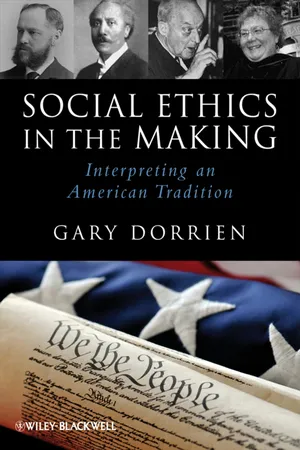
- Charts the story of social ethics - the idea that Christianity has a social-ethical mission to transform society - from its roots in the nineteenth century through to the present day
- Discusses and analyzes how different traditions of social ethics evolved in the realms of the academy, church, and general public
- Looks at the wide variety of individuals who have been prominent exponents of social ethics from academics and self-styled "public intellectuals" through to pastors and activists
- Set to become the definitive reference guide to the history and development of social ethics
- Recipient of a CHOICE Outstanding Academic Title for 2009 award
- English
- ePUB (mobile friendly)
- Available on iOS & Android
eBook - ePub
About this book
In the early 1880s, proponents of what came to be called "the social gospel" founded what is now known as social ethics. This ambitious and magisterial book describes the tradition of social ethics: one that began with the distinctly modern idea that Christianity has a social-ethical mission to transform the structures of society in the direction of social justice.
Information
Chapter 1
Inventing Social Ethics
The social gospelers who founded social ethics were not the ones whom history remembered. The social gospelers history remembered were bracing personalities with a missionary spirit who reached the general public: Washington Gladden, Richard Ely, Josiah Strong, George Herron, and Walter Rauschenbusch. Another renowned social gospeler, Shailer Mathews, was a half-exception by virtue of playing several roles simultaneously, but he operated primarily in the public square. All the renowned social gospelers came to be renowned by preaching the social gospel as a form of public homiletics.
The founders of social ethics also spoke to the general public, but as social ethicists they were absorbed by a cause that belonged to the academy: making a home for Christian ethics as a self-standing discipline of ethically grounded social science. They urged that society is a whole that includes an ethical dimension; thus, there needed to be something like social ethics. This discipline would be a central feature of liberal arts and seminary education. It would succeed the old moral philosophy, replacing an outmoded Scottish commonsense realism with a socially oriented idealism.
Intellectually the founders of social ethics belonged to the American generation that reconciled Christianity to Darwinism, accepted the historical critical approach to the Bible, and discovered the power of social ideas. As first generation social gospelers they believed that modern scholarship had rediscovered the social meaning of Christianity in the kingdom-centered faith of the historical Jesus. As early advocates of sociology, they also believed in the disciplinary unity of social science and its ethical character.
Francis Greenwood Peabody, a longtime professor at Harvard University, was the first to teach social ethics as an academic discipline, in 1880. William Jewett Tucker, an Andover Seminary professor who later achieved distinction as president of Dartmouth College, taught courses in the 1880s on “social economics.” Graham Taylor, an indefatigable social activist and colleague of Jane Addams, chaired the first department of Christian Sociology, at Chicago Theological Seminary (CTS). These pioneers of social-ethical analysis were publicly prominent in their time, and did not belong wholly to the academy. But because they fought primarily in the academy, with limited success, they were not remembered as major social gospelers.
Peabody, Tucker, and Taylor proposed to study social conditions with a Christian ethical view toward what might be done about them. They shared Ely’s concern that the emerging discipline of sociology needed to be informed by the ethical conscience of progressive religion. They updated the liberal third way between authoritarian orthodoxy and secular disbelief. They resisted an ascending social Darwinism in the social sciences and an ascending radicalism in the Socialist and labor movements. They were advocates of liberal reform, good government, cooperation, the common good, and the social gospel Jesus. Believing that social science had a great future in the academy and modern society, they did not want it to be lost to Christianity, or Christianity to it. Earnestly they sought to show that Christianity was descriptively and normatively relevant to modern society.
The founders of social ethics, to their regret, lived to witness the fragmentation of social science, the academic denial of its ethical character, and the marginalization of their intellectual enterprise. Having started something new, they lost the battle for social ethics as a university discipline, but won a place for it in theological education, establishing a theological discipline that outlived much of its social gospel basis. Social ethics survived, albeit on the fringe of the academy, because it was rooted in the nineteenth-century discovery that there is such a thing as social structure and that redemption always has a social dimension.
Becoming Francis Greenwood Peabody
Most of the early social gospelers came from evangelical backgrounds, but the first social ethicist, Francis Greenwood Peabody, was born into liberal Christianity as the son of a prominent Unitarian pastor, Ephraim Peabody, and a privileged Unitarian mother, Mary Ellen Derby. Ephraim Peabody spent his early pastoral career as a Unitarian missionary to the western United States (Cincinnati) and his later career as minister of King’s Chapel in Boston. Highly regarded as a spiritual leader, he preached often on character development and personality, and was known for his dedication to the poor, organizing poor-relief projects. In 1856, when his son Francis was 9 years old, Ephraim Peabody died of tuberculosis; Francis later recalled that he was “nearly seven” at the time. Elsewhere he recalled, with stronger reliability, that his parents had contrasting but complementary personalities. His father was imbued with a radiant holiness and unworldly simplicity that made him a beloved pastor, while his mother, the granddaughter of America’s first millionaire (Salem merchant Elias Haskett Derby), was a cultivated, worldly, impressive woman of confident charm. Peabody viewed his parents’ happy marriage as a symbol of the two traditions of New England coming together: “the idealism of the hills and the commercialism of the cities.”1
As a widow, Mary Ellen Peabody resolved to raise her four children in the spiritual seriousness of their departed father. “All was for his sake; each decision of school or play was as he would have desired,” Peabody later recalled. The ebullient, “luxury-loving” mother became a disciplinarian, dispensing religion with a more rigorous hand than Peabody recalled as being in the nature of his father’s gentle spirit. For many years the family did not celebrate Thanksgiving because Ephraim Peabody had died on Thanksgiving. Thrown into economic hardship by his death, the family continued to live in Boston’s wealthy Beacon Hill, where, Peabody claimed, he felt no envy of privileged neighbors. Gradually he forgot his father’s appearance and maxims, but another kind of paternal memory was instilled in him, one that stayed in his psyche and worldview.2
Peabody wrote affectionate recollections of his parents for the rest of his life, in addition to character portraits of the many friends and relatives who made up New England’s close-knit circle of Unitarian leaders. His father’s former congregation paid for his education, which Peabody took at Harvard College and Harvard Divinity School, graduating respectively in 1869 and 1872. In his telling, his schooling was unremittingly desultory. As a youth it had seemed to him that Harvard professors were remarkably insular and uninteresting. Huddled in a small, secluded world of texts and each other’s company, they seemed to prize their detachment from the real world of politics, commerce, and Boston as though it were a virtue. Sadly, they did not improve after Peabody enrolled at the college. He allowed that Harvard professors were distinguished intellectually, dwelling high above others, where “the air was pure”; philosopher Francis Bowen, an able proponent of Scottish commonsense moralism, taught there, as did botanist Asa Gray, mathematician Benjamin Peirce, and rhetoric scholar Francis J. Child, all respected scholars with much to offer. But in Peabody’s experience of them, Harvard professors took little interest in anything besides themselves and their subjects. They bored their students with deadly recitations and barely acknowledged that a school must have students. Peabody compared them to a monastic order.3
The Divinity School proved to be equally depressing. Peabody called his three years of divinity training “a disheartening experience of uninspiring study and retarded thought.” In theory Harvard Divinity School was nondenominational, not Unitarian, but in reality, a fuddy-duddy brand of Unitarian orthodoxy prevailed. Formally the school contended that it sought the truth, rather than declaring it, in matters of divinity; in reality it remained so deeply attached to the embattled Unitarian orthodoxy of the National Conference of Unitarian Churches that university officials periodically debated a divorce from the Divinity School. During Peabody’s years there historical criticism was practiced sparingly, philosophical idealism was spurned, classroom lectures seemed purposely dull, and theology and ethics were taught, in his phrase, as “subjects of ecclesiastical erudition and doctrinal desiccation.” Reaching for the strongest way of conveying a bad memory, Peabody declared: “The fresh breeze of modern thought rarely penetrated the lecture-rooms … I cannot remember attaining in seven years of Harvard classrooms anything that could be fairly described as an idea.”4
That was slightly hyperbolic. Harvard Divinity School declined steeply from 1840 to 1880, averaging four faculty members and 20 students. It reached its nadir in the year 1868–9, when dean Oliver Stearns was its only full-time, able-bodied professor in residence. But the school was always liberal by virtue of being Unitarian; in the 1850s, despite being neglected by the university, it had three able teachers (Convers Francis, George Rapall Noyes, and Frederic Henry Hedge) and one bad one (George E. Ellis). Moreover, the Divinity School’s upward turn began in 1869, just as Peabody arrived, when Harvard’s new president, Charles William Eliot, declared that a revamped Divinity School had a vital role to play in creating a model research university at Harvard. Three new faculty appointments were made: Charles Carroll Everett, the first Bussey Professor of Theology, who became a distinguished dean at the Divinity School; Ezra Abbott, the first Bussey Professor of New Testament Criticism and Interpretation, who achieved scholarly distinction; and Edward James Young, Hancock Professor of Hebrew and Old Testament, who flopped as a scholar and teacher and was forced to resign in 1880, ostensibly to make room for a non-Unitarian.5
These teachers schooled Peabody in German names, labels, and oracles. Despite his complaints that he heard no modern thoughts, Peabody also complained that his teachers idolized German scholars, settling disputed points with a word from a German authority. This species of reverence drove him straight to Germany. He later explained, “It seemed essential to peace of mind that one should determine whether the gods of German theology were infallible, or whether they might sometimes nod.” Peabody owed his German education to his Harvard teachers, and his subsequent career would not have been possible without the changes that occurred at Harvard during his student days.6
In Germany he journeyed first to Heidelberg, which he didn’t like for its arid rationalism, then to Leipzig, which was worse for its backward-looking orthodoxy. He found a brief reward in Halle, where, like many American students before him, notably Charles Briggs and Egbert Smyth, he luxuriated in the lectures and friendship of Friedrich August Tholuck. A legendary pietist scholar and theologian, equally renowned for his kindly manner, Tholuck welcomed Americans into his classroom and home. As a theologian he stressed religious experience in the fashion of Friedrich Schleiermacher while avoiding the radical aspects of Schleiermacher’s thought. Tholuck taught that evangelical faith and historical criticism were natural allies because good scholarship construed biblical meaning within the circle of faith: “It must be remembered that the scientific apprehension of religious doctrines presupposes a religious experience. Without this moral qualification, it is impossible to obtain a true insight into theological dogmas.”7
Peabody heard Tholuck lecture on historical and modern theology, and Tholuck offered to meet with him privately to study Schleiermacher’s Discourses on Religion. But upon descending the stairway in his home to greet Peabody for their first session, Tholuck either stumbled or had a seizure, falling down the stairs. His health deteriorated rapidly afterwards. Though Tholuck lectured for seven more years until his death in 1877, Peabody and his wife Cora Weld were the last Americans to experience the Tholuck effect. For Peabody, Tholuck was the ideal: a rigorous scholar with a devout Christian spirit. Years later Peabody put it stronger, recalling that Tholuck showed him “that the career of a scholar might be consistent with the character of a saint.” In Tholuck’s classroom Peabody began his long association with German thought and his career as an American interpreter of German theology.8
His first idea came to him in a German bookshop in 1872. Perusing Otto Pfleiderer’s book Die Religion, ihr Wesen und ihre Geschichte (1869) (Religion, Its Nature and Its History) it occurred to Peabody that he might spend his life doing the sort of thing that Pfleiderer did: validating a religious philosophy by its history. Instead of beginning with an a priori doctrine or tradition, one might derive a religious outlook from an inductive study of human nature and ethical activity. Peabody reasoned that if he studied religion inductively, through its historical development, he should be able to defend it in a way that rescued religion from provincialism.9
That was the seed of social ethics – at least, in his case. Peabody expected to write about such things as a pastor. After a brief stint as a chaplain at Antioch College in Ohio he came home to Boston as minister of the First Parish (Unitarian) in Cambridge. Peabody gave six years to parish ministry, although in practice, as he admitted, it was more like three. He aspired to a long career at Cambridge’s flagship Unitarian parish, but was ill most of the time. Nineteenth-century New Englanders believed that long, arduous trips to California and Europe were the best remedy for chronic illnesses, so Peabody took two of them. His father had died of tuberculosis at the age of 49; many of Peabody’s devoted parishioners feared that he was destined to a similar fate. In 1880, after returning from a second prolonged absence still in poor health, he resigned himself to a lower, less important, less taxing vocation: lecturer at Harvard Divinity School. To Peabody, giving up the ministry for the work of a seminary instructor seemed “a calamity.” He consoled himself that perhaps he could teach seminarians “the lessons of my own defeat.” Instead he found an unexpected calling at the take-off of the social gospel, the American liberal theology movement, and Harvard’s drive to become a modern research university.10
Philosophies of Moral Philosophy
The social gospel happened for a confluence of reasons that impacted on each other. It was fed by the wellsprings of eighteenth-century Enlightenment humanitarianism and the postmillennialist passion for social redemption that fueled the evangelical anti-slavery movements. It took root as a response to the corruption and oppressive conditions of the Gilded Age, goaded by writers such as Edward Bellamy, Stephen C...
Table of contents
- Cover
- Half Title Page
- Title Page
- Copyright Page
- Dedication
- Plates
- Acknowledgments
- Introduction
- Chapter 1: Inventing Social Ethics
- Chapter 2: The Social Gospel
- Chapter 3: Lift Every Voice
- Chapter 4: Christian Realism
- Chapter 5: Social Christianity as Public Theology
- Chapter 6: Liberationist Disruptions
- Chapter 7: Disputing and Expanding the Tradition
- Chapter 8: Dealing with Modernity and Postmodernity
- Chapter 9: Economy, Sexuality, Ecology, Difference
- Chapter 10: Borders of Possibility: The Necessity of “Discredited” Social Gospel Ideas
- Index
Trusted by 375,005 students
Access to over 1.5 million titles for a fair monthly price.
Study more efficiently using our study tools.
Frequently asked questions
Yes, you can cancel anytime from the Subscription tab in your account settings on the Perlego website. Your subscription will stay active until the end of your current billing period. Learn how to cancel your subscription
No, books cannot be downloaded as external files, such as PDFs, for use outside of Perlego. However, you can download books within the Perlego app for offline reading on mobile or tablet. Learn how to download books offline
Perlego offers two plans: Essential and Complete
- Essential is ideal for learners and professionals who enjoy exploring a wide range of subjects. Access the Essential Library with 800,000+ trusted titles and best-sellers across business, personal growth, and the humanities. Includes unlimited reading time and Standard Read Aloud voice.
- Complete: Perfect for advanced learners and researchers needing full, unrestricted access. Unlock 1.5M+ books across hundreds of subjects, including academic and specialized titles. The Complete Plan also includes advanced features like Premium Read Aloud and Research Assistant.
We are an online textbook subscription service, where you can get access to an entire online library for less than the price of a single book per month. With over 1.5 million books across 990+ topics, we’ve got you covered! Learn about our mission
Look out for the read-aloud symbol on your next book to see if you can listen to it. The read-aloud tool reads text aloud for you, highlighting the text as it is being read. You can pause it, speed it up and slow it down. Learn more about Read Aloud
Yes! You can use the Perlego app on both iOS and Android devices to read anytime, anywhere — even offline. Perfect for commutes or when you’re on the go.
Please note we cannot support devices running on iOS 13 and Android 7 or earlier. Learn more about using the app
Please note we cannot support devices running on iOS 13 and Android 7 or earlier. Learn more about using the app
Yes, you can access Social Ethics in the Making by Gary Dorrien in PDF and/or ePUB format, as well as other popular books in Theology & Religion & Christian Theology. We have over 1.5 million books available in our catalogue for you to explore.