- English
- ePUB (mobile friendly)
- Available on iOS & Android
eBook - ePub
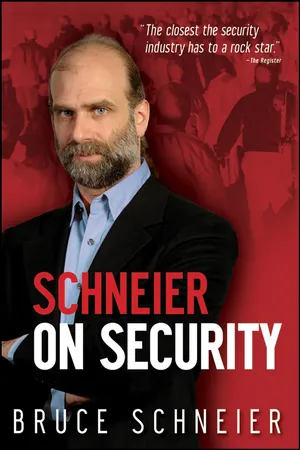
Schneier on Security
About this book
Presenting invaluable advice from the world?s most famous computer security expert, this intensely readable collection features some of the most insightful and informative coverage of the strengths and weaknesses of computer security and the price people pay -- figuratively and literally -- when security fails. Discussing the issues surrounding things such as airplanes, passports, voting machines, ID cards, cameras, passwords, Internet banking, sporting events, computers, and castles, this book is a must-read for anyone who values security at any level -- business, technical, or personal.
Information
1
Terrorism and Security
What the Terrorists Want
Originally published in Wired, 24 August 2006
On August 16, two men were escorted off a plane headed for Manchester, England, because some passengers thought they looked either Asian or Middle Eastern, might have been talking Arabic, wore leather jackets, and looked at their watches—and the passengers refused to fly with them on board. The men were questioned for several hours and then released.
On August 15, an entire airport terminal was evacuated because someone’s cosmetics triggered a false positive for explosives. The same day, a Muslim man was removed from an airplane in Denver for reciting prayers. The Transportation Security Administration decided that the flight crew overreacted, but he still had to spend the night in Denver before flying home the next day. The next day, a Port of Seattle terminal was evacuated because a couple of dogs gave a false alarm for explosives.
On August 19, a plane made an emergency landing in Tampa, Florida, after the crew became suspicious because two of the lavatory doors were locked. The plane was searched, but nothing was found. Meanwhile, a man who tampered with a bathroom smoke detector on a flight to San Antonio was cleared of terrorism, but only after having his house searched.
On August 16, a woman suffered a panic attack and became violent on a flight from London to Washington, so the plane was escorted to Boston’s Logan Airport by fighter jets. “The woman was carrying hand cream and matches but was not a terrorist threat,” said the TSA spokesman after the incident.
And on August 18, a plane flying from London to Egypt made an emergency landing in Italy when someone found a bomb threat scrawled on an air sickness bag. Nothing was found on the plane, and no one knows how long the note was on board.
I’d like everyone to take a deep breath and listen for a minute.
The point of terrorism is to cause terror—sometimes to further a political goal, and sometimes out of sheer hatred. The people terrorists kill are not the targets; they are collateral damage. And blowing up planes, trains, markets, or buses is not the goal; those are just tactics. The real targets of terrorism are the rest of us: the billions of us who are not killed but are terrorized because of the killing. The real point of terrorism is not the act itself, but our reaction to the act.
And we’re doing exactly what the terrorists want.
We’re all a little jumpy after the recent arrest of 23 terror suspects in Great Britain. The men were reportedly plotting a liquid-explosive attack on airplanes, and both the press and politicians have been trumpeting the story ever since.
In truth, it’s doubtful that their plan would have succeeded; chemists have been debunking the idea since it became public. Certainly the suspects were a long way off from trying: None had bought airline tickets, and some didn’t even have passports.
Regardless of the threat, from the would-be bombers’ perspective, the explosives and planes were merely tactics. Their goal was to cause terror, and in that they’ve succeeded.
Imagine for a moment what would have happened if they had blown up ten planes. There would be canceled flights, chaos at airports, bans on carry-on luggage, world leaders talking tough new security measures, political posturing and all sorts of false alarms as jittery people panicked. To a lesser degree, that’s basically what’s happening right now.
Our politicians help the terrorists every time they use fear as a campaign tactic. The press helps every time it writes scare stories about the plot and the threat. And if we’re terrified, and we share that fear, we help. All of these actions intensify and repeat the terrorists’ actions, and increase the effects of their terror.
(I am not saying that the politicians and press are terrorists, or that they share any of the blame for terrorist attacks. I’m not that stupid. But the subject of terrorism is more complex than it appears, and understanding its various causes and effects are vital for understanding how to best deal with it.)
The implausible plots and false alarms actually hurt us in two ways. Not only do they increase the level of fear, but they also waste time and resources that could be better spent fighting the real threats and increasing actual security. I’ll bet the terrorists are laughing at us.
Another thought experiment: Imagine for a moment that the British government had arrested the 23 suspects without fanfare. Imagine that the TSA and its European counterparts didn’t engage in pointless airline security measures like banning liquids. And imagine that the press didn’t write about it endlessly, and that the politicians didn’t use the event to remind us all how scared we should be. If we’d reacted that way, then the terrorists would have truly failed.
It’s time we calm down and fight terror with anti-terror. This does not mean that we simply roll over and accept terrorism. There are things our government can and should do to fight terrorism, most of them involving intelligence and investigation—and not focusing on specific plots.
But our job is to remain steadfast in the face of terror, to refuse to be terrorized. Our job is to not panic every time two Muslims stand together checking their watches. There are approximately 1 billion Muslims in the world, a large percentage of them not Arab, and about 320 million Arabs in the Middle East, the overwhelming majority of them not terrorists. Our job is to think critically and rationally, and to ignore the cacophony of other interests trying to use terrorism to advance political careers or increase a television show’s viewership.
The surest defense against terrorism is to refuse to be terrorized. Our job is to recognize that terrorism is just one of the risks we face, and not a particularly common one at that. And our job is to fight those politicians who use fear as an excuse to take away our liberties and promote security theater that wastes money and doesn’t make us any safer.
Movie-Plot Threats
Originally published in Wired, 8 September 2005
Sometimes it seems like the people in charge of homeland security spend too much time watching action movies. They defend against specific movie plots instead of against the broad threats of terrorism.
We all do it. Our imaginations run wild with detailed and specific threats. We imagine anthrax spread from crop dusters. Or a contaminated milk supply. Or terrorist scuba divers armed with almanacs. Before long, we’re envisioning an entire movie plot—without Bruce Willis to save the day. And we’re scared.
Psychologically, this all makes sense. Humans have good imaginations. Box cutters and shoe bombs conjure vivid mental images. “We must protect the Super Bowl” packs more emotional punch than the vague “we should defend ourselves against terrorism.”
The 9/11 terrorists used small pointy things to take over airplanes, so we ban small pointy things from airplanes. Richard Reid tried to hide a bomb in his shoes, so now we all have to take off our shoes. Recently, the Department of Homeland Security said that it might relax airplane security rules. It’s not that there’s a lessened risk of shoes, or that small pointy things are suddenly less dangerous. It’s that those movie plots no longer capture the imagination like they did in the months after 9/11, and everyone is beginning to see how silly (or pointless) they always were.
Commuter terrorism is the new movie plot. The London bombers carried bombs into the subway, so now we search people entering the subways. They used cell phones, so we’re talking about ways to shut down the cell-phone network.
It’s too early to tell if hurricanes are the next movie-plot threat that captures the imagination.
The problem with movie-plot security is that it only works if we guess right. If we spend billions defending our subways, and the terrorists bomb a bus, we’ve wasted our money. To be sure, defending the subways makes commuting safer. But focusing on subways also has the effect of shifting attacks toward less-defended targets, and the result is that we’re no safer overall.
Terrorists don’t care if they blow up subways, buses, stadiums, theaters, restaurants, nightclubs, schools, churches, crowded markets or busy intersections. Reasonable arguments can be made that some targets are more attractive than others: airplanes because a small bomb can result in the death of everyone aboard, monuments because of their national significance, national events because of television coverage, and transportation because most people commute daily. But the United States is a big country; we can’t defend everything.
One problem is that our nation’s leaders are giving us what we want. Party affiliation notwithstanding, appearing tough on terrorism is important. Voting for missile defense makes for better campaigning than increasing intelligence funding. Elected officials want to do something visible, even if it turns out to be ineffective.
The other problem is that many security decisions are made at too low a level. The decision to turn off cell phones in some tunnels was made by those in charge of the tunnels. Even if terrorists then bomb a different tunnel elsewhere in the country, that person did his job.
And anyone in charge of security knows that he’ll be judged in hindsight. If the next terrorist attack targets a chemical plant, we’ll demand to know why more wasn’t done to protect chemical plants. If it targets schoolchildren, we’ll demand to know why that threat was ignored. We won’t accept “we didn’t know the target” as an answer. Defending particular targets protects reputations and careers.
We need to defend against the broad threat of terrorism, not against specific movie plots. Security is most effective when it doesn’t make arbitrary assumptions about the next terrorist act. We need to spend more money on intelligence and investigation: identifying the terrorists themselves, cutting off their funding, and stopping them regardless of what their plans are. We need to spend more money on emergency response: lessening the impact of a terrorist attack, regardless of what it is. And we need to face the geopolitical consequences of our foreign policy and how it helps or hinders terrorism.
These vague things are less visible, and don’t make for good political grandstanding. But they will make us safer. Throwing money at this year’s movie plot threat won’t.
Fixing Intelligence Failures
Originally published in Crypto-Gram, 15 June 2002
Could the intelligence community have connected the dots? Why didn’t anyone connect the dots? How can we make sure we connect the dots next time? Dot connecting is the metaphor of the moment in Washington, as the various politicians scramble to make sure that 1) their pet ideas for improving domestic security are adopted, and 2) they don’t get blamed for any dot connection failures that could have prevented 9/11.
Unfortunately, it’s the wrong metaphor. We all know how to connect the dots. They’re right there on the page, and they’re all numbered. All you have to do is move your crayon from one dot to another, and when you’re done you’ve drawn a lion. It’s so easy a three-year-old could do it; what’s wrong with the FBI and the CIA?
The problem is that the dots can only be numbered after the fact. With the benefit of hindsight, it’s easy to draw lines from people in flight school here, to secret meetings in foreign countries there, over to interesting tips from foreign governments, and then to INS records. Before 9/11, it’s not so easy. Rather than thinking of intelligence as a simple connect-the-dots picture, think of it as a million unnumbered pictures superimposed on top of each other. Or a random-dot stereogram. Is it a lion, a tree, a cast iron stove, or just an unintelligible mess of dots? You try and figure it out.
This isn’t to say that the United States didn’t have some spectacular failures in analysis leading up to 9/11. Way back in the 30 September 2001 issue of Crypto-Gram, I wrote: “In what I am sure is the mother of all investigations, the CIA, NSA, and FBI have uncovered all sorts of data from their files, data that clearly indicates that an attack was being planned. Maybe it even clearly indicates the nature of the attack, or the date. I’m sure lots of information is there, in files, intercepts, computer memory.” I was guessing there. It seems that there was more than I thought.
Given the bits of information that have been discussed in the press, I would have liked to think that we could have prevented this one, that there was a single Middle Eastern Terrorism desk somewhere inside the intelligence community whose job it was to stay on top of all of this. It seems that we couldn’t, and that there wasn’t. A budget issue, most likely.
Still, I think the “whose fault is it?” witch hunt is a bit much. Not that I mind seeing George Bush on the defensive. I’ve gotten sick of his “we’re at war, and if you criticize me you’re being unpatriotic” nonsense, and I think the enormous damage John Ashcroft has done to our nation’s freedoms and liberties will take a generation and another Warren Court to fix. But all this finger-pointing between the CIA and FBI is childish, and I’m embarrassed by the Democrats who are pushing through their own poorly thought out security proposals so they’re not viewed in the polls as being soft on terrorism.
My preference is for less politics and more intelligent discussion. And I’d rather see the discussion center on how to improve things for next time, rather than on who gets the blame for this time. So, in the spirit of bipartisanship (there are plenty of nitwits in both parties), here are some points for discussion:
• It’s not about data collection; it’s about data analysis. Again from the 30 September 2001 issue of Crypto-Gram: “Demands for even more surveillance miss the point. The problem is not obtaining data, it’s deciding which data is worth analyzing and then interpreting it. Everyone already leaves a wide audit trail as we go through life, and law enforcement can already access those records with search warrants [and subpoenas]. The FBI quickly pieced together the terrorists’ identities and the last few months of their lives, once they knew where to look. If they had thrown up their hands and said that they couldn’t figure out who did it or how, they might have a case for needing more surveillance data. But they didn’t, and they don’t.
• Security decisions need to be made as close to the source as possible. This has all sorts of implications: airport X-ray machines should be right next to the departure gates, like they are in some European airports; bomb target decisions should be made by the generals on the ground in the war zone, not by some bureaucrat in Washington; and investigation approvals should be granted the FBI office that’s closest to the investigation. This mode of operation has more opportunities for abuse, so oversight is vital. But it is also more robust, and the best way to make things work. (The U.S. Marine Corps understands this principle; it’s the heart of their chain of command rules.)
• Data correlation needs to happen as far away from the sources as possible. Good intelligence involves finding meaning amongst enormous reams of irrelevant data, and then organizing all those disparate pieces of information into coherent predictions about what will happen next. It requires smart people who can see connections, and access to information from many different branches of government. It can’t be by the various individual pieces of bureaucracy, whether it be the CIA, FBI, NSA, INS, Coast Guard, etc. The whole picture is larger than any of them, and each one only has access to a small piece.
• Intelligence and law enforcement have fundamentally different missions. The FBI’s model of operation—investigation of past crimes—does not lend itself to an intelligence paradigm: prediction of future events. On the other hand, the CIA is prohibited by law from spying on citizens. Expecting the FBI to become a domestic CIA is a terrible idea; the missions are just too different and that’s too much power to consolidate under one roof. Turning the CIA into a domestic intelligence agency is an equally terrible idea; the tactics that they regularly use abroad are unconstitutional here.
• Don’t forget old-fashioned intelligence gathering. Enough with the Echelon-like NSA programs where everything and anything gets sucked into an enormous electronic maw, never to be looked at again. Lots of Americans managed to become part of al-Qaeda (a 20-year-old Calif...
Table of contents
- Title Page
- Copyright Page
- Dedication
- Credits
- Introduction
- Chapter 1 - Terrorism and Security
- Chapter 2 - National Security Policy
- Chapter 3 - Airline Travel
- Chapter 4 - Privacy and Surveillance
- Chapter 5 - ID Cards and Security
- Chapter 6 - Election Security
- Chapter 7 - Security and Disasters
- Chapter 8 - Economics of Security
- Chapter 9 - Psychology of Security
- Chapter 10 - Business of Security
- Chapter 11 - Cybercrime and Cyberwar
- Chapter 12 - Computer and Information Security
- References
- Index
Trusted by 375,005 students
Access to over 1.5 million titles for a fair monthly price.
Study more efficiently using our study tools.
Frequently asked questions
Yes, you can cancel anytime from the Subscription tab in your account settings on the Perlego website. Your subscription will stay active until the end of your current billing period. Learn how to cancel your subscription
No, books cannot be downloaded as external files, such as PDFs, for use outside of Perlego. However, you can download books within the Perlego app for offline reading on mobile or tablet. Learn how to download books offline
Perlego offers two plans: Essential and Complete
- Essential is ideal for learners and professionals who enjoy exploring a wide range of subjects. Access the Essential Library with 800,000+ trusted titles and best-sellers across business, personal growth, and the humanities. Includes unlimited reading time and Standard Read Aloud voice.
- Complete: Perfect for advanced learners and researchers needing full, unrestricted access. Unlock 1.5M+ books across hundreds of subjects, including academic and specialized titles. The Complete Plan also includes advanced features like Premium Read Aloud and Research Assistant.
We are an online textbook subscription service, where you can get access to an entire online library for less than the price of a single book per month. With over 1.5 million books across 990+ topics, we’ve got you covered! Learn about our mission
Look out for the read-aloud symbol on your next book to see if you can listen to it. The read-aloud tool reads text aloud for you, highlighting the text as it is being read. You can pause it, speed it up and slow it down. Learn more about Read Aloud
Yes! You can use the Perlego app on both iOS and Android devices to read anytime, anywhere — even offline. Perfect for commutes or when you’re on the go.
Please note we cannot support devices running on iOS 13 and Android 7 or earlier. Learn more about using the app
Please note we cannot support devices running on iOS 13 and Android 7 or earlier. Learn more about using the app
Yes, you can access Schneier on Security by Bruce Schneier in PDF and/or ePUB format, as well as other popular books in Computer Science & Cyber Security. We have over 1.5 million books available in our catalogue for you to explore.