eBook - ePub
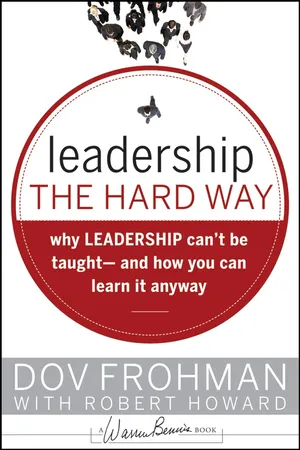
Leadership the Hard Way
Why Leadership Can't Be Taught and How You Can Learn It Anyway
- English
- ePUB (mobile friendly)
- Available on iOS & Android
eBook - ePub
Leadership the Hard Way
Why Leadership Can't Be Taught and How You Can Learn It Anyway
About this book
Leadership the Hard Way presents a method of living and working that can truly facilitate the learning of leadership. Their method shows how to go against the current, fight conventional wisdom, and embrace the unexpected. It is about trusting oneself and valuing intuition, principles, and imagination as much as hard skills and analysis. Frohman combines his counterintuitive ideas with experiences from his own background?from escaping the Nazis as a child to becoming a leading innovator in the semiconductor industry?to show how readers can build their own leadership abilities. A leader?s values and personality, he ultimately reveals, are the only sure source of stability in a world of continuous change.
Information
CHAPTER 1
INSISTING ON SURVIVAL
In a turbulent economy, the first task of the leader is insisting on survival—that is, continuously identifying and addressing potential threats to the long-term survival of the organization. At first glance this statement may seem obvious, even trivial. Doesn’t it go without saying that no organization can be successful if it doesn’t first survive? Yet the rapid increase in the pace of change in business has made survival more problematic than ever before. The frequency with which organizations face major challenges to their survival is growing.
In the days when most established companies had relatively stable markets and competitors, survival was only rarely an issue. To be sure, every now and then a company might face a major crisis, but once that crisis was addressed, things went back to normal. Few companies today have that luxury. Threats to survival aren’t occasional; they are nearly continuous. If an organization waits for a full-blown crisis to develop, it may find that it is already too late.
The growing frequency of threats to survival is especially evident in technology- or innovation-based businesses. In such businesses, success at any one generation of technology is really only buying an option on the future. It wins you the right to compete at the next level of technology, but offers no guarantees of continual success. Indeed, quite the opposite: often it is those companies that are most successful at one generation of technology that have the most difficulty in adapting to subsequent generations.
I believe it was the increasingly problematic nature of survival that Andy Grove had in mind when he claimed famously that “only the paranoid survive.” As Grove describes in his book of that name, sooner or later, every business reaches what he calls a “strategic inflection point”—that “time in the life of a business when its fundamentals are about to change. That change can mean an opportunity to rise to new heights. But it may just as likely signal the beginning of the end.”1 Grove makes clear that such strategic inflection points can be caused by technological change but they are about more than just technology. They can be caused by new competitors, but they are about more than just the competition. “They are full-scale changes in the way business is conducted.” As such they “can be deadly when unattended to.”
Despite the proliferation of such threats to survival in business today, most people in most organizations avoid engaging squarely with the issue. This is partly a result of the complacency that comes with success. But even more, there is something in the very nature of an organization that leads its members to take its ongoing existence for granted. In this respect, an organization is a lot like an adolescent. It assumes it is going to live forever!
It’s easy to understand why most people would prefer not to think about potential threats to their survival. It’s scary, and fear can be paralyzing. Nobody wants to consider the possibility that “I might not survive!” What’s more, threats to survival generate massive uncertainty. To survive such threats means to take risks. But risks are by definition uncertain. What if we try and fail? What if things don’t work out? No wonder people avoid the issue of survival, if they can get away with it.
The job of the leader is to make sure they don’t get away with it. A leader must represent to the organization the imperative of survival, the challenge of survival, and the reality of threats to survival. By constantly asking “What will it take to survive?” leaders in effect force people to anticipate in advance the potential threats facing the organization. In this way, they become the catalyst for continuous adaptation that allows the organization to avoid a genuine crisis of survival.
To do this effectively, you must take a position consciously “in opposition” to the organization and its identity and systematically resist the taken-for-grantedness that one finds in any organization. The leader has to embody the possibility that the organization can fail and fail disastrously—precisely to make sure that it does not.
A Wartime Childhood
In retrospect, I realize that my preoccupation—some might say obsession—with survival is, at least in part, a by-product of my experience as a child during the Second World War. My parents, Abraham and Feijga Frohman, were Polish Jews who emigrated to Holland in the early 1930s to escape the rising anti-Semitism in Poland. I was born in Amsterdam on March 28, 1939, just months before the start of the war.
After the German invasion of the Low Countries in 1940, we continued to live in Amsterdam. But in 1942, as the Nazi grip on Holland’s Jewish community steadily tightened, my parents made the difficult decision to give me up to people they knew in the Dutch underground, who hid me with a family in the Dutch countryside.
Antonie and Jenneke Van Tilborgh were devout Christians, members of the Gereformeerde Kerk or Calvinist Reformed Church, the most orthodox branch of Dutch Protestantism. They lived on a farm on the outskirts of Sprang Capelle, a small village in the region of Noord Braband, in southern Holland near the Belgian border. The Van Tilborghs had four children. Their oldest daughter, Rie, was twenty-one but still living at home. Another daughter, Jet, was fourteen. And the two boys, Coor and Toon, were ten and six. The Van Tilborgh family hid me from the Germans for the duration of the war. Only a few close neighbors knew that I was staying with them.
I was only three when I arrived at the Van Tilborgh household, so it is difficult to differentiate between what I actually remember and what I was told later. But one thing I do recall was feeling different. For example, I had dark hair, and the Van Tilborgh children were all blond. I had to wear a black hat to hide my black hair.
I also remember hiding when the Germans would search the village. Sometimes I would hide under the bed, sometimes in the root cellar (I have a warm memory of treating myself to the apples that were stored there), sometimes with my “brothers” and “sisters” out in the surrounding woods. To this day I have a scar on my wrist that, according to the Van Tilborghs, came from a time when we were running through the woods and I tried to jump over a creek and got caught by some barbed wire.
Other memories are more disturbing. One day, looking out the cellar window, I saw German soldiers execute a fellow soldier. I don’t know why they were doing it; perhaps he was a deserter, perhaps he himself had helped some Jews who were in hiding. Whatever the cause, I have the image seared in my mind of seeing him hit by the bullets and falling to the ground in a heap.
My parents did not survive the war. They were taken in one of the many roundups of Jews by the Nazis. Much later, I learned that my father died in Auschwitz. I never learned for sure where my mother died, although it’s likely she was taken to Auschwitz as well.
I see now that my experience during the war inculcated in me a stubborn conviction that nothing is truly secure, that survival must never be taken for granted—but also that the actions of determined individuals can “achieve the impossible” and have a literally heroic impact on events. If it weren’t for my parents’ ability to make the excruciatingly difficult choice to give me up to the underground and for the Van Tilborghs’ willingness to take me in, I wouldn’t be here today.
Who knows what motivates human beings to do something truly heroic? In the case of the Van Tilborghs, it is clear to me that a major source of their motivation was their deep religious faith. Without such bedrock convictions, they wouldn’t have been able to do what they did. I also suspect that their own experience as members of a minority religious sect in Holland allowed them to empathize and identify with the plight of Holland’s Jews and develop a compelling urgency to do something about it. Orthodox Calvinists made up only about 8 percent of the population of the Netherlands in the 1940s. Yet they were responsible for helping roughly a quarter of the approximately twenty-five thousand Jews who went into hiding. Thanks to the help of people like the Van Tilborghs, some sixteen thousand Jews who went into hiding survived the war, including some four thousand children like myself.2
In agreeing to hide me, the Van Tilborghs took unimaginable risks. They endangered not only themselves, but their own children as well—to a degree that, seen from the outside, may appear almost irresponsible. In contemplating their example over the years, I learned something essential about leadership: survival requires taking big risks, and sometimes the risks a leader takes, when viewed from a normal or conventional point of view, can appear crazy. But it really only looks that way. Often, genuine leadership is the result of the leader’s commitment to a transforming vision and to a set of values that follow from that vision. A key challenge of leadership is to live with the tension between two incommensurate sets of values, perspectives, and commitments—in this particular case, the Van Tilborghs’ responsibilities to their children and the responsibilities they took on in protecting me.
I also learned something else from the Van Tilborghs’ behavior. If a leader is too focused on personal survival as head of the organization, he or she may end up, paradoxically, undermining the organization’s long-term capacity to survive. A lot of ineffective leaders become so focused on their own survival in their leadership role that they avoid taking necessary risks and, in the long run, end up damaging the organization’s survival capacity. Much like the Van Tilborghs who saved me during World War II, sometimes visionary leaders must risk themselves to do the right thing.
After the liberation of southern Holland in 1944, my father’s sister, who had emigrated to Palestine in the 1930s, somehow was able to locate me. She had a friend who was serving in the Jewish Brigade—the volunteer fighting force of Palestinian Jews raised by the British that had fought in North Africa and Europe and that, at the time, was stationed in nearby Belgium. She sent the friend to meet with the Van Tilborghs and convince them to place me in a Jewish orphanage, with the intention of eventually emigrating to Palestine.
The Van Tilborghs were hesitant to let me go and, to be honest, I didn’t want to leave. By that time I barely remembered my parents. For all intents and purposes, the Van Tilborghs had become my family. But after all that had happened to European Jewry during the war, the Jewish community was determined to recover those children who had survived. Eventually the Van Tilborghs were persuaded that it was the best thing for me and, reluctantly, they gave me up. I lived the next few years in orphanages for Jewish children whose parents had died during the war, first in Antwerp and then in Marseilles, before sailing to the newly created country of Israel on the Theodore Herzl in 1949.
Eventually I was adopted by relatives in Israel. But I never forgot the Van Tilborghs, and over the years I have kept in touch with my Dutch family. Antonie and Jenneke are dead now, as are two of their four children. But the families continue to keep in touch. The children of my Dutch brothers and sisters know my children. We have attended their weddings in Holland, and they have visited us in Israel, where Antonie and Jenneke’s names are enrolled on the list of the Righteous Among the Nations in the records of Yad Vashem, Israel’s official memorial to those who died in the Holocaust.
“The Last Operation to Close in a Crisis”
It may seem absurd, or perhaps even inappropriate, to compare the threats I faced as a young Jew in Nazi-occupied Europe to the competitive threats that most companies face today. Yet, in part because of my childhood experience, I’ve always believed that an organization’s survival can never be taken for granted—in bad times certainly, but also even in good times. For this reason, it is essential for an organization to accept complete responsibility for its own survival.
When you’re working in a startup, this responsibility is obvious. Every day you live with the possibility that you might not succeed. But when you are working in a large global corporation, it’s easy to become passive, to assume that the company will be around forever, even to start thinking that your own fate relies on decisions made at corporate headquarters far away. When I founded Intel Israel, I was determined to fight this tendency, to cultivate the atmosphere of a precarious startup, even though we were part of a successful and fast-growing company. I wanted people not only to avoid complacency but also to feel that they—and they alone—were responsible for their own fate.
For that reason, my vision for Intel Israel always emphasized survival in a highly volatile industry and region. After all, semiconductors is a highly cyclical business, with dizzying booms often followed by extremely painful busts. And in the 1970s and ’80s, when we were building Intel Israel, Intel was passing through some of the most important and most dangerous strategic inflection points of its history—in particular, the company’s exit from the memory business in the mid-1980s. If that wasn’t turbulence enough, we were also trying to build an outpost for Intel in the Middle East, a region wracked by political tension and war and that, despite moments of hope in the 1990s, still has not found its way to a definitive peace.
So I saw threats to survival everywhere and was determined to make sure we were tough enough to survive them. As I used to put it, I wanted Intel Israel to be “the last Intel operation to close in a crisis.” To be honest, many employees, including some of my direct reports, didn’t much like this vision. They thought it was too negative. “Is that the best we can do,” they would ask, “just avoid being closed down?” Eventually we came up with a simple slogan: “Survival through success.” And I used that slogan to drive our behavior in every area of the business.
Take the example of layoffs. Layoffs at Intel were relatively rare—but they did happen, especially in the company’s early years. In 1970 the company had had to lay off 10 percent of its (then still quite small) workforce after the market failure of its very first product. In 1974 the first big downturn in the industry caused the company to lay off 30 percent of its workforce, about 350 people. And in 1986 there were plant closings and layoffs associated with exiting the memory business.
From the moment I helped establish Intel Israel, I simply refused to accept the idea that we would lay people off, and I went out of my way to make sure that whatever layoffs did occur at Intel as a whole happened to others, not to Intel Israel. Of course, the only sure way to avoid layoffs was to make sure that our operations were so competitive that they were “the last to close in a crisis.” But sometimes more extraordinary measures were necessary.
In the 1990s, for example, we had a small software development group at the Haifa design center. But in 1994, in a move aimed to cut costs, the global head of Intel’s systems software unit decided to close it down. To avoid losing what was a cadre of highly skilled software programmers, I immediately traveled to the States and met with Intel’s then-CEO Andy Grove to see whether there was any way to fund their positions, at least temporarily, until other more long-term opportunities opened up.
I argued that these were highly skilled employees and to lay them off now, although it might be penny-wise, was certainly pound-foolish. Come the next upturn, we would need these people, so we should keep them with Intel. Grove agreed to commit some $700,000 to keep the people at Intel, and we distributed them among other engineering groups. The decision paid off three years later when, with the ramp-up to the Internet boom in the late 1990s, we found ourselves facing yet another shortage of software engineers. As a result of such efforts, there were fewer than ten employees who had to be laid off during my entire tenure at Intel Israel.
Containing Fear
Earlier I mentioned that people don’t want to think about survival because it is scary. In fact, there is a complex relationship between survival and fear. To insist on survival, a leader must know how to navigate fear. The goal is neither to exaggerate fear nor to eliminate it, but rather to contain it.
It can be difficult for leaders to maintain this delicate balance. Take an example that is top of mind for so many people today—the fear of terrorism. In my opinion, many political leaders in both the United States and Israel aren’t containing fear over terrorism so much as exacerbating it. Indeed, they exploit fear to further their political agenda. When you think about it, their message is completely contradictory: on the one hand, they exaggerate the “existential threat” of terrorism to keep people in a state of constant anxiety; on the other, they promise perfect security—on the condition, of course, that the public support their policies. Both are illusions. In a turbulent world, there is no such thing as perfect security. But at the same time, extreme fear leads only to passivity and paralysis, making it all the more difficult to address the genuine challenges that we face. Whether for terrorism or any of the other threats we face in today’s ...
Table of contents
- Cover
- Contents
- Title
- Copyright
- Dedication
- Foreword
- Introduction: Flying Through a Thunderstorm
- Chapter 1: Insisting on Survival
- Chapter 2: Leading Against the Current
- Chapter 3: Leveraging Random Opportunities
- Chapter 4: Leadership Under Fire
- Chapter 5: The Soft Skills of Hard Leadership
- Chapter 6: Making Values Real
- Chapter 7: Bootstrapping Leadership
- Epilogue: Knowing When to Let Go
- Acknowledgments
- The Authors
- More from Wiley
- Index
Trusted by 375,005 students
Access to over 1.5 million titles for a fair monthly price.
Study more efficiently using our study tools.
Frequently asked questions
Yes, you can cancel anytime from the Subscription tab in your account settings on the Perlego website. Your subscription will stay active until the end of your current billing period. Learn how to cancel your subscription
No, books cannot be downloaded as external files, such as PDFs, for use outside of Perlego. However, you can download books within the Perlego app for offline reading on mobile or tablet. Learn how to download books offline
Perlego offers two plans: Essential and Complete
- Essential is ideal for learners and professionals who enjoy exploring a wide range of subjects. Access the Essential Library with 800,000+ trusted titles and best-sellers across business, personal growth, and the humanities. Includes unlimited reading time and Standard Read Aloud voice.
- Complete: Perfect for advanced learners and researchers needing full, unrestricted access. Unlock 1.5M+ books across hundreds of subjects, including academic and specialized titles. The Complete Plan also includes advanced features like Premium Read Aloud and Research Assistant.
We are an online textbook subscription service, where you can get access to an entire online library for less than the price of a single book per month. With over 1.5 million books across 990+ topics, we’ve got you covered! Learn about our mission
Look out for the read-aloud symbol on your next book to see if you can listen to it. The read-aloud tool reads text aloud for you, highlighting the text as it is being read. You can pause it, speed it up and slow it down. Learn more about Read Aloud
Yes! You can use the Perlego app on both iOS and Android devices to read anytime, anywhere — even offline. Perfect for commutes or when you’re on the go.
Please note we cannot support devices running on iOS 13 and Android 7 or earlier. Learn more about using the app
Please note we cannot support devices running on iOS 13 and Android 7 or earlier. Learn more about using the app
Yes, you can access Leadership the Hard Way by Dov Frohman,Robert Howard in PDF and/or ePUB format, as well as other popular books in Business & Leadership. We have over 1.5 million books available in our catalogue for you to explore.