Written by the quantitative research team of Deutsche Bank, the world leader in innovative equity derivative transactions, this book acquaints readers with leading-edge thinking in modeling and hedging these transactions. Equity Derivatives offers a balanced, integrated presentation of theory and practice in equity derivative markets. It provides a theoretical treatment of each new modeling and hedging concept first, and then demonstrates their practical application. The book covers: the newest and fastest-growing class of derivative instruments, fund derivatives; cutting-edge developments in equity derivative modeling; new developments in correlation modeling and understanding volatility skews; and new Web-based implementation/delivery methods.
Marcus Overhaus, PhD, Andrew Ferraris, DPhil, Thomas Knudsen, PhD, Frank Mao, PhD, Ross Milward, Laurent Nguyen-Ngoc, PhD, and Gero Schindlmayr, PhD, are members of the Quantitative Research team of Deutsche Bank's Global Equity Division, which is based in London and headed by Dr. Overhaus.
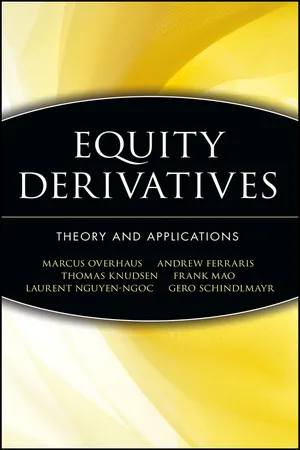
eBook - ePub
Equity Derivatives
Theory and Applications
- English
- ePUB (mobile friendly)
- Available on iOS & Android
eBook - ePub
Equity Derivatives
Theory and Applications
CHAPTER 1
Mathematical Introduction
The use of probability theory and stochastic calculus is now an established standard in the field of financial derivatives. During the last 30 years, a large amount of material has been published, in the form of books or papers, on both the theory of stochastic processes and their applications to finance problems. The goal of this chapter is to introduce notions on probability theory and stochastic calculus that are used in the applications presented afterwards. The notations used here will remain identical throughout the book.
We hope that the reader who is not familiar with the theory of stochastic processes will find here an intuitive presentation, although rigorous enough for our purposes, and a set of useful references about the underlying mathematical theory. The reader acquainted with stochastic calculus will find here an introduction of objects and notations that are used constantly, although maybe not very explicitly.
This chapter does not aim at giving a thorough treatment of the theory of stochastic processes, nor does it give a detailed view of mathematical finance theory in general. It recalls, rather, the main general facts that will be used in the examples developed in the next chapters.
1.1 PROBABILITY BASIS
Financial models used for the evaluation of derivatives are mainly concerned with the uncertainty of the future evolution of the stock prices. The theory of probability and stochastic processes provides a framework with a form of uncertainty, called randomness. A probability space Ω is assumed to be given once and for all, interpreted as consisting of all the possible paths of the prices of securities we are interested in. We will suppose that this probability space is rich enough to carry all the random objects we wish to construct and use. This assumption is not restrictive for our purposes, because we could always enlarge the space Ω, for example, by considering a product space. Note that Ω can be chosen to be a “canonical space,” such as the space of continuous functions, or the space of cadlag (French acr...
Table of contents
- Cover
- Contents
- Title
- Copyright
- About the Authors
- Preface
- Chapter 1: Mathematical Introduction
- Chapter 2: Incomplete Markets
- Chapter 3: Financial Modeling with Lévy Processes
- Chapter 4: Finite-Difference Methods for Multifactor Models
- Chapter 5: Convertible Bonds and Asset Swaps
- Chapter 6: Data Representation
- Chapter 7: Application Connectivity
- Chapter 8: Web-Based Quantitative Services
- Chapter 9: Portfolio and Hedging Simulation
- References
- Index
Trusted by 375,005 students
Access to over 1.5 million titles for a fair monthly price.
Study more efficiently using our study tools.
Frequently asked questions
Yes, you can cancel anytime from the Subscription tab in your account settings on the Perlego website. Your subscription will stay active until the end of your current billing period. Learn how to cancel your subscription
No, books cannot be downloaded as external files, such as PDFs, for use outside of Perlego. However, you can download books within the Perlego app for offline reading on mobile or tablet. Learn how to download books offline
Perlego offers two plans: Essential and Complete
- Essential is ideal for learners and professionals who enjoy exploring a wide range of subjects. Access the Essential Library with 800,000+ trusted titles and best-sellers across business, personal growth, and the humanities. Includes unlimited reading time and Standard Read Aloud voice.
- Complete: Perfect for advanced learners and researchers needing full, unrestricted access. Unlock 1.5M+ books across hundreds of subjects, including academic and specialized titles. The Complete Plan also includes advanced features like Premium Read Aloud and Research Assistant.
We are an online textbook subscription service, where you can get access to an entire online library for less than the price of a single book per month. With over 1.5 million books across 990+ topics, we’ve got you covered! Learn about our mission
Look out for the read-aloud symbol on your next book to see if you can listen to it. The read-aloud tool reads text aloud for you, highlighting the text as it is being read. You can pause it, speed it up and slow it down. Learn more about Read Aloud
Yes! You can use the Perlego app on both iOS and Android devices to read anytime, anywhere — even offline. Perfect for commutes or when you’re on the go.
Please note we cannot support devices running on iOS 13 and Android 7 or earlier. Learn more about using the app
Please note we cannot support devices running on iOS 13 and Android 7 or earlier. Learn more about using the app
Yes, you can access Equity Derivatives by Marcus Overhaus,Andrew Ferraris,Thomas Knudsen,Frank Mao,Laurent Nguyen-Ngoc,Gero Schindlmayr in PDF and/or ePUB format, as well as other popular books in Business & Finance. We have over 1.5 million books available in our catalogue for you to explore.