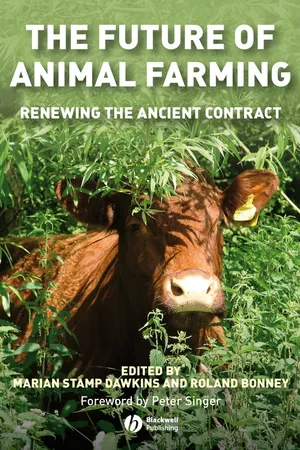
The aim of this book is to challenge the "them-and-us" thinking that sets the interests of humans and farm animals against each other and to show that to be really "sustainable," farming needs to include, not ignore, animal welfare. The authors of this remarkable book come from a diversity of backgrounds: industry, animal welfare organizations, academic institutions, and practical farming. They are united in arguing that farm animals matter and that sustainable farming must have animal welfare at its ethical core, along with the production of healthy, affordable food and care for the environment.
eBook - ePub
The Future of Animal Farming
Renewing the Ancient Contract
- English
- ePUB (mobile friendly)
- Available on iOS & Android
eBook - ePub
The Future of Animal Farming
Renewing the Ancient Contract
About this book
Does animal welfare have a place in sustainable farming, or do the demands of a rising human population and the threat of climate change mean that the interests of animals must be put aside? Can we improve the way we keep animals and still feed the world – or is it a choice between ethics and economics?
Information
1
The future of animal farming
Does animal welfare have a place in sustainable farming? Or does the threat of climate change now mean that the interests of nonhumans must be sacrificed to meet the demands of a rising human population? Can we improve the way we keep animals and still feed the world? Do we have to choose between ethics and economics? Between humans and animals?
The current debates about the future of the planet have thrown up answers to such questions that could be very bad news for farm animals. The Food and Agriculture Organization (2006), for example, has argued that since livestock contribute so much to global warming, the only solution is more and more intensive agriculture – animals packed closely together to make the maximum use of space and kept inside to limit the damage they can do to the environment. The Food and Agriculture Organization (FAO) foresees more selective breeding and more genetic manipulation to produce animals that survive under such conditions. So just at the point where more and more people are becoming concerned with the ethics of how their food is produced (Tudge, 2004; Singer & Mason, 2006), animal welfare is in danger of being pushed off the agenda.
The aim of this book is to challenge the “them and us” thinking that sets the interests of humans and farm animals against each other and to show that to be really “sustainable,” farming needs to include, not ignore, the welfare of farmed animals. Animal welfare is so closely linked to human health and to the quality of human life that true sustainability cannot be a choice between economics and ethics or between human welfare and animal welfare. Sustainability must mean having it all – viable farms, healthy safe food, protection for the environment, as well as better lives for our farm animals.
But in today’s global economy, with its increasing concern about climate change, is this possible? Isn't animal welfare a luxury for a rich minority and quite irrelevant to the majority of people in the world who cannot afford it? Surely there is not enough space, or enough money, or enough anything to achieve high standards of animal welfare when we are not even managing to ensure basic standards of human welfare? Surely we are going to have to make some very difficult choices. Of course we are. The point we want to make in this book is that those choices should put animal welfare at the heart of farming, even for those who put human welfare first. You don't have to care much about animals at all to see that their health and welfare will affect the health and well-being of you and your family and the whole human species through the food you eat, the diseases that might affect you, and the impact that agriculture of all sorts has on the whole planet.
As Bernie Rollin explains more fully in the next chapter, this interdependence between humans and animals can be seen as a kind of contract – a “deal” that goes back over thousands of years of human history. Traditionally, the deal was that farm animals provided us with food, clothing and much else while we provided them with food, protection from the elements and from predators. Humans have most often cared for their animals not out of sentiment but because their animals were valuable to them. With the industrialization of agriculture, we have broken that contract. Many people are no longer in touch with how farm animals are raised and so the health and welfare of food animals no longer seems to affect their own survival so directly. But indirectly it still does. Disease in food animals has potentially catastrophic effects on human health and the ecological effects of poor farming practices threaten the very life of the planet. It is time to renew the ancient contract for the benefit of all of us, not because it would be a pleasant extra if we could afford it but because it is a necessity we cannot afford to be without.
The exact terms of the new contract have yet to be worked out in detail because there are no easy solutions to the problems that confront us. On our side, there will have to be many changes – in our mind sets, in our diets, in our business models, and in the ways we keep animals. Furthermore, the future itself is uncertain as far as the technology that might become available or the changes in climate that might occur are concerned. But the essential elements are already clear. As this book shows, there are successful ways of farming that give priority to animal welfare, deliver high quality food, protect the environment and, most importantly, make business sense. o What people value in their food is changing and continues to change. As a result, cc there are some surprising changes in the way that global businesses set their priorities. tz There are commercial as well as social and ethical benefits to animal welfare.
The scale of the challenge
Agriculture is the largest industry on the planet. It employs 1.3 billion people and provides a livelihood for about a billion more (Food and Agriculture Organization, 2006a). Livestock production, which uses land both for grazing and for growing animal feed, takes up 30% of the ice-free land on the planet and is responsible for 18% of all greenhouse gas emissions measured as CO2 equivalent – higher even than transport. Of the gases emitted as a result of human activity, livestock are responsible for 37% of the methane, 65% of the nitrous oxide, and 64% of the ammonia. Much of this pollution comes from manure but livestock have an even more insidious effect on the environment. Livestock now account for about 20% of the total animal biomass in the world and 30% of what they now occupy was once the habitat for wildlife. Through forest clearance, livestock farming could thus be said to be the biggest destroyer of biodiversity. In Latin America, for example, 70% of previously forested land is now occupied by pasture (Food and Agriculture Organization, 2006a).
And that is just the current situation. The human population of the world is currently 6.5 billion. It is growing by 76 million each year and 95% of this population increase is in developing countries. The UN’s medium projection forecasts that world population will reach 9.1 billion by 2050. Not only is the populations growing , so are individual incomes and, as people become richer their demand for food and other agricultural products also increases. With higher disposable incomes, people move towards more varied diets that include more pre-processed food, more foods of animal origin and more added sugar and fat (Food and Agriculture Organization, 2006a). The statistics are staggering. Currently 276 million tonnes of meat is being produced globally each year, increasing by approximately 3% each year. The UN’s Food and Agriculture Organization’s prediction is that global production of meat is set to double from its value at the beginning of this century to over 465 million tonnes in 2050. That means that the environmental impact of the animals that are currently farmed must be halved just to keep environmental damage to its current level.
Increasing demand for animal food products exerts extra pressures on an economy in all sorts of ways. It encourages advanced breeding and feeding technology in livestock production and it leads to the development of irrigation systems and the use of fertilizers to increase production of plant crops on which to feed the animals. However, the largest pressure is for change in the very structure of livestock production itself. Much animal farming is rapidly shifting away from extensive systems towards more intensive, “landless” production, particularly of pigs and poultry. Comparisons between world livestock production systems by the FAO (averages for 1991–1993 and 2001–2003) show that globally, 14.6% of total meat is produced in grassland-based systems (ruminants), compared to 33.6% in landless systems. Total pig meat output rose by 30% at world level, an increase accounted for almost entirely by Asia. The total production of poultry meat grew by approximately 75%, again with the highest expansion in Asia. By contrast, cattle stocks are up 5% and small ruminants 10% (Steinfeld et al., 2006).
All of us, rich or poor, city dwellers or rural farmers, are affected by agriculture and by the rising global demand for animal products. Against this background of potential water shortages, pollution and environmental damage, rising fuel costs, and the need to feed the human population, it would be all too easy for animal welfare to get lost. Indeed, the FAO response to what it calls “Livestock’s Long Shadow” is to concentrate entirely on the human issues and to see the future of farming in terms of intensive, indoor units, which have the aim of maximizing productivity and limiting the environmental damage food animals can do. There is no mention of animal welfare anywhere in the report (2006). The aim of this book is to redress that balance and to explore a more optimistic future for animal farming.
The scope of the book
We will be questioning the pessimistic view that there are just two possible futures for animal farming: either more and more intensive farms or no meat eating at all. Many different people will argue from many different points of view that these are not the only alternatives in front of us. We want to show that there is another future that involves farming in a sustainable way but also makes sure that food animals have reasonable lives. The basis for this optimism is the fact that there already are successful commercial farms that are putting into practice many ideas that could form the future for animal farming if enough people want them and are prepared to make them work. The contributors to the book come from a diversity of backgrounds – from big business, from animal welfare organizations, from academic institutions, and from practical farming. They certainly do not agree with each other on everything but two common threads unite them. They all agree that farm animals matter and they all agree that sustainable farming must have animal welfare at its core, along with healthy food, human welfare, and environmental protection.
The book falls loosely into two sections, the first making the case for why major changes in animal farming are necessary, the second describing what the changed farming will be like. However, the fact that there is no clear distinction between the case for change and change that is already happening is one of the most encouraging features of the book. It shows that the aspirations are not only realistic but practical.
The book is dedicated to two people who directly or indirectly inspired many of b the contributors to this book. Ruth Harrison’s book Animal Machines (1964) awoke the public to the dangers of intensive agriculture and “factory farming” Throughout her life Ruth continued to campaign on behalf of farm animals and was never afraid to make herself unpopular on their behalf. David Wood-Gush was Professor of Agriculture at Edinburgh University and brought veterinary science and ethology (the study of behavior) into the service of animal welfare. His “family pig” system has now, with modification, been adopted with great success into a commercial venture and, as we will see throughout the book, provides a case study for how it is possible to bring about sustainable change in animal farming. We remember them and thank them.
Part 1
Voices for change
We start with the arguments in favor of changing the way in which animals are currently farmed. Some of these arguments come from looking at how farm ani-mals are kept now and the deep-seated conviction that many people have that all is not well. This imperative for change comes from a rejection of current farming practices because of the harm they do to animals (Rollin, Chapter 2; D'Silva, Chapter 3; and Midgely, Chapter 4 , who argue that we must change because farm animals suffer from what is now done to them). But other arguments reach the same conclusion from quite different starting points. Even if current farming methods are considered acceptable as far as the animals are concerned, we must change because what we are doing is unsustainable. We cannot continue as we are because we will run out of space, food, and water and we will be overcome by disease and pollution. This imperative for change comes from the fact that current farming methods cannot last. The threat of climate change has seen to that.
It is the convergence of these two kinds of argument - concern for animals and the need for sustainability in the face of climate change - that is now bringing about the possibility of real change (Rawles, Chapter 5). Public concern for animal welfare may not in itself be enough to have a major impact on farming as a whole. But couple it with the need to farm in a way that helps not hinders the problems of what is happening to the climate and we have a powerful and unstoppable force for change in farming.
2
The ethics of agriculture: the end of true husbandry
Bernie Rollin is one of the leading voices on the ethics of the way in which humans treat animals. He is an academic philosopher at Colorado State University but has a uniquely practical approach to ethics. His belief that philosophers should address serious applied issues and not just play intellectual games can be seen in his books such as Animal Right and Human Morality and Farm Animal Welfare.
Animal agriculture
The subject of this chapter is a betrayal of great magnitude, the modern human abrogation of our ancient contract with animals and with the earth, which contract nourished and sustained the growth of our civilization and, with consummate irony, allowed us to develop the science and technology which in turn enabled us to cavalierly disregard that same contract. This betrayal is not only a moral violation of our age-old relationship with animals, but a prudential denial of our own self-interest. For unless we renew the symbiosis intrinsic to that contract, we will be unable to nourish ourselves physically; in the end, like all animals, we must eat to live, reproduce, and survive. And the end of this contract means an end to a renewable food supply, without which abrogation cannot be sustained.
This ancient contract, which we will characterize as husbandry with regard to animals, and stewardship with regard to the land, is the bedrock upon which economics, art, and culture rests. Yet with the profound hubris of an Icarus who challenged inherent human limitations, with blind and abiding faith in the humanly crafted tools which repeatedly show themselves as impotent in the face of natural disaster, we thumb our noses at both morality and prudence. As the ancients crafted the tower of Babel, so we overreach the constraints imposed on us by the natural world.
These seemingly lofty and pretentious claims will be fleshed out in the body of this chapter, in depressing detail. But it is fitting to tether our discussion to a pair of anecdotes experienced by the author that will point the way to that discussion. The examples evoke both our balanced past and our tenuous future in the area of animal agriculture.
About three years ago, I was visiting a rancher friend in Wyoming, and having dinner at his home along with a dozen other ranch people. I asked the dinner guests how many of them had ever spent more money on medical treatment for their cattle than the animal was worth in economic terms. All replied in the affirmative. One women, a fifth generation rancher, asked, with something of an edge, “What's wrong with that, Buster?” I replied “Nothing from my perspective. But if I were an agricultural economist, I would tell you that one does not spend $25 to produce a widget that one sells for $20.” She fairly spat her reply: “Well that's your mistake, Buster. We're not producing widgets, we're taking care of living beings for whom we are responsible!”
Virtually every rancher I have encountered – and I have lectured to around 15,000 across the US and Canadian West – would respond in a similar vein. Even if they do not spend cash, ranch people often sit up all night for days with a marginal calf, warming the animal by the stove in the kitchen, and implicitly valuing their sleep at pennies per hour! Children of ranch families often report that the only time their father ever blew up at them was when they went to a dance or a sporting event without taking care of the animals. These ranchers represent the last large group of agriculturalists in the US still practicing animal husbandry, as we shall explain shortly.
In contrast to this elevating anecdote, consider the story told to me by one of my colleagues in Animal Science at Colorado State University. This man told of his son-in-law who had grown up on a ranch, but could not return to it after college because it could not support him and all of his siblings. (Notably, the average net income of a Front Range (i.e.eastern slope of the Rocky Mountains) rancher in Colorado, Wyoming, or Montana is about $35,000!) He reluctantly took a job managing a feeder pig barn at a large swine factory farm. One day he reported a disease that had struck his piglets to his boss. “I have u bad news and good news,” he reported. “The bad news is that the piglets are sick. The good news is that they can be treated economically.” “No,” said the boss. “We don’t treat! We euthanize (by dashing the baby pigs' heads on the side of the concrete pen).” The young man could not accept this. He proceeded to buy the medicine with his own money and clock in on his day off, and treated the animals. They recovered, and he told the boss. The boss's response was “You’re fired!” The young man pointed out that he had treated them with his own time and money, and was thus not subject to firing. He did, however, receive a reprimand in his file. Six months later he quit and became an electrician. He wrote to his father-in-law: “I know you are disappointed that I left agriculture, Dad. But this ain’t agriculture!”
In these two stories is encapsulated the history of where agriculture was traditionally, and what it has overwhelmingly become today. How and why did this change take place?
The traditional account of the growth of human civilization out of a hunter- gatherer society invariably invokes the rise of agriculture, i.e. the domestication of animals and the cultivation of crops. This of course allowed for as predictable a food supply as humans could create in the vagaries of the natural world – floods, droughts, hurricanes, typhoons, extremes of heat and cold, fires, etc. Indeed, the use of animals enabled the development of successful crop agriculture, with the animals providing labor and locomotion, as well as food and fiber.
This eventuated in what Temple Grandin refers to as the “ancient contract” with animals, a highly symbiotic relationship that endured essentially unchanged for thousands of years. Humans selected among animals congenial to human management, and further shaped them in terms of temperament and production traits by breeding and artificial selection. These animals included cattle – dubbed by Calvin...
Table of contents
- Cover
- Dedication
- Title page
- Copyright
- Foreword
- 1: The future of animal farming
- Part 1: Voices for change
- Part 2: Bringing about change
- Commentary
- References
- Index
Trusted by 375,005 students
Access to over 1.5 million titles for a fair monthly price.
Study more efficiently using our study tools.
Frequently asked questions
Yes, you can cancel anytime from the Subscription tab in your account settings on the Perlego website. Your subscription will stay active until the end of your current billing period. Learn how to cancel your subscription
No, books cannot be downloaded as external files, such as PDFs, for use outside of Perlego. However, you can download books within the Perlego app for offline reading on mobile or tablet. Learn how to download books offline
Perlego offers two plans: Essential and Complete
- Essential is ideal for learners and professionals who enjoy exploring a wide range of subjects. Access the Essential Library with 800,000+ trusted titles and best-sellers across business, personal growth, and the humanities. Includes unlimited reading time and Standard Read Aloud voice.
- Complete: Perfect for advanced learners and researchers needing full, unrestricted access. Unlock 1.5M+ books across hundreds of subjects, including academic and specialized titles. The Complete Plan also includes advanced features like Premium Read Aloud and Research Assistant.
We are an online textbook subscription service, where you can get access to an entire online library for less than the price of a single book per month. With over 1.5 million books across 990+ topics, we’ve got you covered! Learn about our mission
Look out for the read-aloud symbol on your next book to see if you can listen to it. The read-aloud tool reads text aloud for you, highlighting the text as it is being read. You can pause it, speed it up and slow it down. Learn more about Read Aloud
Yes! You can use the Perlego app on both iOS and Android devices to read anytime, anywhere — even offline. Perfect for commutes or when you’re on the go.
Please note we cannot support devices running on iOS 13 and Android 7 or earlier. Learn more about using the app
Please note we cannot support devices running on iOS 13 and Android 7 or earlier. Learn more about using the app
Yes, you can access The Future of Animal Farming by Marian Stamp Dawkins, Roland Bonney, Marian Stamp Dawkins,Roland Bonney in PDF and/or ePUB format, as well as other popular books in Biological Sciences & Ecology. We have over 1.5 million books available in our catalogue for you to explore.