Synthetic aperture radar provides broad-area imaging at high resolutions, which is used in applications such as environmental monitoring, earth-resource mapping, and military systems. This book presents the tools required for the digital processing of synthetic aperture radar images. They are of three types: (a) the elements of physics, (b) mathematical models and (c) image processing methods adapted to particular applications.
The Physical Basis of Synthetic Aperture Radar Imagery1
1.1. Electromagnetic propagation
The physics behind radar image formation is complex and involves several different topics. Some deal with electronic components devoted to transmission and reception of the wave, but they will not be discussed here. Other aspects, namely wave propagation and the interaction between microwave frequency waves and materials, are more important for our purposes. These two topics are the subject of this chapter. Electromagnetism obviously underlies both these phenomena and we begin with a review of useful results in this area.
1.1.1. The laws of propagation in homogenous media
1.1.1.1. Basic equations
An electromagnetic wave such as that emitted by radars is characterized at any point in space and at every moment by four vector values:
(electric field),
(electric displacement),
(magnetic induction) and
(magnetic field).
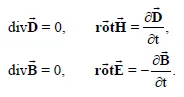
These quantities verify Maxwell’s equations, which in the absence of free charges and current densities are written as [JAC 75]:
In the linear stationary case, the fields, the electric displacement and the magnetic induction are ruled by the following relations:
where
is the permittivity and µ is the permeability. We will consider them as scalar values in this book (they are tensors in the general case of anisotropic dielectrics).
The electric field
and magnetic field
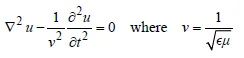
vectors are sufficient to characterize this electromagnetic wave for an unbounded, homogenous, isotropic medium which is free of charges and currents. We will use Maxwell’s equations to show that every component of these fields verifies the wave equation:
[1.1]
We thus observe the electromagnetic energy transmission; v is the propagation velocity of the electromagnetic wave.
By denoting
0 the vacuum permittivity and μ0 the vacuum permeability, we deduce c, i.e. the speed of light, as being:
In the general case and in the absence of any charge or current, the relative permittivity
and relative permeability
of the propagation medium are normally used, which makes it possible to express the propagation velocity according to c:
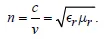
The refractive index n for a propagation medium is defined as:
Note that in non-magnetic media we will deal with µr = 1, which leads to
Since the medium is unbounded,
and
are perpendicular to each other at any
and both are perpendicular to the propagation direction
that represents the energy path, which is also called a ray.
If a preferred direction can be specified by convention in the plan (
,
), we will then be able to characterize
(and therefore
) in terms of its polarization, i.e., its orientation with respect to the defined direction.
1.1.1.2. Propagation equation solution
In the presence of an isotropic radiation source
located at
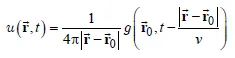
the solution of propagation equation [1.1] at any
point in space is written:
[1.2]
The wave then propagates from the source (homogenous medium) in such a way that the wavefront, i.e., the normal ray surface everywhere in space, is a sphere centered on the source: the propagation between the source and any observer is carried out in a straight line.
In the specific case of satellite systems, the objects impinged by the ...
Table of contents
Cover
Title Page
Copyright
Introduction
Chapter 1: The Physical Basis of Synthetic Aperture Radar Imagery
Chapter 2: The Principles of Synthetic Aperture Radar
Chapter 3: Existing Satellite SAR Systems
Chapter 4: Synthetic Aperture Radar Images
Chapter 5: Speckle Models
Chapter 6: Reflectivity Estimation and SAR Image Filtering
Chapter 7: Classification of SAR Images
Chapter 8: Detection of Points, Contours and Lines
Chapter 9: Geometry and Relief
Chapter 10: Radargrammetry
Chapter 11: Radarclinometry
Chapter 12: Interferometry
Chapter 13: Phase Unwrapping
Chapter 14: Radar Oceanography
Bibliography
List of Authors
Index
Trusted by 375,005 students
Access to over 1.5 million titles for a fair monthly price.
Study more efficiently using our study tools.
Frequently asked questions
Yes, you can cancel anytime from the Subscription tab in your account settings on the Perlego website. Your subscription will stay active until the end of your current billing period. Learn how to cancel your subscription
No, books cannot be downloaded as external files, such as PDFs, for use outside of Perlego. However, you can download books within the Perlego app for offline reading on mobile or tablet. Learn how to download books offline
Perlego offers two plans: Essential and Complete
Essential is ideal for learners and professionals who enjoy exploring a wide range of subjects. Access the Essential Library with 800,000+ trusted titles and best-sellers across business, personal growth, and the humanities. Includes unlimited reading time and Standard Read Aloud voice.
Complete: Perfect for advanced learners and researchers needing full, unrestricted access. Unlock 1.5M+ books across hundreds of subjects, including academic and specialized titles. The Complete Plan also includes advanced features like Premium Read Aloud and Research Assistant.
Both plans are available with monthly, semester, or annual billing cycles.
We are an online textbook subscription service, where you can get access to an entire online library for less than the price of a single book per month. With over 1.5 million books across 990+ topics, we’ve got you covered! Learn about our mission
Look out for the read-aloud symbol on your next book to see if you can listen to it. The read-aloud tool reads text aloud for you, highlighting the text as it is being read. You can pause it, speed it up and slow it down. Learn more about Read Aloud
Yes! You can use the Perlego app on both iOS and Android devices to read anytime, anywhere — even offline. Perfect for commutes or when you’re on the go. Please note we cannot support devices running on iOS 13 and Android 7 or earlier. Learn more about using the app
Yes, you can access Processing of Synthetic Aperture Radar (SAR) Images by Henri Maître in PDF and/or ePUB format, as well as other popular books in Technology & Engineering & Electrical Engineering & Telecommunications. We have over 1.5 million books available in our catalogue for you to explore.