eBook - ePub
Leadership Agility
Five Levels of Mastery for Anticipating and Initiating Change
- English
- ePUB (mobile friendly)
- Available on iOS & Android
eBook - ePub
Leadership Agility
Five Levels of Mastery for Anticipating and Initiating Change
About this book
Leadership Agility is the master competency needed for sustained success in today's complex, fast-paced business environment. Richly illustrated with stories based on original research and decades of work with clients, this groundbreaking book identifies five levels that leaders move through in developing their agility. Significantly, only 10% have mastered the level of agility needed for consistent effectiveness in our turbulent era of global competition. Written in an engaging, down-to-earth style, this book not only provides a map that guides readers in identifying their current level of agility. It also provides practical advice and concrete examples that show managers and leadership development professionals how they can bring greater agility to the initiatives they take every day.
Information
PART ONE
What Is Leadership Agility?
CHAPTER ONE
Agility in a World of Change and Complexity

Robert faced the biggest leadership challenge of his career. An executive in a Canadian oil corporation, he’d just been named president of its refining and retailing company. Competitively, his company was positioned around the middle of the pack in a mature, margin-sensitive market where long-range demand was projected to be flat. With little to distinguish it from other regionals, it was watching its earnings go steadily downhill. In fact, its future looked dismal.
Within the company, morale was at an all-time low. People at all levels were frustrated and unhappy. The previous president had taken many steps to make the company more efficient, including a series of layoffs, but these steps had not produced the desired results. The whole organization was in a state of fear. Privately, the outgoing president had been considering which division would have to be sold or shut down. As Robert moved into his new position, everything was truly up for grabs.
Over the next three years, Robert led his company through an amazing turnaround. At the end of this period, it not only survived without selling any of its divisions, it entered a phase of aggressive growth, clearing $71 million a year more than when he took over. In the business press, the company went from being a “bad bet” to “one of the darlings of the stock market.” Why did Robert succeed when his predecessor did not?
The company badly needed a short-term increase in its stock price. But Robert wanted to do much more than that. He wanted to transform an admittedly lackluster company into the best regional in North America. In fact, his vision was to develop an organization whose business performance and innovative ways of operating would be benchmarked by companies from a wide variety of industries. By putting the stock price goal in this larger context, Robert overturned his predecessor’s assumption that the company’s options were limited to difficult but familiar cost-cutting solutions. Instead, he decided to create a set of break-out strategies that would develop a more innovative organization.
Realizing that he and his top management group might not have all the answers, Robert hired a world-class strategy firm. He also set up ten “idea factories”: creative strategic-thinking sessions, where employees and other stakeholders developed ideas for the top team to consider. People responded with enthusiasm, generating a huge number of ideas.
Robert then held a two-day retreat where he and his top management group synthesized the strategy firm’s ideas with those generated by the idea factories. As he put it later, “We tried to involve as many people as possible in the strategic review process. We invested time and energy up front to listen to people, build trust, and get everyone aligned. It paid off, because we started to think with one brain. Instead of being at cross-purposes, we could understand and support each other’s decisions.”
The new strategies that emerged went well beyond those Robert, his team, and the strategy firm would have generated on their own. They resulted in a smaller, more focused organization with a much stronger “people strategy” designed to catapult the company into the ranks of high-performing organizations. When the new game plan was ready, Robert and his team presented it to the employees before they announced it to the market.
The presentation included some bad news, but the employees gave it a standing ovation. Over the months that followed, Robert and his team repeatedly communicated their new vision and its implications for employees in many different forums. As the new strategies were implemented, the top team kept everyone updated on the performance of the business. Every year, Robert met with each of the company’s twenty management teams to discuss objectives and strategies and check for alignment.
Robert’s participative approach to transforming his organization not only led to innovative strategies, it also developed the commitment, trust, and alignment necessary to implement them reliably and effectively. As a result, during his first three years as president, annual earnings went from $9 million to $40 million, and cash expenses were reduced by $40 million a year. A once-faltering company had become one of the most efficient and effective refiners in North America and one of the top retailers in its marketplace.1
THE AGILITY IMPERATIVE
Robert’s story is part of a much larger drama: The struggle of organizations around the globe to adapt to a turbulent world economy. Underlying this turbulence are two deep global trends that have radically altered what it takes to achieve sustained success: accelerating change and growing complexity and interdependence.
Every year, new technologies, markets, and competitors emerge at an ever-increasing pace. As change accelerates, so does uncertainty and novelty: future threats and opportunities are harder to predict, and emerging challenges increasingly include novel elements. Further, with the globalization of the economy and the spread of connective technologies, it’s increasingly clear that we live in a diverse planetary village where everything is connected with everything else.2 In this interdependent world, the most successful companies will be those that create strong, timely alliances and partner effectively with customers, suppliers, and other stakeholders.
This means that, while specific future developments are increasingly difficult to predict, we can make two predictions with great certainty: The pace of change will continue to increase, and the level of complexity and interdependence will continue to grow. For more than a decade, organizational change experts, acutely aware of these powerful trends, have stressed the need to develop “agile” companies—organizations that anticipate and respond to rapidly changing conditions by leveraging highly effective internal and external relationships.3
Robert is one of those rare, agile leaders who succeeded in developing his management group into a cohesive leadership team that could transform their company into an agile organization. However, as many companies have discovered, developing truly agile teams and organizations is an unfamiliar and demanding task. Left to their own devices, the vast majority of today’s managers would not approach Robert’s challenge in the way that he did. Consequently, very few firms have developed the level of agility needed to keep pace with the ever-increasing degree of change and complexity in their business environment.4
A major reason for this continuing “agility gap” is the need for more agile leaders, not just in the executive suite but at all organizational levels. In a recent survey of CEOs in North America, Europe and Asia, 91 percent said that developing leaders is the most critical success factor for the growth of their business.5 In another survey, senior executives in Fortune 500 companies identified “agility” as a leadership competency “most needed” for the future success of their business.6 Yet although leadership development programs are a priority for most larger companies, very little attention has been given to understanding and developing the specific capacities and skills needed for agile leadership.
Leadership agility is directly analogous to organizational agility: It’s the ability to take wise and effective action amid complex, rapidly changing conditions. In the last-mentioned survey, executives said they much preferred agility to similar-sounding competencies like flexibility and adaptability. Why? By themselves, flexibility and adaptability imply a passive, reactive stance, while agility implies an intentional, proactive stance.
FIVE LEVELS OF LEADERSHIP AGILITY
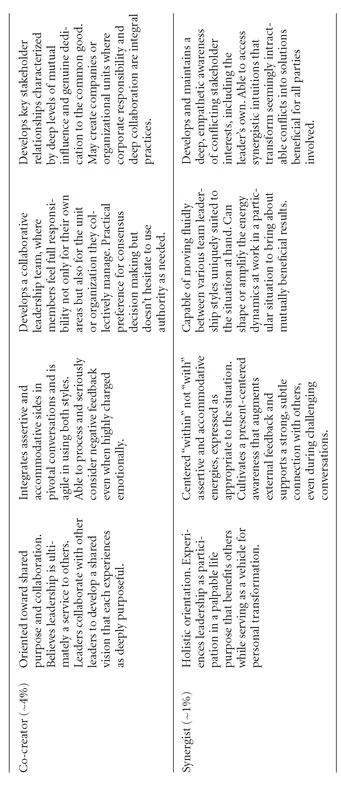
Based on data collected from more than six hundred managers, we’ve found that there are five distinct levels in the mastery of leadership agility: Expert, Achiever, Catalyst, Co-Creator, and Synergist.7 In Table 1.1, you’ll find profiles that show how managers at each agility level carry out initiatives in each of the three action arenas described in the Introduction: pivotal conversations, leading teams, and leading organizational change. Note that the competencies you need for agile leadership evolve further with each new level of mastery. Yet each time you move to a new level, you retain the ability to use those competencies you developed at previous levels.
The Expert Level
The name we’ve chosen for each agility level is intended to emphasize its strengths. Experts are so named because they’re strongly motivated to develop subject-matter expertise, and because they assume that a leader’s legitimate power comes from expertise and positional authority. Experts (roughly 45 percent of all managers) are the least agile of those profiled in the chart, but they’re more agile than about 10 percent who remain at Pre-expert levels. With their tactical orientation and their capacity for analytic problem solving, the Experts’ agility level is best suited for environments where success can be achieved by making incremental improvements to existing strategies.
The Achiever Level
About 35 percent of today’s managers have developed to the Achiever level of agility. These managers are highly motivated to accomplish outcomes valued by the institutions with which they’ve identified themselves. They realize that a leader’s power comes not only from authority and expertise but also from motivating others by making it challenging and satisfying to contribute to important outcomes. With their capacity for strategic thinking, Achievers can be highly effective in moderately complex environments where the pace of change requires episodic shifts in corporate strategy.
Heroic and Post-Heroic Leadership
In their book Power Up: Transforming Organizations Through Shared Leadership, David Bradford and Allan Cohen distinguish between “heroic” and “post-heroic” leadership. We found that managers at the Pre-expert, Expert, and Achiever levels (about 90 percent of all managers) operate from a heroic leadership mind-set.8 That is, they assume sole responsibility for setting their organization’s objectives, coordinating the activities of their subordinates, and managing their performance.
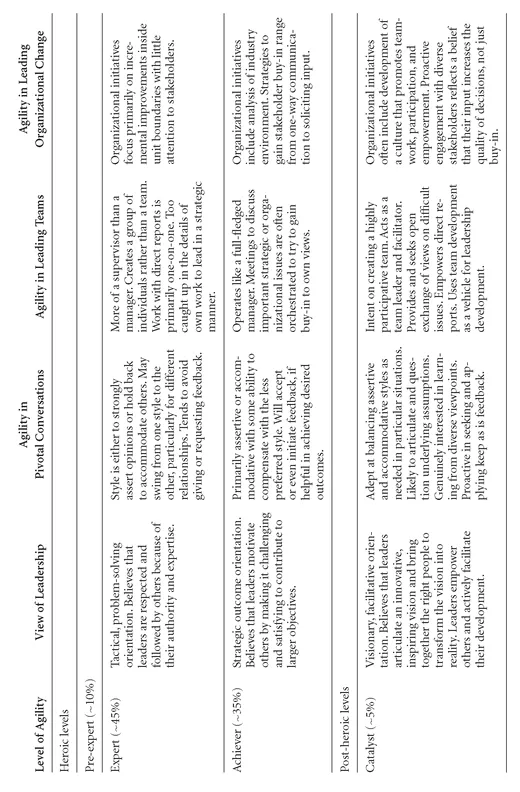
Table 1.1. Quick Reference Guide to Five level of Leadership agility Notes: Each level of agility includes and goes beyond the compretencies developed at previous levels. The percentage figures refer to research-based estimates of the managers currently capable of operting at each agility level.9
Heroic leadership can be highly effective in certain situations. The predominant combination of Expert and Achiever leadership worked relatively well for most companies until the waning decades of the twentieth century, when the globalization of the economy ushered in an era of constant change and growing interdependence. In this new environment, with its increased demand for collaborative problem solving, teamwork, and continuous organizational change, heroic leadership overcontrols and underutilizes subordinates. It discourages people from feeling responsible for anything beyond their assigned area, inhibits optimal teamwork, and implicitly encourages subordinates to use the heroic approach with their own units.
In this new century, sustained success will require post-heroic leadership. Leaders who develop beyond the Achiever level of agility retain the ultimate accountability and authority that comes with any formal leadership role. At the same time, they work to create highly participative teams and organizations characterized by shared commitment and responsibility.10 Unfortunately, as noted in the Introduction, only about 10 percent of today’s managers are functioning at post-heroic levels of agility: approximately 5 percent at the Catalyst level, 4 percent at the Co-Creator level, and 1 percent at the Synergist level.
The Catalyst Level
Robert’s story provides a clear example of post-heroic leadership at the Catalyst level. When appropriate, he exercised Expert and Achiever power, but he led his company in a way that emphasized the power of vision and participation. While his Achiever-level predecessor took the company’s existing culture as a given, Robert, like other Catalysts, was strongly motivated to create a participative culture capable of achieving valued outcomes over the longer term. Catalysts, with their openness to change, their willingness to rethink basic assumptions, and their visionary orientation, represent the first level of agility capable of sustained success in today’s highly complex, constantly changing business environment.
The Co-Creator Level
Co-Creator leaders derive their name, in part, from their understanding that everything in business and in the rest of life is interdependent. Because of their principled commitment to the common good, many of the Co-Creators in our sample have pioneered new forms of organization where corporate responsibility is integral to their bottom line. Whether or not they establish new organizations, Co-Creator leaders are committed to developing genuinely collaborative team and organizational relationships rooted in a deep sense of shared purpose. With their emotional resilience, their capacity for dialogue, and their ability to generate creative, win-win solutions, Co-Creators are well-equipped for long-term success in the rapidly changing and often disruptive global economy of the early twenty-first century.
The Synergist Level
In conducting the research for this book, we found that the differences between the agility levels become more subtle as leaders move to each successive level. This is particularly true of the distinctions between Co-Creators and Synergists. More than any other, the Synergist level is best understood from the inside out. Part of what distinguishes the leaders who function at this level is their ability to enter fully into the moment-to-moment flow of their present experience. As this capacity for present-centered awareness develops, it gives leaders the ability, in contentious and chaotic situations, to stand in the eye of the storm. This ability to remain centered amid competing demands allows them to access “synergistic intuitions” that transform seemingly intractable conflicts into solutions that are beneficial for all parties involved. We believe that the capacities and competencies developed by these men and women represent the cutting edge of leadership development for the twenty-first century.
AGILITY LEVELS AND PERSONALITY TYPES
In the next chapter, we provide a more detailed walk-through of these five levels of leadership agility, designed to help you identify your own agilit...
Table of contents
- Title Page
- Copyright Page
- Dedication
- Introduction
- PART ONE - What Is Leadership Agility?
- PART TWO - Five Levels of Leadership Agility
- PART THREE - Becoming a More Agile Leader
- APPENDIX A - Research Behind This Book
- APPENDIX B - Stages of Personal Development
- Notes for Inquiring Readers
- References
- Resources
- Acknowledgements
- The Authors
- Index
Trusted by 375,005 students
Access to over 1.5 million titles for a fair monthly price.
Study more efficiently using our study tools.
Frequently asked questions
Yes, you can cancel anytime from the Subscription tab in your account settings on the Perlego website. Your subscription will stay active until the end of your current billing period. Learn how to cancel your subscription
No, books cannot be downloaded as external files, such as PDFs, for use outside of Perlego. However, you can download books within the Perlego app for offline reading on mobile or tablet. Learn how to download books offline
Perlego offers two plans: Essential and Complete
- Essential is ideal for learners and professionals who enjoy exploring a wide range of subjects. Access the Essential Library with 800,000+ trusted titles and best-sellers across business, personal growth, and the humanities. Includes unlimited reading time and Standard Read Aloud voice.
- Complete: Perfect for advanced learners and researchers needing full, unrestricted access. Unlock 1.5M+ books across hundreds of subjects, including academic and specialized titles. The Complete Plan also includes advanced features like Premium Read Aloud and Research Assistant.
We are an online textbook subscription service, where you can get access to an entire online library for less than the price of a single book per month. With over 1.5 million books across 990+ topics, we’ve got you covered! Learn about our mission
Look out for the read-aloud symbol on your next book to see if you can listen to it. The read-aloud tool reads text aloud for you, highlighting the text as it is being read. You can pause it, speed it up and slow it down. Learn more about Read Aloud
Yes! You can use the Perlego app on both iOS and Android devices to read anytime, anywhere — even offline. Perfect for commutes or when you’re on the go.
Please note we cannot support devices running on iOS 13 and Android 7 or earlier. Learn more about using the app
Please note we cannot support devices running on iOS 13 and Android 7 or earlier. Learn more about using the app
Yes, you can access Leadership Agility by William B. Joiner,Stephen A. Josephs in PDF and/or ePUB format, as well as other popular books in Business & Leadership. We have over 1.5 million books available in our catalogue for you to explore.