![]()
PART 1
STRATEGIES
![]()
1
CORPORATE SOCIAL RESPONSIBILITY, GOOD CORPORATE GOVERNANCE, AND REPUTATION RISK
In general, people in business have yet to see the benefits of corporate social responsibility (CSR), and therefore have had no incentive to include the philosophy in their strategic framework or in their operational processes. Most still consider CSR activities as a sort of discretionary favor granted to the community by the business, and that such largesse is only appropriate after the company is well established, growing, and profitable. CSR of this type typically results in a one-off direct benefit to the community and very limited benefit to the company itself. Significantly, the benefits to both the community and the company are not sustainable.
On the other hand, driven by an ongoing revolution in communications technology, and underpinned by broader political, economical, and social changes, all businesses within a country are inevitably becoming part of the wider global market. Over the past 15 years, the world has also seen significant changes: the collapse of communism, the liberalization of China, Vietnam, and India, the emerging activities of the nongovernmental organization (NGO) sector, environmentalism, fundamentalism, consumerism, protectionism, World Social Forums, and so on. These changes have had a profound effect on not only the attitudes of governments and businesses, but also the people.
Advancements in information technology have also led to the availability of global television networks and the internet, which easily disseminate information instantaneously. Critics of business become better informed, helped by the global communication and the internet, while customers and consumers are better educated and becoming more aware of their rights and their potential power to influence corporate behavior.
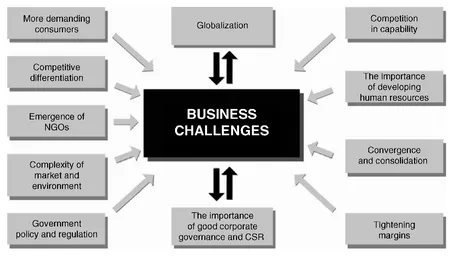
Within this aggressive changing global marketplace, in addition to opportunities, businesses have also to face multiple challenges, as shown in figure 1.1. The impact of globalization has touched different business dimensions: from human resources aspects of capability and service competition to human resources development; from business operations to governments, NGOs, and consumers; and unquestionably CSR develops into one important area to deal with.
In acknowledging the complexity and diversity of the fast-changing world, and to ensure sustainable growth also to gain competitive edge, businesses globally have transformed their key business processes into strategic capabilities to facilitate the change from “product” into “services capabilities competition.” Traditional functional marketing skills are necessary, but they no longer are sufficient. Broader-based leadership skills and capabilities, as a result of cross functional teamwork, are required.
FIGURE 1.1 Globalization offers both business opportunities and challenges
At the same time, the mantra of business people has also evolved from “profit” alone into “profit, people, and planet.” This new concept includes concern for several issues, those relating to people, to social issues, and to the environment:
• People issues range from workers’ health and safety and employee morale, engagement, and development to corporate culture and good corporate governance.
• Social issues embrace community building, education and issues such as entrenched poverty.
• Environmental issues include concern for global warming, pollution, and disturbance of ecosystems.
All these factors are no longer considered as incidental, so CSR has come to the fore as a core business issue. One of the first organizations that got businesses to involve and respond to sustainability concerns is the World Business Council for Sustainable Development (WBCSD).
As a global association, dealing with the promotion of sustainable development, the WBCSD was looking for a generic definition of what CSR means to businesses because governments, the market, communities, and NGOs expect companies to do more, while companies demand more flexibility in CSR implementation. Fundamentally, the CSR-WBCSD journey supports the view that a coherent CSR strategy based on sound ethics and core values offers clear business benefits. In other words, acting in a socially responsible manner internally as well as externally is more than just an ethical duty for the company. It is something that actually has a bottom-line payoff, and at the same time could mitigate the corporation’s reputation risk.
The WBCSD has advanced three concepts delineating the boundaries of CSR with the intention of suggesting to companies the most appropriate boundary of control and influence:
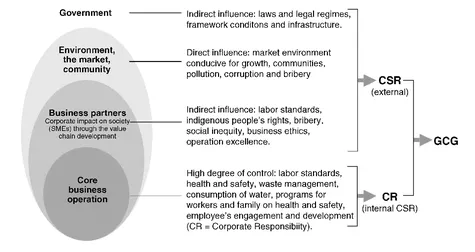
FIGURE 1.2 Spheres of influence adopted from World Business Council for Sustained Development (WBCSD) to accommodate the unique environment in Indonesia
1. Spheres of influence
• To illustrate the decision and control inter-relationship between a company and its stakeholders, the WBCSD defines the CSR role of a company in spheres of influence. The diagram shown in
figure 1.2 depicts the boundaries as nested circles of responsibility:
• The inner core contains matters that are within the company’s control, such as labor standards, health and safety, and waste management.
• The outermost circle in which decisions and relationships contained are subject to the least amount of corporate scrutiny or influence.
2. The value chain
• To map issues and dilemmas along a value chain or a product lifecycle.
3. Questions for the board
• To identify corporate values and issues
• To analyze the impact on the value chain
• To communicate, do outreach, and influence
These questions can provide a valuable framework for businesses in defining “what’s in and what’s out” of the CSR box.
The WBCSD has found that the CSR priority issues today are human rights, employees’ rights, environmental protection, supplier relations, and community involvement. Two related issues that cut across the others are the rights of stakeholders and the monitoring and assessing of CSR performance.
For our discussion, the WBCSD “Spheres of Influence” is adopted to map the author’s experience in successfully implementing community-related programs in Indonesia that are now categorized under CSR.
By doing the mapping as in figure 1.2, we can define very clearly the boundaries of corporate responsibility (CR), which is internal CSR and external CSR. In summary, good corporate governance can be described as the incorporation of high standards of corporate behavior as a culture within the core business operation (CR) and in the interaction of the corporation and the external environment outside the core business operation (CSR). As mentioned earlier in the preface, this book only concentrates on external CSR, which involves the interdependent relationship of the business’ core operation, its partners, the environment, and the market, including the wider community and the regulators (government).
Both good corporate governance and CSR are now becoming increasingly important parts of the business strategy. Good corporate culture and human resources capability are major determinants of a company’s success or failure and CSR activities are important tools to support the company’s strategy and image or reputation. It is only when a company is able to exert a high degree of control required to ensure good corporate governance within its core business operations that it can expect to successfully practice sustainable CSR for the benefit of both the company and society.
Successful internal CSR (CR) and corporate governance of an organization—with a well-understood vision or mission supported by a clear guiding principles, a demand-driven process organization, integrated human resources development, and an effective monitoring and control system, led by a strong exemplary leadership—will have “professional skilled human resources.” Only professional skilled human resources can define and implement the right CSR in line with the business’ vision and mission, and guide, lead, and negotiate, as well as train or change the values or mindset of business partners successfully.
Given the complexity and challenges, if a business is to survive and thrive, it must define the optimum balance among social, environmental, and economic factors for short- and long-term performance and profit. This means that good corporate governance and CSR activities should be embedded into the company’s culture and become an integral part of the short- and long-term strategy of the company. To achieve this, and to ensure the sustainability of profit and growth, businesses should adopt values, principles, strategies, and practices that are both compatible and consistently applied.
Business need not be concerned that its motivations and intentions in adopting CSR within an overall objective of growth and increasing profits might be misinterpreted by a cynical public. The WBCSD noted that business and the society at large are interdependent and through mutual understanding and responsible behavior (good corporate governance), the business role in building a better future should be recognized by society.
Further, as Adrian Cadbury said in 2002, because unprofitable business is a drain on society, there is no conflict between social responsibility and the efficient and profitable use of scarce resources by business. The essence of the contract between society and business is that companies should not pursue their immediate profit objectives at the expense of the longer-term interest of the community.
Focus Point
A company can expect to practice sustainable CSR successfully only
when it is able to exert the high degree of control required to ensure good
corporate governance within its core business operations.
It is extremely important to ensure the ongoing support and understanding of the community because the business world has changed. Value creation to the business, as well as to the wider society, should now become the ultimate objective of any business, and adopting this concept would entail a fundamental internal change; that is, to integrate CSR into the business processes. This has to be considered a strategic approach because people may have to recognize that CSR provides an effective mechanism to create, preserve, and improve the company’s reputation and image. There are quite a few examples of companies struggling to withstand a damaged reputation, not because they have breached the law, but mainly due to the lack of trust and acceptance from the community, or the lack of company’s understanding of the local community’s needs.
With the high-speed development in communication technology and the media, bad corporate behavior can travel fast across the globe, delivering a hard blow to the organization, harming the company’s reputation. However, companies with an approved contribution to the people and the environment—thereby gaining the trust and confidence of the community—will have a better chance to protect their reputation. The company’s impact on the community is an excellent catalyst for social accountability, and at the same time promotes positive image and reputation. Unlike financial risk, which typically involves quantifiable market, credit, and operational risks, it is impossible to estimate reputation risk up front. But the cost of losing this most precious asset can be very dear.
CSR and GCG can be seen as intangible elements that contribute to corporate success, with equal importance but different perspectives from that of the financial measures. Plotting the chart in figure 1.3 to the spheres of influence gives us a clearer picture of the role of CSR and good corporate governance in safeguarding, or better yet, in improving the company’s reputation.
Reputation reflects the perception, good or bad, of different groups of people who interact willingly with, or are affected by, the organizations that are in their sphere of influence. We usually call these groups stakeholders. They build their perception based on their evaluation of the businesses’ culture, behavior, and performance, while working within or in cooperation with the businesses, or through available information, which disseminates very quickly in this new world of...