Cope with legal, financial, and medical issues
Minimize anxiety and stress and make the later years golden
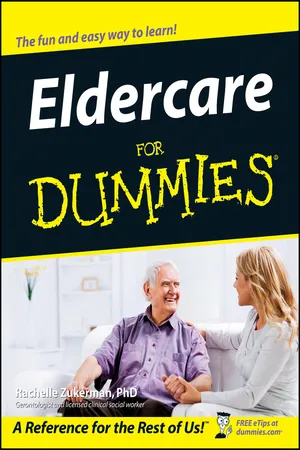
Need help caring for an elderly loved one? This sensitive, reassuring guide provides strategies for assessing older persons' needs, arranging for care, ensuring their safety, and enhancing quality of life - all while respecting their dignity. You'll see how to manage physical disabilities and chronic health problems, evaluate nursing homes, and help elders control their destinies.
The Dummies Way
* Explanations in plain English
* "Get in, get out" information
* Icons and other navigational aids
* Tear-out cheat sheet
* Top ten lists
* A dash of humor and fun
- English
- ePUB (mobile friendly)
- Available on iOS & Android
eBook - ePub
Eldercare For Dummies
About this book
Information
Part I
Entering the World of Caregiving

In this part . . .
If you feel bad because your elder is no longer as fit as a fiddle or raring to go, remember that it’s no picnic for her either. In this part, you find out what your older person truly needs to remain independent and how to help in a way that preserves her dignity — and your sanity.
Chapter 1
Eldercare Basics
In This Chapter

Contrary to what many folks think, aging isn’t a disease to overcome — it’s simply a normal part of living. Declines in your long-living person’s physical and mental functioning present new challenges. But chronic illnesses, family squabbles, and the sheer amount of work involved make caregiving one of the most difficult jobs anyone can have. It’s important to know that you’re not alone. The array of resources to help you cope is vast. In this book, I tell you everything I know to make your job easier.
Recognizing the Challenges of Aging
People over 65 are more diverse than people in any other age group. The varied life experiences of those who live a long time probably account for much of the individual uniqueness. People also age in different ways. Some folks remain healthy and active into their 80s, while others become frail early on. Even within an individual, organs age at different speeds. For example, Dad’s ticker may be strong, but his digestive system seems to be falling apart.
A person who has smoked for decades, has rarely exercised, has eaten poorly, and has worked with hazardous materials as a young person probably will age differently than a person who has had another lifestyle.
How old is old?
If you feel old — you’re old. If you feel young — you’re young. Nothing is magical about the number 65. But that number has been the widely accepted jumping-off point for “old” since 1935, when President Franklin D. Roosevelt signed an act creating an insurance program that paid eligible retirees, age 65 or older, a continuing income. You know it as Social Security.
Slowed reflexes, memory lapses, and “senior moments”
Even in the healthiest people, strength, flexibility, and reaction time diminish with age. The decline actually starts when you’re a young adult but isn’t noticeable until middle age, when knees aren’t what they used to be and pesky memory lapses (senior moments) appear. (See Chapter 2 for help with understanding and coping with your elder’s forgetfulness.)
Forgetfulness can signal a more serious illness, such as depression or Alzheimer’s disease. (See Chapters 15, 17, and 18 to help you recognize, understand, and cope with Alzheimer’s disease and depression in an elderly person.)

Diminished senses
In the normal healthy older adult, the five senses (vision, hearing, smell, taste, and touch) tend to decline somewhat with age. (See Chapter 2 for help with understanding and coping with your elder’s vision and hearing problems.) A dulling in the perception of pain (the sense of touch) may cause an elderly person to ignore a bedsore, burn, or other injury increasing their risk of serious infection or disability. (See Chapter 10 for information on observing and detecting signs of illness in your older person.)
Age-related disease and disability
Lots of diseases strike older people more often than younger people. Interestingly, the same illnesses may produce different symptoms in older people than they produce in younger adults. For example, an underactive or overactive thyroid may cause confusion in an older patient but not in a younger one. When the confusion is mistaken as dementia, the elder may be unnecessarily institutionalized and the underlying illness left untreated.
Once upon a time, heart attacks, kidney problems, and diabetes were likely to cause an early death. Now they are simply considered “chronic” illnesses — controlled or treated, but not cured. Managing the medications, disabilities, and visits to medical specialists for multiple chronic illnesses can become a gargantuan caregiving task. (See Chapter 10 for help in understanding and managing various age-related chronic illnesses and the medications used to treat or control them.)
Changed family relationships
A parent who can’t take care of himself o...
Table of contents
- Title
- Contents
- Introduction
- Part I : Entering the World of Caregiving
- Chapter 1: Eldercare Basics
- Chapter 2: The Elderly Are Like Vintage Computers
- Chapter 3: Old Age Is a Family Affair: Deciding Who, What, Where, and When
- Chapter 4: Where to Turn When Your Elder Needs a New Home
- Part II : Mastering Everyday Challenges
- Chapter 5: Sleeping Well Means Doing Well
- Chapter 6: Helping Finicky Eaters
- Chapter 7: Helping Elderly People Be All That They Can Be
- Chapter 8: Sharing the Caring
- Chapter 9: Growing Closer and Dearer: Improving Relationships
- Part III : Keeping Elderly Folks Safe and Sound
- Chapter 10: Living Well with Chronic Medical Conditions
- Chapter 11: Just Say “Yes” to Health-Giving Drugs
- Chapter 12: Protective Doohickeys and Thingamajigs
- Chapter 13: Dealing with Leaky Plumbing and Other Incontinence Problems
- Chapter 14: Getting Out and About
- Part IV : The Blues, the “Good Old Days,” and Other Senior Moments
- Chapter 15: When the Clouds Roll In: Dealing with Depression
- Chapter 16: Managing Anxiety
- Chapter 17: All About Alzheimer’s Disease
- Chapter 18: Managing the Distressing Behavior and Emotions of Confused Elderly
- Part V : Making the Final Years Golden
- Chapter 19: When “The Apple of Your Eye” Needs a Peer
- Chapter 20: Keeping Your Elder at the Helm
- Chapter 21: Keeping the Bill Collector from the Door
- Chapter 22: Helping Spiritual and Religious Elderly “Keep the Faith”
- Chapter 23: Ensuring a Good Death
- Part VI : The Part of Tens
- Chapter 24: Ten Tests to Help You Assess a Nursing Home
- Chapter 25: Ten Ways (More or Less) That Elders Hide Their Feelings
Trusted by 375,005 students
Access to over 1.5 million titles for a fair monthly price.
Study more efficiently using our study tools.
Frequently asked questions
Yes, you can cancel anytime from the Subscription tab in your account settings on the Perlego website. Your subscription will stay active until the end of your current billing period. Learn how to cancel your subscription
No, books cannot be downloaded as external files, such as PDFs, for use outside of Perlego. However, you can download books within the Perlego app for offline reading on mobile or tablet. Learn how to download books offline
Perlego offers two plans: Essential and Complete
- Essential is ideal for learners and professionals who enjoy exploring a wide range of subjects. Access the Essential Library with 800,000+ trusted titles and best-sellers across business, personal growth, and the humanities. Includes unlimited reading time and Standard Read Aloud voice.
- Complete: Perfect for advanced learners and researchers needing full, unrestricted access. Unlock 1.5M+ books across hundreds of subjects, including academic and specialized titles. The Complete Plan also includes advanced features like Premium Read Aloud and Research Assistant.
We are an online textbook subscription service, where you can get access to an entire online library for less than the price of a single book per month. With over 1.5 million books across 990+ topics, we’ve got you covered! Learn about our mission
Look out for the read-aloud symbol on your next book to see if you can listen to it. The read-aloud tool reads text aloud for you, highlighting the text as it is being read. You can pause it, speed it up and slow it down. Learn more about Read Aloud
Yes! You can use the Perlego app on both iOS and Android devices to read anytime, anywhere — even offline. Perfect for commutes or when you’re on the go.
Please note we cannot support devices running on iOS 13 and Android 7 or earlier. Learn more about using the app
Please note we cannot support devices running on iOS 13 and Android 7 or earlier. Learn more about using the app
Yes, you can access Eldercare For Dummies by Rachelle Zukerman in PDF and/or ePUB format. We have over 1.5 million books available in our catalogue for you to explore.