Healing Your Emotional Self
"Emotionally abusive parents are indeed toxic parents, and they cause significant damage to their children's self-esteem, self-image, and body image. In this remarkable book, Beverly Engel shares her powerful Mirror Therapy program for helping adult survivors to overcome their shame and self-criticism, become more compassionate and accepting of themselves, and create a more posititve self-image. I strongly recommend it for anyone who was abused or neglected as a child."
--Susan Forward, Ph.D., author of Toxic Parents
"In this book, Beverly Engel documents the wide range of psychological abuses that so many children experience in growing up. Her case examples and personal accounts are poignant and powerful reminders that as adults, many of us are still limited by the defenses we formed when trying to protect ourselves in the face of the painful circumstances we found ourselves in as children. Engle's insightful questionnaires and exercises provide concrete help in the healing process, and her writing style is lively and engaging. This book is destined to positively affect many lives."
--Joyce Catlett, M.A., coauthor of Fear of Intimacy
The Emotionally Abusive Relationship
"Beverly Engel clearly and with caring offers step-by-step strategies to stop emotional abuse . . . helping both victims and abusers to identify the patterns of this painful and traumatic type of abuse."
--Marti Tamm Loring, Ph.D., author of Emotional Abuse
Loving Him without Losing You
"A powerful and practical guide to relationships that every woman should read."
--Barbara De Angelis, Ph.D., author of Are You the One for Me?
eBook - ePub
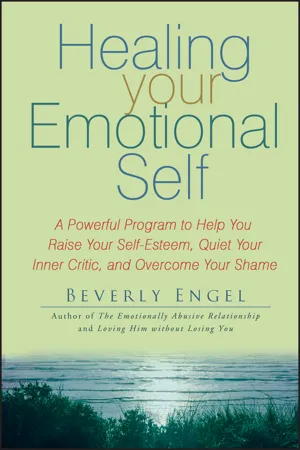
Healing Your Emotional Self
A Powerful Program to Help You Raise Your Self-Esteem, Quiet Your Inner Critic, and Overcome Your Shame
- English
- ePUB (mobile friendly)
- Available on iOS & Android
eBook - ePub
Healing Your Emotional Self
A Powerful Program to Help You Raise Your Self-Esteem, Quiet Your Inner Critic, and Overcome Your Shame
About this book
Information
PART ONE
How Your Parents Shaped Your Self-Esteem, Self-Image, and Body Image
1
Our Parents as Mirrors
Perfectionism is self-abuse of the highest order.
—ANN WILSON SCHAEF
—Kristin, age twenty-six
—Elliot, age thirty-one
—Teresa, age forty-three
—Charles, age fifty-five
DO YOU RELATE TO ANY of these people? Do you have a difficult time looking in the mirror because you never like what you see? Do you find that you are never pleased with yourself, no matter how much effort you put into making yourself a better person, no matter how much work you do on your body? Do you constantly find fault in yourself? Are you a perfectionist? Are you plagued by an inner critic who constantly berates you or finds something wrong with everything you do? Or are you like Charles, who believes that the way to feeling good about yourself is through your accomplishments—yet no matter how much you accomplish it is never enough?
Many of us focus a great deal of time and attention on improving our bodies and making ourselves more attractive. Yet, for all the time and money spent on dieting, exercise, clothes, and cosmetic surgery, many still do not like who they see in the mirror. There is always something that needs to be changed or improved.
People who are critical of how they look are usually critical of other aspects of themselves as well. They tend to focus on their flaws rather than their assets, and they are seldom pleased with their performance—whether at work, at school, or in a relationship. They chastise themselves mercilessly when they make a mistake.
There is nothing wrong with wanting to improve yourself; everyone suffers from time to time with self-critical thoughts. But some people have such low self-esteem that they are never satisfied with their achievements, their physical appearance, or their performance. They have a relentless inner critic who constantly tears them down and robs them of any satisfaction they might temporarily feel when they have reached a goal. The following questionnaire will help you determine whether you are suffering from low self-esteem and an unhealthy inner critic.
QUESTIONNAIRE: A “SELF” EXAMINATION
1. Do you suffer from insecurity or a lack of confidence?
2. Do you focus more on what you do wrong or what you fail at than what you do right or well?
3. Do you feel less than or not as good as other people because you are not perfect in what you do or how you look?
4. Do you believe you need to do more, be more, or give more in order to earn the respect and love of other people?
5. Are you aware of having a critical inner voice that frequently tells you that you did something wrong?
6. Are you constantly critical of your performance—at work, at school, at sports?
7. Are you critical of the way you interact with others? For example, do you frequently kick yourself for saying the wrong thing or for behaving in certain ways around others?
8. Do you feel like a failure—in life, in your career, in your relationships?
9. Are you a perfectionist?
10. Do you feel like you do not deserve good things? Do you become anxious when you are successful or happy?
11. Are you afraid that if people knew the real you, they wouldn’t like you? Are you afraid people will find out you are a fraud?
12. Are you frequently overwhelmed with shame and embarrassment because you feel exposed, made fun of, or ridiculed?
13. Do you constantly compare yourself to others and come up short?
14. Do you avoid looking in the mirror as much as possible, or do you tend to look in the mirror a lot to make sure you look okay?
15. Are you usually critical of what you see when you look in the mirror? Are you seldom, if ever, satisfied with the way you look?
16. Are you self-conscious or embarrassed about the way you look?
17. Do you have an eating disorder—compulsive overeating, bingeing and purging, frequent dieting or starvation, or anorexia?
18. Do you need to drink alcohol or take other substances in order to feel comfortable or less self-conscious in social situations?
19. Do you fail to take very good care of yourself through poor diet, not enough sleep, or too little or too much exercise?
20. Do you tend to be self-destructive by smoking, abusing alcohol or drugs, or speeding?
21. Have you ever deliberately hurt yourself, that is, cut yourself?
If you answered yes to more than five of these questions, you need the special help this book provides in order to raise your self-esteem, quiet your inner critic, heal your shame, and begin to find real joy and satisfaction in your achievements and accomplishments.
Even if you only answered yes to one of these questions, this book can help you because it isn’t natural or healthy to experience any of those feelings. You were born with an inherent sense of goodness, strength, and wisdom that you should be able to call upon in moments of self-doubt. Unfortunately, you may have lost touch with this inner sense because of the way you were raised and by the messages you received to the contrary.
Self-Esteem Defined
Let’s start by defining self-esteem and differentiating it from self-image and self-concept. Self-esteem is how you feel about yourself as a person—your overall judgment of yourself. Your self-esteem may be high or low, depending on how much you like or approve of yourself. If you have high self-esteem, you have an appreciation of the full extent of your personality. This means that you accept yourself for who you are, with both your good qualities and your so-called bad ones. It can be assumed that you have self-respect, self-love, and feelings of self-worth. You don’t need to impress others because you already know you have value. If you are unsure whether you have high self-esteem, ask yourself: “Do I believe that I am lovable?” “Do I believe I am worthwhile?”
Our feelings of self-worth form the core of our personality. Nothing is as important to our psychological well-being. The level of our self-esteem affects virtually every aspect of our lives. It affects how we perceive ourselves and how others perceive us, and how they subsequently treat us. It affects our choices in life, from our careers to whom we befriend or get involved with romantically. It influences how we get along with others and how productive we are, as well as how much use we make of our aptitudes and abilities. It affects our ability to take action when things need to be changed and our ability to be creative. It affects our stability, and it even affects whether we tend to be followers or leaders. It only stands to reason that the level of our self-esteem, the way we feel about ourselves in general, would also affect our ability to form intimate relationships.
Many people use the words self-esteem and self-concept interchangeably, but these terms actually have different meanings. Our self-concept, or self-image, is the set of beliefs or images we have about ourselves. Our self-esteem is the measure of how much we like and approve of our self-concept. Another way of thinking about it is that self-esteem is how much respect you have for yourself, while self-image is how you see yourself. Still another way of differentiating between self-esteem and self-image is to think of self-esteem as something you give to yourself (that’s why it is called self-esteem) and self-image is usually based on how you imagine others perceive you.
Our self-image is made up of a wide variety of images and beliefs. Some of these are self-evident and easily verifiable (for example, “I am a woman,” “I am a therapist”). But there are also other, less tangible aspects of the self (for example, “I am intelligent,” “I am competent”).
Many of the ideas we have about ourselves were acquired in childhood from two sources: how others treated us and what others told us about ourselves. How others defined us has thus become how we now perceive ourselves. Your self-image—who you think you are—is a package that you have put together from how others have seen and treated you, and from the conclusions you drew in comparing yourself to others.
The Real Cause of Your Low Self-Esteem or Negative Self-Image
The primary cause of your low self-esteem or negative self-image probably goes back to your childhood. No matter what has happened to you in your life, your parents (or the people who raised you) have the most significant influence on how you feel about yourself. Negative parental behavior and messages can have a profound effect on our self-image and self-esteem. This is especially true of survivors of emotional abuse, neglect, or smothering as a child.
Inadequate, unhealthy parenting can affect the formation of a child’s identity, self-concept, and level of self-esteem. Research clearly shows that the single most important factor in determining the amount of self-esteem a child starts out with is his or her parents’ style of child-rearing during the first three or four years of the child’s life.
When parents are loving, encouraging, and fair-minded, and provide proper discipline and set appropriate limits, the children they shape end up being self-confident, self-monitoring, and self-actualized. But when parents are neglectful, critical, and unfair, and provide harsh discipline and inappropriate limits, the children they shape are insecure and self-critical, and they suffer from low self-esteem.
When I first met Matthew I was struck by his dark good looks. He resembled a younger, taller, more exotic-looking Tom Cruise, with his chiseled features, his large, dark, almond-shaped eyes, and his straight dark hair. Because he was so strikingly good-looking I expected him to speak to me with confidence, but instead he spoke in a reticent, almost apologetic way. As he explained to me why he had come to therapy, I discovered that he felt extremely insecure. Although he was an intelligent, talented, attractive young man, he was tormented with self-doubt and was extremely critical of himself. Why would a young man with so much going for him feel so badly about himself?
As Matthew told me the story of his life, I discovered his father was never pleased with him. No matter what Matthew did, it was never enough. He told me about a time when he got on the honor roll in school and was excited to tell his father about it. Instead of congratulating Matthew and being proud of him, his father told him that since school was so easy for him he needed to get a job after school. So Matthew did as his father suggested. But this didn’t seem to please him, either. Instead, his father complained that he wasn’t helping out enough with yard work and that he needed to quit his job. “You’re just working so you can make money to waste on girls,” his father criticized, somehow not remembering that he had been the one to pressure Matthew into getting a job in the first place. Matthew had an interest in music and was a very talented piano player. But his father wasn’t happy about his taking lessons. “You’re already too effeminate,” he scoffed. “Why don’t you go out for sports like I did in school?” When Matthew followed his father’s advice and tried out for the track team, his father complained, “It just doesn’t have the same prestige as playing football or basketball. Why don’t you try out for one of those teams?”
Because his father was never proud of him and never acknowledged his accomplishments, Matthew became very hard on himself. He became very self-critical; no matter what he accomplished he found something wrong with it. If someone did try to compliment him, he pushed their praise away with statements such as “Oh, anyone could have done that,” or “Yeah, but you should have seen how I messed up yesterday.”
By not acknowledging Matthew and by never being pleased, Matthew’s father had caused him to be self-conscious and fearful. Many parents undermine their children’s self-esteem and create in them a sort of “self anxiety” by treating them in any or all of the following ways: with a lack of warmth and affection, acknowledgment, respect, or admiration, as well as with unreasonable expectations, domination, indifference, belittling, isolation, or unfair or unequal treatment.
“Inner Critic” Defined
Having a strong inner critic is another factor in creating low self-esteem, and it usually goes hand in hand with low self-esteem. Your inner critic is formed through the normal socialization process that every child experiences. Parents teach their children which behaviors are acceptable and which are unacceptable, dangerous, or morally wrong. Most parents do this by praising the former and discouraging the latter. Children know (either consciously or unconsciously) that their parents are the source of all physical and emotional nourishment, so parental approval feels like a matter of life or death to them. Therefore, when they are scolded or spanked they feel the withdrawal of parental approval very acutely because it carries with it the horrible risk of losing all support.
All children retain conscious and unconscious memories of those times when they felt wrong or bad because of the loss of their parents’ approval. This is where the inner critic gets his start. (I use “he” when referring to the inner critic because many people, including women, think of their inner critic as being male. Feel free to substitute “she” if it feels more appropriate for you.) Even as an adult there is still a part of you that believes you are “bad” whenever someone gets angry with you or when you make a mistake.
Your inner critic’s voice is the voice of a disapproving parent—the punishing, forbidding voice that shaped your behavior as a child. If your early experiences were mild and appropriate, your adult critic may only rarely attack, but if you were given very strong messages about your “badness” or “wrongness” as a child, your adult critic will attack you frequently and fiercely.
Emotional Abuse and Neglect Defined
Abuse is a very emotionally powerful word. It usually implies intent or even malice on the part of the abuser. But parents who emotionally abuse or neglect their children seldom do so intentionally. Most are simply repeating the way they were treated as a child—doing to their children what was done to them. Many do not realize that the way they are treating their children is harmful to them; few do so out of malice—an intentional desire to hurt their children.
Low self-esteem is not usually instilled in children through conscious or deliberate efforts on the part of the parents. Typically, parents of children with low self-esteem had low self-esteem themselves. And those parents who emotionally abuse, neglect, or smother their children usually do not recognize the tremendous power they have in shaping their children’s sense of self.
We need to be very specific when we use the words emotional abuse. Emotional abuse of a child is a pattern of behavior—meaning that it occurs on a continuous basis, over time. Occasional negative attitudes or actions are not con...
Table of contents
- Title Page
- Copyright Page
- Dedication
- Acknowledgements
- Introduction
- PART ONE - How Your Parents Shaped Your Self-Esteem, Self-Image, and Body Image
- PART TWO - Shattering Your Distorted Parental Mirror
- PART THREE - Creating a New Mirror
- PART FOUR - Specialized Help
- Appendix - Recommended Therapies
- References
- Recommended Reading
- Index
Trusted by 375,005 students
Access to over 1.5 million titles for a fair monthly price.
Study more efficiently using our study tools.
Frequently asked questions
Yes, you can cancel anytime from the Subscription tab in your account settings on the Perlego website. Your subscription will stay active until the end of your current billing period. Learn how to cancel your subscription
No, books cannot be downloaded as external files, such as PDFs, for use outside of Perlego. However, you can download books within the Perlego app for offline reading on mobile or tablet. Learn how to download books offline
Perlego offers two plans: Essential and Complete
- Essential is ideal for learners and professionals who enjoy exploring a wide range of subjects. Access the Essential Library with 800,000+ trusted titles and best-sellers across business, personal growth, and the humanities. Includes unlimited reading time and Standard Read Aloud voice.
- Complete: Perfect for advanced learners and researchers needing full, unrestricted access. Unlock 1.5M+ books across hundreds of subjects, including academic and specialized titles. The Complete Plan also includes advanced features like Premium Read Aloud and Research Assistant.
We are an online textbook subscription service, where you can get access to an entire online library for less than the price of a single book per month. With over 1.5 million books across 990+ topics, we’ve got you covered! Learn about our mission
Look out for the read-aloud symbol on your next book to see if you can listen to it. The read-aloud tool reads text aloud for you, highlighting the text as it is being read. You can pause it, speed it up and slow it down. Learn more about Read Aloud
Yes! You can use the Perlego app on both iOS and Android devices to read anytime, anywhere — even offline. Perfect for commutes or when you’re on the go.
Please note we cannot support devices running on iOS 13 and Android 7 or earlier. Learn more about using the app
Please note we cannot support devices running on iOS 13 and Android 7 or earlier. Learn more about using the app
Yes, you can access Healing Your Emotional Self by Beverly Engel in PDF and/or ePUB format, as well as other popular books in Personal Development & Mental Health & Wellbeing. We have over 1.5 million books available in our catalogue for you to explore.