A reference you'll warm up to
From the background and basics of heating systems to the newest chip-based technology, this first volume of Audel's HVAC Library gives you comprehensive information you need on the job. Whether you're installing, servicing, repairing, or troubleshooting an old or new heating system, you'll find what you're looking for, from wood and coal furnace maintenance to new calculations and the latest environmental technologies and regulations.
* Review the basics of installation, wiring, and troubleshooting for different HVAC systems
* Choose the correct system for the space, climate, and needs
* Compare the economy and efficiency of various fuel types
* Install, maintain, and troubleshoot conversion units
* Find formula cross references, data tables with conversions, and listings of trade organizations and equipment manufacturers
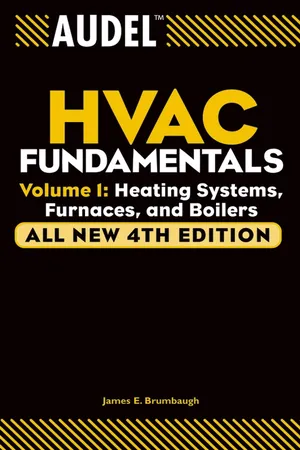
eBook - ePub
Audel HVAC Fundamentals, Volume 1
Heating Systems, Furnaces and Boilers
- English
- ePUB (mobile friendly)
- Available on iOS & Android
eBook - ePub
About this book
Information
Chapter 1
Introduction
This series is an introduction to the basic principles of heating, ventilating, and air conditioning (HVAC). Each represents a systematic attempt to control the various aspects of the environment within an enclosure, whether it is a room, a group of rooms, or a building.
Among those aspects of the immediate environment that people first sought to control were heat and ventilation. Attempts at controlling heat date from prehistoric times and probably first developed in colder climates, where it was necessary to produce temperatures sufficient for both comfort and health. Over the years the technology of heating advanced from simple attempts to keep the body warm to very sophisticated systems of maintaining stabilized environments in order to reduce heat loss from the body or the structural surfaces of the room.
Ventilation also dates back to very early periods in history. Certainly the use of slaves to wave large fans or fanlike devices over the heads of rulers was a crude early attempt to solve a ventilating problem. Situating a room or a building so that it took advantage of prevailing breezes and winds was a more sophisticated attempt. Nevertheless, it was not until the nineteenth century that any really significant advances were made in ventilating. During that period, particularly in the early stages of the Industrial Revolution, ventilating acquired increased importance. Work efficiency and the health of the workers necessitated the creation of ventilation systems to remove contaminants from the air. Eventually, the interrelationship of heating and ventilating became such that it is now regarded as a single subject.
Air conditioning is a comparatively recent development and encompasses all aspects of environmental control. In addition to the control of temperature, both humidity (i.e., the moisture content of the air) and air cleanliness are also regulated by air conditioning. The earliest attempts at air conditioning involved the placing of wet cloths over air passages (window openings, entrances, etc.) to cool the air. Developments in air conditioning technology did not progress much further than this until the nineteenth century. From about 1840 on, several systems were devised for both cooling and humidifying rooms. These were first developed by textile manufacturers in order to reduce the static electricity in the air. Later, adaptations were made by other industries.
Developments in air conditioning technology increased rapidly in the first four decades of the nineteenth century, but widespread use of air conditioning in buildings is a phenomenon of the post-World War II period (i.e., 1945 to the present). Today, air conditioning is found not only in commercial and industrial buildings but in residential dwellings as well. Unlike early forms of air conditioning, which were designed to cool the air or add moisture to it, modern air conditioning systems can control temperature, air moisture content, air cleanliness, and air movement. That is, modern systems condition the air rather than simply cool it.
Heating and Ventilating Systems
Many different methods have been devised for heating buildings. Each has its own characteristics, and most methods have at least one objectionable aspect (e.g., high cost of fuel, expensive equipment, or inefficient heating characteristics). Most of these heating methods can be classified according to one of the following four criteria:
1. The heat-conveying medium
2. The fuel used
3. The nature of the heat
4. The efficiency and desirability of the method
The term heat-conveying medium means the substance or combination of substances that carries the heat from its point of origin to the area being heated. There are basically four mediums for conveying heat. These four mediums are:
1. Air
2. Water
3. Steam
4. Electricity
Different types of wood, coal, oil, and gas have been used as fuels for producing heat. You may consider electricity as both a fuel and a heat-conveying medium. Each heating fuel has its own characteristics; the advantage of one type over another depends upon such variables as availability, efficiency of the heating equipment (which, in turn, is dependent upon design, maintenance, and other factors), and cost. A detailed analysis of the use and effectiveness of the various heating fuels is found in Chapter 5 (“Heating Fuels”).
Heating methods can also be classified with respect to the nature of the heat applied. For example, the heat may be of the exhaust steam variety or it may consist of exhaust gases from internal combustion engines. The nature of the heat applied is inherent to the heat system and can be determined by reading the various chapters that deal with each type of heating system (Chapters 6 through 9) or with heat-producing equipment (e.g., Chapter 11, “Gas Furnaces”).
The various heating methods differ considerably in efficiency and desirability. This is due to a number of different but often interrelated factors, such as energy cost, conveying medium employed, and type of heating unit. The integration of these interrelated components into a single operating unit is referred to as a heating system.
Because of the different conditions met within practice, there is a great variety in heating systems, but most of them fall into one of the following broad classifications:
1. Warm-air heating system (Chapter 6)
2. Hydronic heating systems (Chapter 7)
3. Steam heating systems (Chapter 8)
4. Electric heating systems (Chapter 9)
You will note that these classifications of heating systems are based on the heat-conveying method used. This is a convenient method of classification because it includes the vast majority of heating systems used today.
As mentioned, ventilating is so closely related to heating in its various applications that the two are very frequently approached as a single subject. In this series, specific aspects of ventilating are considered in Chapter 6 (“Ventilation Principles”) and Chapter 7 (“Ventilation and Exhaust Fans”) of Volume 3.
The type and design of ventilating system employed depends on a number of different factors, including:
1. Building use or ventilating purpose
2. Size of building
3. Geographical location
4. Heating system used
A residence will have a different ventilating system from a building used for commercial or industrial purposes. Moreover, the requirements of a ventilating system used to provide fresh air result in fundamental design differences from a ventilating system that must remove noxious gases or other dangerous contaminants from the enclosure.
The size of a building is a factor that also must be considered. For example, a large building presents certain ventilating problems if the internal areas are far from the points where outside air would initially gain access. Giving special attention to the overall design of the ventilating system can usually solve these problems.
Buildings located in the tropics or semitropics present different ventilating problems from those found in temperature zones. The differences are so great that they often result in different architectural forms. At least this was the case before the advent of widespread use of air conditioning. The typical southern house of the nineteenth century was constructed with high ceilings (heat tends to rise); large porches that sheltered sections of the house from the hot, direct rays of the sun; and large window areas to admit the maximum amount of air. They were also usually situated so that halls, major doors, and sleeping areas faced the direction of the prevailing winds. Today, with air conditioning so widely used, these considerations are not as important—at least not until the power fails or the equipment breaks down.
Air Conditioning
Although the major emphasis in this series has been placed on the various aspects of heating and ventilating, some attention has also been given to air conditioning. The reason for this, of course, is the increasing use of year-round air conditioning systems that provide heating, ventilating, and cooling. These systems condition the air by controlling its temperature (warming or cooling it), cleanliness, moisture content, and movement. This is the true meaning of the term air conditioning. Unfortunately, it has become almost synonymous with the idea of cooling, which is becoming less and less representative of the true function of an air conditioning system. Air conditioning, particularly the year-round air conditioning systems, is examined in detail in Chapters 8, 9, and 10 of Volume 3.
Selecting a Suitable Heating, Ventilating, or Air Conditioning System
There are a number of different types of heating, ventilating, and air conditioning equipment and systems available for installation in the home. The problem is choosing the most efficient one in terms of the installation and operating costs. These factors, in turn, are directly related to one’s particular heating and cooling requirements. The system must be the correct size for the home. Any reputable building contractor or heating and air conditioning firm should be able to advise you in this matter.
If you are having a heating and ventilating or air conditioning system installed in an older house, be sure to check the construction. Weather stripping is the easiest place to start. All doors and windows should be weather-stripped to prevent heat loss. Adequate weather stripping can cut heating costs by as much as 15 to 20 percent. If the windows provide suitable protection (they should be double- or triple-glazed) from the winter cold, check the caulking around the edge of the glass. If it is cracking or crumbling, replace it with fresh caulking. You may even want to go to the expense of insulating the ceilings and outside walls. This is where a great deal of heat loss and air leakage occurs.
You have several advantages when you are building your own house. For example, you may be able to determine the location of your house on the lot. This should enable you to establish the direction in which the main rooms and largest windows face. If you position your house so that these rooms and windows face south, you will gain maximum sunlight and heat from the sun during the cold winter months. This will reduce the heat requirement and heating costs. The quality of construction depends on how much you wish to spend and the reliability of the contractor. It is advisable to purchase the best insulation you can afford. Your reduced heating costs will eventually pay for the added cost of the insulation. If you suspect that your building contractor cannot be trusted, you can reduce opportunities for cheating and careless work by making frequent and unexpected visits to the construction site.
Career Opportunities
Many career opportunities are available in heating, ventilating, and air conditioning fields, and they extend over several levels of education and training. Accordingly, the career opportunities open to an individual seeking employment in these fields can be divided roughly into four categories, each dependent upon a different type or degree of education and/or training. This relationship is shown in Table 1-1.
Table 1-1 Relationships between Career Category and Type of Work or Education and/or Training Required
| Career Category | Type of Work | Education/Training |
| Engineer | Design and development | 4 years or more of college |
| Technician | Practical application | Technical training school and/or college |
| Skilled worker | Installation, maintenance, and repair | Apprentice program or on-the-job training (OJT) |
| Apprentice or OJT worker | Training for skilled-worker position | High school degree or equivalency |
Among workers in these fields, engineers receive the highest pay, but they also unde...
Table of contents
- Cover
- Contents
- Title
- Copyright
- Dedication
- Introduction
- About the Author
- Chapter 1: Introduction
- Chapter 2: Heating Fundamentals
- Chapter 3: Insulating and Ventilating Structures
- Chapter 4: Sizing Residential Heating and Air Conditioning Systems
- Chapter 5: Heating Fuels
- Chapter 6: Warm-Air Heating Systems
- Chapter 7: Hydronic Heating Systems
- Chapter 8: Steam Heating Systems
- Chapter 9: Electric Heating Systems
- Chapter 10: Furnace Fundamentals
- Chapter 11: Gas Furnaces
- Chapter 12: Oil Furnaces
- Chapter 13: Coal Furnaces, Wood Furnaces, and Multi-Fuel Furnaces
- Chapter 14: Electric Furnaces
- Chapter 15: Steam and Hot-Water Space
- Chapter 16: Boiler and Furnace Conversion
- Appendix A: Professional and Trade Associations
- Appendix B: Manufacturers
- Appendix C: HVAC/R Education, Training, Certification, and Licensing
- Appendix D: Data Tables
- Appendix E: Conversion Tables
- Index
Trusted by 375,005 students
Access to over 1.5 million titles for a fair monthly price.
Study more efficiently using our study tools.
Frequently asked questions
Yes, you can cancel anytime from the Subscription tab in your account settings on the Perlego website. Your subscription will stay active until the end of your current billing period. Learn how to cancel your subscription
No, books cannot be downloaded as external files, such as PDFs, for use outside of Perlego. However, you can download books within the Perlego app for offline reading on mobile or tablet. Learn how to download books offline
Perlego offers two plans: Essential and Complete
- Essential is ideal for learners and professionals who enjoy exploring a wide range of subjects. Access the Essential Library with 800,000+ trusted titles and best-sellers across business, personal growth, and the humanities. Includes unlimited reading time and Standard Read Aloud voice.
- Complete: Perfect for advanced learners and researchers needing full, unrestricted access. Unlock 1.5M+ books across hundreds of subjects, including academic and specialized titles. The Complete Plan also includes advanced features like Premium Read Aloud and Research Assistant.
We are an online textbook subscription service, where you can get access to an entire online library for less than the price of a single book per month. With over 1.5 million books across 990+ topics, we’ve got you covered! Learn about our mission
Look out for the read-aloud symbol on your next book to see if you can listen to it. The read-aloud tool reads text aloud for you, highlighting the text as it is being read. You can pause it, speed it up and slow it down. Learn more about Read Aloud
Yes! You can use the Perlego app on both iOS and Android devices to read anytime, anywhere — even offline. Perfect for commutes or when you’re on the go.
Please note we cannot support devices running on iOS 13 and Android 7 or earlier. Learn more about using the app
Please note we cannot support devices running on iOS 13 and Android 7 or earlier. Learn more about using the app
Yes, you can access Audel HVAC Fundamentals, Volume 1 by James E. Brumbaugh in PDF and/or ePUB format, as well as other popular books in Technology & Engineering & Construction & Architectural Engineering. We have over 1.5 million books available in our catalogue for you to explore.