As more factors, perspectives, and metrics are incorporated into the planning and building process, the roles of engineers and designers are increasingly being fused together. Sustainable Infrastructure explores this trend with in-depth look at sustainable engineering practices in an urban design as it involves watershed master-planning, green building, optimizing water reuse, reclaiming urban spaces, green streets initiatives, and sustainable master-planning. This complete guide provides guidance on the role creative thinking and collaborative team-building play in meeting solutions needed to affect a sustainable transformation of the built environment.
As designers of sustainable infrastructure, we are concerned with both bringing an ecological awareness to engineering technology and fostering an integrative design process that addresses evolving global challenges. From aging infrastructure and failing ecosystems to drought, pollution, and rising sea levels, designers can have a meaningful impact on some of the world’s most significant environmental problems, and this is indeed a primary responsibility of our work.
The ecological imperatives are clear: we need to bring natural systems back into balance. Equally clear are the human requirements for healthy food, water, shelter, and energy. Our primary design challenge is to knit together gray infrastructure and green infrastructure; our goal is to design systems that harness natural technologies and meet human needs by working with nature, instead of solving our problems at nature’s expense. Creating green infrastructure is about designing regenerative systems and establishing new ecologies that thrive in their own right.
Ours is not a new field; it is, however, rapidly evolving. In fact, the primary challenges for green design have shifted over the years. The obstacles used to be technical: discovering better ways to treat water and provide clean power. As technologies are developed, the challenges shift toward changing social and regulatory environments. Now that green design has become more common, clients are demanding sustainability. Support for these projects is coming by way of governmental policy, green building codes, and climate action plans around the world. The initiative is now with implementing solutions in an integrated way and applying them globally.
Every building retrofit, urban master plan, and streetscape redesign can be implemented more sustainably. There is more work than could possibly be done by one company—or even one country. And this is precisely the point: we face a global challenge. While this book does not have an answer for every sustainable design challenge, it does offer the tools and strategies to get you started. It is not a blueprint for changing the world as much as an approach: a way of thinking to address the most pressing challenges. We are on the verge of a paradigm shift—engineering that moves beyond ameliorating the negatives of conventional design and instead seeks to create a host of new positive outcomes. This book offers a method for implementing new tools and integrating existing ones into a holistic approach to sustainable design.
In chapter 1 we present an engineer’s perspective on the integrated design process, and a detailed look at the role engineers play on integrated design teams. We cover the various drivers of project design, and the expanded criteria for sustainability on design projects. We also discuss how to define project goals and metrics with examples from San Francisco, Brazil, China, and Florida, to give readers a concrete sense of how systems are applied.
Chapter 2 provides an overview of four sustainable infrastructure frameworks used in integrative design. Establishing an overarching framework is critical to understanding the interrelationships between the different systems including energy, water, land use, and waste products. Accounting for system overlaps is critical for understanding the full potential of these systems, while system synergies can be powerful levers for transformative design. In this chapter we discuss the “5 Pillars” framework for integrating and prioritizing different systems on a project. We discuss the scale-density framework, used to understand the intersection of these two critical variables of development; and the transect system developed by New Urbanists to understand different land use patterns on a project. Finally, we cover the built form-ecology framework to address the intersection of natural ecologies and the built environment, and how sustainable design works to integrate the two.
In the standard design process, sustainable frameworks are not used. This has resulted in fragmented infrastructure that is highly unsustainable and vulnerable. Centralized power systems are prone to rolling brownouts, peaking failures, and power losses during transmission. Channelized rivers and extensive stormwater systems are characterized by complex, expensive infrastructure systems that are prone to dangerous, unhygienic failures. Sustainable design, on the other hand, seeks to work in accordance with nature’s flows and cycles, using natural materials when possible to establish localized, resilient, diverse infrastructure systems modeled on natural principles.
CHAPTER 1
The Process of Sustainable Engineering Design
CREATING A NEW PARADIGM FOR DESIGN
Traditional site engineering design concentrated solely on building infrastructure. Today, engineers are an integral part of complex design teams. Our role has expanded to include the strategies that help determine a project’s design concepts at the outset. Such strategies include adopting and adapting the ideas and priorities of others during the design process as well as developing maintenance guidelines for keeping an integrated, “living” design operating properly throughout its life span.
INTEGRATING DISCIPLINES : ARCHITECTS AND ENGINEERS
ERIN CUBBISON, GENSLER
In the last several years, architects and planners have increasingly delved into topics outside their typical skill sets. Now that design projects must meet specific energy reductions or water savings, for example, there is greater collaboration between designers and other disciplines—especially engineering. As engineers move upstream in the design process, they can offer more design options at lower costs.
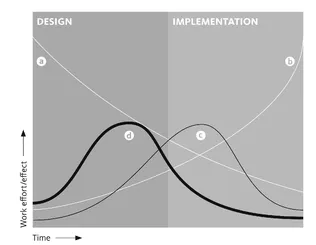
The American Institute of Architects (AIA) has solidified this shift toward performance-based design and the increased integration of disciplines early in the design process through its proposal for integrated design and delivery (see Figure 1-1). Integrated design and delivery typically refers to the collaborative, information-sharing process of project design and delivery carried out by a team of owners, designers, consultants, builders, fabricators, and users. Figure 1-1 shows how current practices place the emphasis (time, effort, and fee) on the construction phase but should instead emphasize the design phase in order for collaboration to take place. In addition to improving the project’s level of sustainability, this can also increase overall project quality and value, while reducing risk.
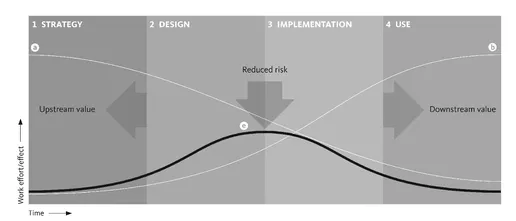
The architects and planners at Gensler have taken the idea a step further by adding two phases for consideration by the project team: a strategy phase and a use phase. This addresses the entire real estate life cycle, from business and real estate strategy through the occupancy and use of completed buildings and facilities. Strategy and use involve activities such as portfolio analysis, commissioning, and post-occupancy evaluation. By extending the focus of integrated delivery, the teams responsible for dispatching specific projects understand the need to ensure that the knowledge gained at each stage is captured for the future, not only for individual projects but also for the broader initiatives of the organization whose strategic goals and plans they serve. The strategy phase is particularly important because it allows for critical evaluations and decisions to be fully integrated with design work. As illustrated by Figure 1-2, if the project team can begin the design process in the strategy phase, then it can reduce risk even further. This provides the opportunity for even deeper sustainability efforts and a higher quality of work.
Figure 1-1AIA integrated design model. Gensler.
For more information on this subject please see www.sherwoodinstitute.org/resources.
Figure 1-2Gensler integrated design model. The Gensler integrated design model includes the use of a strategy phase and a use phase within the AIA integrated design model. This diagram shows how the ability to have the largest impact on value for the lowest cost (a) is in the strategy and design phases of a project. Once a project is under construction, the situation is reversed, and the cost of design changes (b) is much higher relative to their potential impacts. InFigure 1-1, (c) represents traditional project delivery while (d) demonstrates how integrated project delivery improves by moving the bulk of the work upstream into the design phase of the project. The Gensler integrated design model (e) shows a gentler curve that reduces risk and improves benefits by beginning in the strategy phase and continuing through occupancy. This allows critical decisions to be fully integrated with design, bridging the gap between strategy and implementation while ensuring that those strategies are put successfully to use by a site’s occupants. Gensler.
An engineer’s ability to make the biggest impact on a project comes at its beginning, when assumptions are laid out, goals are established, and limitations are imposed. Working within an integrative design process is the most effective way to meet a project’s many (often competing) objectives while helping to ensure the most sustainable project possible. Engineers are much better equipped to succeed in their areas of specialty when they have the opportunity to help shape such factors, be they increased water savings, decreased materials usage, or earthwork balancing. Without the chance to create integrated solutions, engineers are essentially left to solve technical problems created by the design.
A successful design process has a much greater chance of yielding an integrated design that creates synergies between the various elements and design disciplines. This synergy—creating a whole that is greater than the sum of its parts—is a cornerstone of sustainable design. Without a site engineer at the table from the outset to coordinate with the architect, landscape architect, and engineers from other disciplines, many of the sustainable elements that engineers help realize become more difficult to achieve.
The environmental and energy performance of our buildings and built environment is of increasing concern in the design process; it is therefore critical that engineers offer their technical expertise in the early phases. While this occasionally creates a longer, more complex design process, it reduces a project’s overall costs by providing significant improvements in design. In a successful integrative design process, the higher up-front costs of design will be offset by savings on construction, reduced maintenance, and improved operations and performance over the lifetime of the project. However, such benefits must be clearly demonstrated to the client from the outset. Throughout this book, successful engineering strategies are described in order to show how incorporating engineers early on—and throughout the design process—can make a project more successful.
THE SUSTAINABLE DESIGN TEAM: AN ENGINEER’S PERSPECTIVE
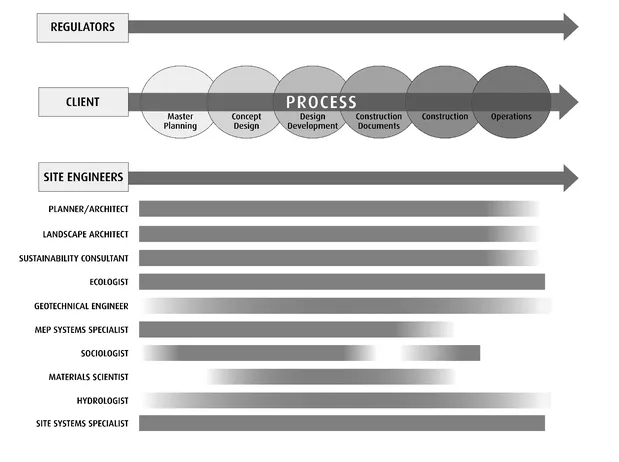
As a project advances, different professionals contribute their expertise in different ways and at different times. Effectively integrating the members of a design team is essential for a successful process. It also creates an atmosphere of familiarity that allows for more collaboration and higher levels of achievement in design each time professional teams reconvene. Figure 1-3 illustrates the consultant team’s structure on a master planning project in Brazil and how its members interacted throughout the process.
Each of these design team members interfaces in unique ways. A list of the typical team members and how each interacts with the site engineer follows:
Sustainability consultant: Often in-house at one of the design team members. Helps design clear priorities for the whole project and encourages synergies to engender success in reaching sustainability metrics. Works with engineers to reduce demand for water, energy, and source materials; integrate green space; and reduce carbon footprint.
Ecologist: Conducts baseline surveys of existing ecosystems and partners with site engineer and design team members to determine areas of constraints and opportunities for development. Helps establish development priorities that promote ecological benefits and diminish environmental impact.
PART I - THE PROCESS AND SYSTEMS OF SUSTAINABLE DESIGN
PART II - SUSTAINABLE RESOURCE SYSTEMS
PART III - DESIGN APPLICATIONS
Conclusion
Index
Trusted by 375,005 students
Access to over 1.5 million titles for a fair monthly price.
Study more efficiently using our study tools.
Frequently asked questions
Yes, you can cancel anytime from the Subscription tab in your account settings on the Perlego website. Your subscription will stay active until the end of your current billing period. Learn how to cancel your subscription
No, books cannot be downloaded as external files, such as PDFs, for use outside of Perlego. However, you can download books within the Perlego app for offline reading on mobile or tablet. Learn how to download books offline
Perlego offers two plans: Essential and Complete
Essential is ideal for learners and professionals who enjoy exploring a wide range of subjects. Access the Essential Library with 800,000+ trusted titles and best-sellers across business, personal growth, and the humanities. Includes unlimited reading time and Standard Read Aloud voice.
Complete: Perfect for advanced learners and researchers needing full, unrestricted access. Unlock 1.5M+ books across hundreds of subjects, including academic and specialized titles. The Complete Plan also includes advanced features like Premium Read Aloud and Research Assistant.
Both plans are available with monthly, semester, or annual billing cycles.
We are an online textbook subscription service, where you can get access to an entire online library for less than the price of a single book per month. With over 1.5 million books across 990+ topics, we’ve got you covered! Learn about our mission
Look out for the read-aloud symbol on your next book to see if you can listen to it. The read-aloud tool reads text aloud for you, highlighting the text as it is being read. You can pause it, speed it up and slow it down. Learn more about Read Aloud
Yes! You can use the Perlego app on both iOS and Android devices to read anytime, anywhere — even offline. Perfect for commutes or when you’re on the go. Please note we cannot support devices running on iOS 13 and Android 7 or earlier. Learn more about using the app
Yes, you can access Sustainable Infrastructure by S. Bry Sarte,S. Bry Sarte in PDF and/or ePUB format, as well as other popular books in Architecture & Urban Planning & Landscaping. We have over 1.5 million books available in our catalogue for you to explore.