- English
- ePUB (mobile friendly)
- Available on iOS & Android
eBook - ePub
About this book
Praise for The WorldatWork Handbook of Compensation, Benefits & Total Rewards
This is the definitive guide to compensation and benefits for modern HR professionals who must attract, motivate, and retain quality employees. Technical enough for specialists but broad in scope for generalists, this well-rounded resource belongs on the desk of every recruiter and HR executive. An indispensable tool for understanding and implementing the total rewards concept, the WorldatWork Handbook of Compensation, Benefits, and Total Rewards is the key to designing compensation practices that ensure organizational success.
Coverage includes:
- Why the total rewards strategy works
- Developing the components of a total rewards program
- Common ways a total rewards program can go wrong
- Designing and implementing a total rewards program
- Communicating the total rewards vision
- Developing a compensation philosophy and package
- FLSA and other laws that affect compensation
- Determining and setting competitive salary levels
- And much more
Frequently asked questions
Yes, you can cancel anytime from the Subscription tab in your account settings on the Perlego website. Your subscription will stay active until the end of your current billing period. Learn how to cancel your subscription.
No, books cannot be downloaded as external files, such as PDFs, for use outside of Perlego. However, you can download books within the Perlego app for offline reading on mobile or tablet. Learn more here.
Perlego offers two plans: Essential and Complete
- Essential is ideal for learners and professionals who enjoy exploring a wide range of subjects. Access the Essential Library with 800,000+ trusted titles and best-sellers across business, personal growth, and the humanities. Includes unlimited reading time and Standard Read Aloud voice.
- Complete: Perfect for advanced learners and researchers needing full, unrestricted access. Unlock 1.4M+ books across hundreds of subjects, including academic and specialized titles. The Complete Plan also includes advanced features like Premium Read Aloud and Research Assistant.
We are an online textbook subscription service, where you can get access to an entire online library for less than the price of a single book per month. With over 1 million books across 1000+ topics, we’ve got you covered! Learn more here.
Look out for the read-aloud symbol on your next book to see if you can listen to it. The read-aloud tool reads text aloud for you, highlighting the text as it is being read. You can pause it, speed it up and slow it down. Learn more here.
Yes! You can use the Perlego app on both iOS or Android devices to read anytime, anywhere — even offline. Perfect for commutes or when you’re on the go.
Please note we cannot support devices running on iOS 13 and Android 7 or earlier. Learn more about using the app.
Yes, you can access The WorldatWork Handbook of Compensation, Benefits and Total Rewards by in PDF and/or ePUB format, as well as other popular books in Negocios y empresa & Gestión de recursos humanos. We have over one million books available in our catalogue for you to explore.
Information
1
Total Rewards: Everything That Employees Value in the Employment Relationship
Fifty years ago, when a group of visionary professionals formed what was to become WorldatWork, the world of work and the world of pay were much simpler than they are today. Compensation was the primary “reward” and benefits, still in their infancy, were a separate and seemingly low-cost supplement for employees. The concept of combining these things—let alone using them with still other “rewards” to influence employee behavior on the job—was decades away.
Today we are only partially through an evolution from a largely industrialized business environment to a far more virtual, knowledge- and service-based environment, at least in North America and Europe. Among some major shifts:
- Business increasingly operates as a global village, with work moving to different parts of the world to take advantage of lower-cost labor and address skill gaps.
- Technology continues to revolutionize work, not only in terms of automating more jobs, but also in enabling the virtual workplace as more professionals conduct business in home offices or remote locations.
- Women are equally represented in the overall workforce, if not yet fully in the ranks of senior management.
- Traditional hierarchical distinctions have eroded in the name of faster decision making and speed to market. Teamwork is one of the most common behaviors rated in performance reviews.
- More businesses and business units in the United States are owned by European or Asian parents, which expect their practices and norms to be followed and respected in the workplace.
- Job mobility is taken for granted, with workers averaging six employers over the course of a career.
- Gender, race, and religious differences are a common part of most work environments. Diversity has become a respected value, demonstrated through a range of specific programs.
- Business leaders increasingly regard employees as drivers of productivity, rather than as relatively interchangeable cogs in a larger wheel. Along with these changes have come dramatically different views about the nature of rewards. In the shift toward a more knowledge- and service-based economy, the relationship, or deal, between employer and employee began to evolve as well. Viewing employees as performance drivers meant thinking differently about what it would take to attract, keep, and engage them in giving discretionary effort on the job. And so total rewards entered the lexicon to address these needs.
BROADENING THE DEFINITION OF TOTAL REWARDS
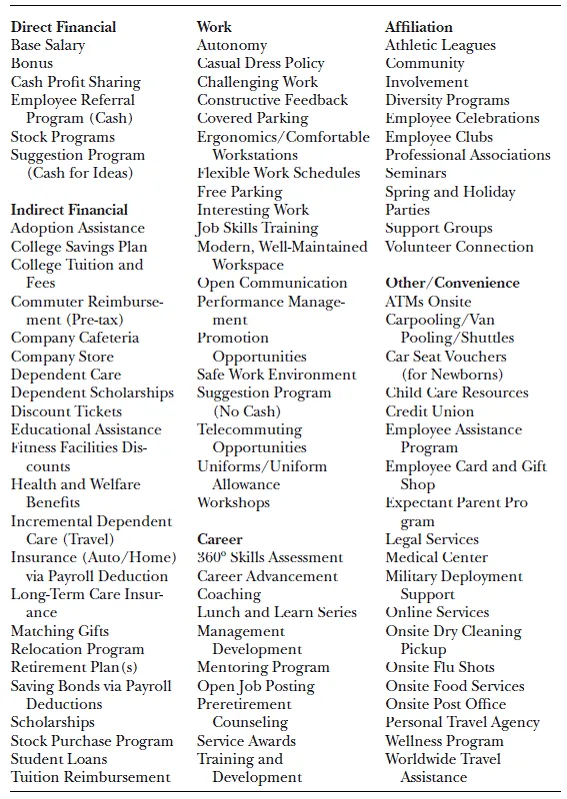
The definition of total rewards always sparks debate. For example, Figure 1.1 includes a comprehensive list of items that have shown up at one time or another in one company’s definition of total rewards. From this, it is easy to see how people can use the term in conversation only to find that they are referring to very different notions.
Generally speaking, there are two prevailing camps of definitions:
- Narrow definitions. These virtually always comprise compensation and benefits, and sometimes include other tangible elements (e.g., development). This sometimes is referred to as total compensation or total remuneration.
- Broad definitions. These can expand to encompass everything that is “reward ing” about working for a particular employer or everything employees get as a result of their employment. Sometimes terms such as value proposition or total value are used interchangeably with total rewards.
While the narrower definitions have been around for a long time, it is the broader notion that is generating buzz. (See Sidebar 1.1.) Indeed, much of the current activity in total rewards involves companies moving to a broader definition. There are several reasons for this:
- Erosion of the “core” elements of the package. The traditional elements of rewards— pay, benefits, and stock awards—are no longer differentiating factors for organizations. The competitive position for pay is trending toward median or mean. Benefits costs continue to rise. Stock programs, such as the distribution of options, do not offer the appeal they once did. Given all of this, a logical response is to broaden what companies provide for the overall employment package.
- Pressure for operational efficiency and effectivenesss. Total rewards can represent a major cost element. As companies seek to manage costs tightly, there is more emphasis on ensuring that all costs are counted and managed. By redefining rewards more broadly and focusing on those elements that achieve the biggest payoff, organizations can drive toward efficiency.
- Catering to diverse needs. Companies today are managing a much more heterogeneous population. For the diverse workforce, no single component becomes a value driver. Employees have choices to make and a need for greater flexibility. A broad definition of total rewards helps employers show how their slate of rewards responds to the broad needs of today’s global workforce.
- Need to more strongly reinforce business strategy. Companies are concerned about sending clear business messages to employees. A properly structured total rewards package sends a key message—by aligning all the components of total rewards with the overall business vision, a company ensures its workforce is on the same page.

FIGURE 1.1Total rewards: different things to different employers.
Given these factors, it is not surprising that a broader definition is gaining favor in the marketplace. Companies still need to decide how broadly they want to define total rewards, based on what they can adequately measure and manage.
Sidebar 1.1: How We Def...
Table of contents
- Cover
- Contents
- Title Page
- Copyright page
- Introduction: Redefining Employee Rewards
- About the Author
- 1 Total Rewards: Everything That Employees Value in the Employment Relationship
- 2 Why the Total Rewards Approach Works
- 3 Developing a Total Rewards Strategy
- 4 Designing a Total Rewards Program
- 5 Communicating Total Rewards
- 6 Compensation Fundamentals
- 7 Regulatory Environment: The FLSA and Other Laws That Affect Compensation Practices
- 8 Market Pricing
- 9 Salary Surveys: A Snapshot
- 10 Job Analysis, Documentation, and Evaluation
- 11 Base Pay Structures
- 12 Sales Compensation Fundamentals
- 13 Executive Compensation: An Introduction
- 14 Linking Pay to Performance
- 15 Cash Bonus Plans and Recognition Programs
- 16 Equity-Based Rewards
- 17 Employee Benefits Basics
- 18 Benefits Compliance: An Overview for the HR Professional
- 19 Worker Privacy, Unpaid Leave, and Other Benefit-Related Laws That Protect the Individual
- 20 Planning Benefits Strategically
- 21 Implementing Flexible Benefits
- 22 Work-Life Effectiveness
- 23 Caring for Dependents
- 24 Culture at Work
- Notes
- Total Rewards Glossary
- Handbook References
- WorldatWork Bibliography
- Index
- WILEY END USER LICENSE AGREEMENT