SwitchPoints is the inspiring story of how Canadian National Railway (CN) advanced from good to great in a few short years–becoming North America's top-performing railroad and a favorite with of corporate customers and investors. In it, the authors reveal how company-wide culture change propelled this aging transportation giant to become the profitable powerhouse it is today. Rich with insights and anecdotes, SwitchPoints offers lessons that can be applied to any organization seeking to improve the bottom line by improving their culture.
Before we can tell you how CN achieved its culture change, you need to know the unique history of Canadian National Railway. Understanding this remarkable enterprise’s 90-year history makes clear why we were so passionate about changing the company’s culture.
CHAPTER 1
The Road to Best-in-Class
1830: Pioneering Days
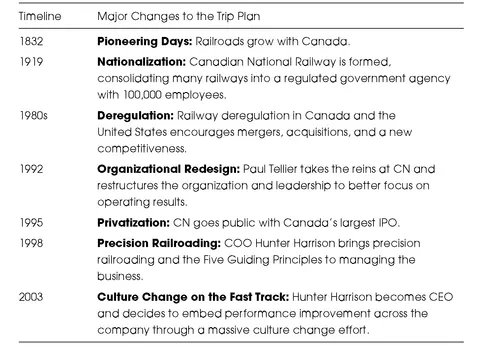
Railroads in Canada began in the 1830s with one small rail line in Quebec, then expanded in a growing spiderweb from coast to coast. Like the transcontinental railroad that tied the United States together with its first coast-to-coast transportation link in 1869, the numerous Canadian rail lines networked together to achieve the same for Canada. (See Table 1.1.)
Railroads were the tech bubble of their day. The industry was chaotic, with startups and failures, mergers, and lack of standards. There were problems with interconnecting the rail lines of different companies—some used different spacing between their rails, so trains could not move continuously from rail line to rail line, and cargo had to be transferred from one company’s train to another’s.
By World War I (1914-1918), many Canadian railroads were failing. This posed a serious threat to Canada’s economy and the nation itself, because in those days no national highway system offered backup transportation if the railroads failed. National survival demanded action.
1919: Nationalization
Starting in 1919, the Canadian government formed a holding company for this mass of floundering rail lines. Assembling the vast network of individual railroads into a coherent system took several years. The result was CN, a rail system that spanned Canada from the Atlantic to the Pacific. It served communities large and small, and became the national pride of Canada.
Table 1.1Canadian National Railway—Milestones on Our Trip Plan
Source: Developed with data from the Canadian National Railway Company website.
CN also became a major national employer, with over 100,000 on the payroll at its peak. This included not only the rail system, but subsidiary telephone companies (to support rail communications), hotels (to support tourism), the beginning of an airline (Air Canada), and even the Canadian Broadcasting Corporation (started by CN to provide radio entertainment on long rail journeys). As the decades passed, CN became Canada’s economic backbone, with the best rail infrastructure in North America. As a business, it carried a good balance of commodities: coal, fertilizer, grain, forest products, automobiles and parts, and intermodal containerized cargo.
In 1975, CN built the world’s tallest freestanding structure at the time, the famous CN Tower in Toronto. A platform for railway communications and radio and TV broadcasting, the magnificent tower also proclaimed Canada’s success in world business and industry.
The 1980s: Deregulation
Over time, the railroad had become a lot of things besides a national cargo hauler: hotelier, ferry service provider, truck line. One thing it wasn’t was profitable.
In 1980, U.S. railroads were deregulated under the Staggers Act, freeing their operations to become more competitive. In Canada, the National Transportation Act (1987) and the Canada Transportation Act (1996) gave similar freedom to Canada’s commercial railways. But CN was locked into antiquated rules and the politics of Canadian government ownership, making improvement extremely difficult.
Also during the 1980s, double-digit interest rates revolutionized how business looked at inventory. No longer could companies afford large stock reserves, so they maintained the smallest possible inventories. Just-in-time shipping stood the freight world on its head. Traditional railways weren’t built for this, so the trucking industry boomed, cutting deeply into the freight business, especially CN’s.
In 1986, CN’s long-term debt exceeded $3.4 billion, and interest charges alone surpassed $1 million a day. The railroad was burdened with hundreds of miles of business track that went to specific customers and carried extremely low volume, but the government would not abandon it. One-third of the track carried less than 1 percent of the business. CN was profitable in some years, but those profits occurred mostly when the railroad could jettison little-used track or large numbers of employees.
All this forced CN to further commoditize the business, and lower prices followed. Year after year, this downward slide of price cuts became a necessary way to keep and attract customers. As the railway struggled to lower costs, it quickly became a burden on the taxpayers. But in the commodity business, cutting prices was the main way to beat the competition.
Canada’s national dream had become a national nightmare. Taxpayers were bailing out CN decade after decade, to the tune of tens of billions of dollars. But CN’s trains ran late and deliveries were undependable. Running 500-plus trains daily was inefficient, customers were fed up, and bankruptcy rumbled at the doorstep. CN’s bloated facilities and payroll led the media to bestow an unflattering nickname, “The Pig.”
The government and CN’s management struggled to improve matters, with occasional success. Some operations were sold off and some track mileage reduced. The payroll shrank from 51,000 to 38,000. Yet in 1992, the company lost over $1 billion in eastern Canada alone.
1992: Organizational Redesign
Clearly, it was time for a big change. That change was Paul Tellier. In 1992, he took the reins as CEO of the floundering company. Tellier had been the head of the Canadian government bureaucracy under two prime ministers of different political parties. His role in running the administration of the government can best be described as a “CEO of civil servants.”
He was indeed a consummate bureaucrat—but he had no railroad experience. Labor, railroaders, and the investment community rolled their eyes. Few could picture him revolutionizing CN into a viable business, much less making CN into North America’s number one railroad.
On one count, they had a point: Tellier didn’t know the old-fashioned way of running a railroad. But his years in politics made him a master at overcoming bureaucracy, and he could assimilate huge volumes of data and make quick, incisive decisions. Critics completely underestimated Tellier’s intense, hard-driving leadership and two of his greatest skills: building a team and executing a plan.
On his very first workday as CEO, Tellier met with union leaders. “I wanted to tell them that I was taking them seriously, but that they should take me seriously, too, because I was determined to turn this place around.”1
To do this, Tellier gathered around him an exceptional group of executives. They included Michael Sabia, a genius in finance; Jim Foote, an expert in investor relations who knew how to talk to the Street; Claude Mongeau, another finance expert of great intellectual horsepower and strategic insight; and others. Together, they markedly improved relations with shareholders, government, and the unions.
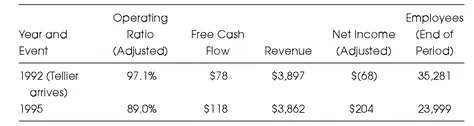
When Tellier took over in 1992, CN’s operating ratio was a horrendous 97.1. This meant that CN was spending 97.1 cents for every dollar earned. This was no way to run a company. For CN, each 1 percent of operating ratio equated to approximately $40 million.
If there were ever to be a meaningful bottom line, things would have to change drastically.
People cautioned Tellier to make changes slowly; “over five years” would be a good time frame, they said. But this was the exact opposite of what Tellier had planned. He saw in CN a too-comfortable corporation. He wanted to instill a visceral sense of urgency.
From then on there would be disciplined focus and follow-up. Projects would not sit in limbo amid endless analysis. Decisions would be made, and the right people put in place to make them. So it began.
A Quick Change
Tellier and his team quickly focused on the core business and sold off nearly 9,000 miles of track—an astonishing one-third of the rail network. They also disposed of CN’s nonrailroad assets, including a hotel in Paris and the CN Tower. And they eliminated redundant processes that wasted time and money.
In less than four months, five senior executives were gone and not replaced. The entire CN payroll was cut by about one-third, including about 11,000 jobs over three years. Tellier reorganized his executive team and reduced management layers from as many as a dozen to only five between himself and the front line. He made it clear: Bureaucracy in CN was history, everyone must pull his own weight, and no one had guaranteed employment.
The sense of urgency and focus on the bottom line translated into immediate results. Within three years, the operating ratio dropped from the high 90s to the high 80s. CN’s net income grew 3.5 times, from a loss in 1992 of $68 million to $204 million.
The results were impressive, but Tellier knew that long-term, bottom-line growth required more than just cost-cutting. He quickly turned his focus to the customer and new markets. He published a Customer Bill of Rights and a vision for the future.
The visionary Tellier correctly predicted the highly integrated role that railroads and trucking would share in freight handling that we see today. He foresaw the potential impact that the North American Free Trade Agreement (NAFTA) would have on an integrated North American economy. This NAFTA orientation was one that would shape the flow of sales, strategic acquisitions, and the destiny of Canadian National Railway for decades to come.
Table 1.2CN’s Financial Performance Impacted by Organizational Redesign (Canadian Dollars in Millions)
Source: Adapted from financial data as disclosed in Canadian National Railway Company annual reports or publicly available data.
Tellier also prepared the company for the future by driving CN’s technological advancement, including new infrastructure, remote-controlled locomotives, and computerized operations.
Viewing CN’s business results, you can easily see the impact Tellier had on the company. (See Table 1.2.)
With the significant beginnings of a healthy bottom line, a new focus on the customer, and a company stoked for performance, it was time for the next phase.
1995: Privatization
Tellier’s greatest accomplishment was the initial public offering in 1995 that privatized CN. At the time, it was the largest IPO in Canadian history. Some 83,800,000 shares went for over $2 billion on the stock exchanges in New York (CNI) and Toronto (CNR).
Overnight, the railroad went from government-owned to a pu...
Table of contents
Praise
Title Page
Copyright Page
Dedication
Foreword
Preface
Acknowledgements
Introduction
PART I - BUILDING ONE OF NORTH AMERICA’S TOP RAILROADS
PART II - CLARIFYING THE VISION
PART III - CHOOSING THE RIGHT SWITCHPOINTS
PART IV - SELECTING THE TOOLS FOR CHANGE
PART V - ALIGNING THE SWITCHES
PART VI - ASSESSING SWITCHPOINTS’ IMPACT
PART VII - SPIKING THE SWITCHES
PART VIII - LEARNING FROM OUR JOURNEY
Notes
About the Authors
About the Companies
Index
Trusted by 375,005 students
Access to over 1.5 million titles for a fair monthly price.
Study more efficiently using our study tools.
Frequently asked questions
Yes, you can cancel anytime from the Subscription tab in your account settings on the Perlego website. Your subscription will stay active until the end of your current billing period. Learn how to cancel your subscription
No, books cannot be downloaded as external files, such as PDFs, for use outside of Perlego. However, you can download books within the Perlego app for offline reading on mobile or tablet. Learn how to download books offline
We are an online textbook subscription service, where you can get access to an entire online library for less than the price of a single book per month. With over 1.5 million books across 990+ topics, we’ve got you covered! Learn about our mission
Look out for the read-aloud symbol on your next book to see if you can listen to it. The read-aloud tool reads text aloud for you, highlighting the text as it is being read. You can pause it, speed it up and slow it down. Learn more about Read Aloud
Yes! You can use the Perlego app on both iOS and Android devices to read anytime, anywhere — even offline. Perfect for commutes or when you’re on the go. Please note we cannot support devices running on iOS 13 and Android 7 or earlier. Learn more about using the app
Yes, you can access SwitchPoints by Judy Johnson,Les Dakens,Peter Edwards,Ned Morse in PDF and/or ePUB format, as well as other popular books in Business & Entrepreneurship. We have over 1.5 million books available in our catalogue for you to explore.