- English
- ePUB (mobile friendly)
- Available on iOS & Android
eBook - ePub
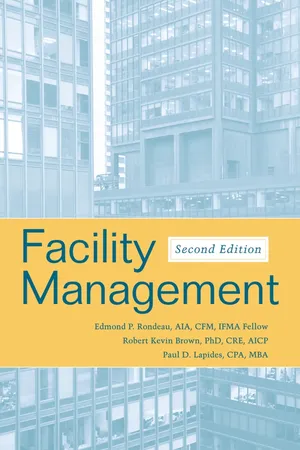
Facility Management
About this book
From the moment it was first published, Facility Management became the ultimate reference for facility and design professionals who want to create a productive workplace that corresponds to the short- and long-term goals of their corporation. This Second Edition provides complete, fully up-to-date information and guidance on the evolving facility management profession that will help facility professionals and their service providers meet and exceed these goals.
Information
Chapter One
An Overview of Facility Management
How did facility management evolve into the current profession? In this chapter, we describe facility management of the past and the changes that have brought the profession and practice to its current state. The directions we believe facility management will take in the United States and Canada are discussed in chapter 10.
Only in the past thirty years has facility management become a recognized and required process of organizations throughout the world that expend resources on people, their work environment, and the ways they work. Why has this come about? Is it new? Not really. For many years, universities, colleges, and major corporations, as well as government agencies with numerous large facilities, extensive maintenance and operating budgets, and scarce capital budgets, have been developing and using management practices and procedures that are now widely accepted by professionals.
Such organizations, with minimal financial and human resources, have had to closely manage their day-to-day requirements and the details of their expenditures. They have had to think, plan, and develop their facility programs based on long-term goals, political reality, and economic necessity.
Organizations with less restrictive economic or physical requirements traditionally spent little time on long-range or day-to-day facility issues or details. Such expenditures did not comprise a large percentage of the budget, nor was the planning, implementation, and operation of a small number of facilities complex.
Design a building, build it, put up office partition walls, doors, and so on; hookup the AT&T-provided phone; install a desk, chair, credenza, side chairs—and move in, with few complications.
What changed this process, and what impact have the changes had on the way we develop and manage work environments? Thirty-five years ago, many companies were smaller than they are today; they were often state or regionally focused; had relatively cheap energy, construction, and work space costs; and focused on short-term goals, objectives, and requirements.
In the early 1970s, inflation became a threatening issue. The oil embargo brought fuel shortages that spurred a dramatic increase in the cost of materials and the financing of all endeavors. Capital funds and materials became scarce, and the deregulation of monopolies and previously regulated services (phone, fuel, airline, etc.) required many large companies to compete more effectively and efficiently in the marketplace.
Increased competition from foreign companies filled some of the material and services void, while many U.S. companies that reacted positively with innovation and alternate solutions prospered. Inefficient manufacturing processes, nonproductive work environments, and higher worker expectations required senior management to seek alternatives, to plan for the long term, to “work smarter,” to be more productive and become more competitive.
One result of this business crisis and upheaval in U.S. companies was the evolutionary management of scarce resources—the transition to managing facilities as an asset. Facility management as a practice and profession is continuing to evolve to provide management services that meet strategic long-range and short-term corporate requirements. These business practices combine proven and innovative methods and techniques with the most current technical knowledge to achieve humane, productive, and cost-effective work environments. Strong central threads of quality of life, cost-effectiveness, flexibility, and environmental considerations run through the technical components of the practice. In most cases, facility professionals are corporate generalists or boundary spanners who recruit and manage a variety of specialists such as in-house staff, consultants, or outsourcing firms.
Facility professionals must look ahead with minimal knowledge and be able to both perform and improve routine tasks. The desire and ability to work well with people in a service capacity, to be practical, economical, available, tactful, flexible, persuasive, responsive, and timely, are additional facility management traits and requirements.
Corporate or organizational owners/tenants and their staffs have always had facility management responsibilities, handling them with varying degrees of success depending on the manager’s training, capabilities, and interest. Whether corporations or organizations own or lease their office, factories, retail space, warehouses, or specialty business locations, they have found it necessary to assign one or more employees the tasks of planning, budgeting, securing a location, designing, constructing, furnishing, occupying, managing, maintaining, redesigning, reconstructing, relocating, and disposing of corporate facilities.
Corporations with approximately 100,000 rentable square feet of office space or 100 to 200 employees often find that they need a structured way to deal with project budgets, planning, project delivery and internal coordination, authority, and responsibility for major capital projects, day-to-day customer building change requests, and building/site management issues. Thus, many corporate leaders have created or chosen one internal department, Facility Management (FM), to manage and coordinate these issues.
The facility management profession continues to change and evolve. Corporate mergers and buyouts have required facility professionals to compete for limited career opportunities and to become more proactive within their organizations. The recession of the 1990s and early 2000s taught facility professionals some hard lessons. To remain in business and excel, we must have informed and knowledgeable service partners in the facility management process who are trained, educated, and prepared to address the challenges and opportunities that await them.
The trend of outsourcing facility management and other corporate services continues as organizations seek to focus long-term personnel and resources on core business requirements. Outsourcing has changed the way management and service providers look at the in-house staff because these same support employees—with little advance notice—may become outsourced employees as service providers or contract consultants.
The pressure to reduce staff costs through downsizing, which continued into the early 2000s, has been replaced by programs to actively reduce all real estate and facility management expenses. We find that senior executives in many corporations are requiring reductions in annual operational costs in the range of 1...
Table of contents
- Cover
- Table of Contents
- Title
- Copyright
- Dedication
- Foreword
- Preface
- Acknowledgments
- About the Authors
- Chapter One: An Overview of Facility Management
- Chapter Two: Long-range and Annual Facility Planning
- Chapter Three: Facility Financial Forecasting and Management
- Chapter Four: Real Estate Considerations, Analysis, and Planning
- Chapter Five: Architectural and Engineering Planning and Design
- Chapter Six: Interior Programming and Space Planning
- Chapter Seven: Construction and Renovation Work
- Chapter Eight: Maintenance and Operations
- Chapter Nine: General Administrative Services and Technology
- Chapter Ten: Successful Facility Management
- Glossary of Facility Management Definitions and Buzzwords
- Index
- End User Licence Agreement
Trusted by 375,005 students
Access to over 1.5 million titles for a fair monthly price.
Study more efficiently using our study tools.
Frequently asked questions
Yes, you can cancel anytime from the Subscription tab in your account settings on the Perlego website. Your subscription will stay active until the end of your current billing period. Learn how to cancel your subscription
No, books cannot be downloaded as external files, such as PDFs, for use outside of Perlego. However, you can download books within the Perlego app for offline reading on mobile or tablet. Learn how to download books offline
We are an online textbook subscription service, where you can get access to an entire online library for less than the price of a single book per month. With over 1.5 million books across 990+ topics, we’ve got you covered! Learn about our mission
Look out for the read-aloud symbol on your next book to see if you can listen to it. The read-aloud tool reads text aloud for you, highlighting the text as it is being read. You can pause it, speed it up and slow it down. Learn more about Read Aloud
Yes! You can use the Perlego app on both iOS and Android devices to read anytime, anywhere — even offline. Perfect for commutes or when you’re on the go.
Please note we cannot support devices running on iOS 13 and Android 7 or earlier. Learn more about using the app
Please note we cannot support devices running on iOS 13 and Android 7 or earlier. Learn more about using the app
Yes, you can access Facility Management by Edmond P. Rondeau,Robert Kevin Brown,Paul D. Lapides in PDF and/or ePUB format, as well as other popular books in Architecture & Architecture General. We have over 1.5 million books available in our catalogue for you to explore.