Discover the deep, dark secrets of the Alpha businessman
As a woman, you know you're every bit as effective and capable as a man is in the arena of business-but that doesn't mean there aren't things you need to know about men and business. In this invaluable guide for the modern businesswoman, former Alpha Male Christopher Flett reveals everything you need to know to understand, communicate, and compete with men in business.
To some extent, business is still a man's world; here's how to play the game by their rules-and win:
*
Know what the average Alpha Male is thinking
*
Learn 10 things you need to know about men in business
*
Force men to take you seriously
*
Stop self-sabotage with male colleagues
*
Get all the credit you deserve
*
Be more confident and effective
*
Learn to take charge and lead
*
Never make excuses for failures
*
Keep secrets-it's vital
*
Never bring personal issues to the office
*
Gain credibility and trust with Alphas
*
Never look for affirmation openly
*
Effectively deal with condescending or disrespectful men
*
Understand why being "nice" gets you nowhere
eBook - ePub
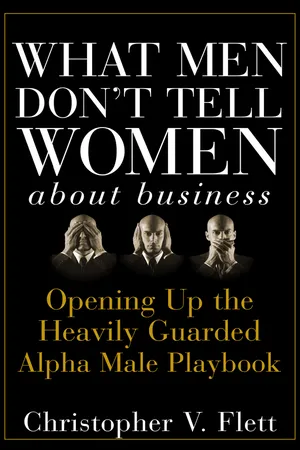
What Men Don't Tell Women About Business
Opening Up the Heavily Guarded Alpha Male Playbook
- English
- ePUB (mobile friendly)
- Available on iOS & Android
eBook - ePub
What Men Don't Tell Women About Business
Opening Up the Heavily Guarded Alpha Male Playbook
About this book
Information
PART I
The Male Point of View
1
Who Are You?
How many of the following statements apply to you?
• You enjoy making people feel special at work.
• You bring baking or other culinary creations to share with coworkers.
• You track people’s birthdays and anniversaries and touch base on those days to recognize the event.
• You like to plan company parties and events.
• You look to be seen as supportive and jump in with your sleeves rolled up to help out with company activities.
• You notice little things about what people like and track it so you can use that information later to surprise them with something.
• You prefer to sit quietly in the background and stay out of things unless called upon.
• You make suggestions on how people can get over colds.
• You believe that if someone wants something they should come to you and ask.
• You have decided that you don’t have to be in the spotlight and you’ll let the big mouths fight it out.
• You want to be seen as a necessary part of the team and someone who will focus on all the details.
• You think going out for drinks after work is a great way to build rapport.
• You look forward to company events, like Christmas parties and golf tournaments, where you can let your hair down and get to know colleagues on a more intimate level.
• You go on common vacations or mini retreats with coworkers.
• You have taken up golf so you can get deals going on the course.
• You have learned to like certain sporting events (hockey/baseball) so that you can be included in conversations.
• You have become very proficient at bluffing into conversations by nodding your head and smiling to keep the information going.
• You have found out the size of engine in your car so you can joke with the guys in the office.
• You have strong rules for how people get to interact with you and are quick to take offense if someone oversteps your boundaries.
• You believe that a good defense is a good offense.
• You enjoy having a strong personality and don’t mind bowling over people who get in your way.
• You love the fact that you are referred to as a “force to be reckoned with.”
• You will attack, if provoked, to show that you are serious about what you do.
• You believe that to be a leader you must exert your abilities to the group when it is misdirected.
• You like to manage people with an iron fist in a satin glove where you are tough on them, but considerate.
Commiserations! The more these statements fit you, the more you are undermining yourself to male colleagues in business. My guess is you’re not closing specific deals. You’re not getting invited to certain meetings. You’re not being taken seriously by male colleagues. You’re not moving ahead as quickly as you thought you would. Sound familiar?
You are sabotaging yourself. You now have your starting point for the rest of this book.
Reformation of an Alpha Male
Like most Alphas, I grew up in the shadow of my father. He was a strong, powerful ex-cop who ran construction companies most of his life. He was a man’s man and was aggressive, driven, unstoppable, and successful. He was a hard act to follow as a kid. On summer vacations, I would get up with him, have breakfast, and then work around our house and yard most of the day—painting fences, running cables, weeding, mowing lawns. I would watch my friends ride by on their bikes, loving their time off, but I was only allowed to play with them after work and before dinner. Sometimes after dinner I would go out as well. I used to moan to my dad that it wasn’t fair and that summer was for kids to have vacation. He would tell me that my friends and their parents simply lacked discipline and that he was raising me to be different. I would conspire with my friends for them to ask my dad if I could come out and play, and once in a while it would work, but basically my summers were for doing labor. I can remember being the only kid pleased about school starting again because it meant there was time to play at recess and lunch as well as after school.
My parents got divorced when I was in fifth grade and my mom and I moved away from my hometown to a larger city 90 minutes south. When my mom remarried three years later, I had my first insight into unions. My stepfather, one of the greatest men I’ve ever known, was a union guy. He had received many union contacts because his father was a union leader, and although hard working, he bought into the belief that the boss owed him something for his hard work. I was learning lessons as a young man from my Alpha Male father (who seemed to get everything) and my Beta Male stepfather (who seemed never to get enough). It was a confusing time, but I was very attracted to becoming more like my father because I liked to do things that cost money. I remember my father saying, “Fletts are good at everything it is worth being good at. The mud work can be hired out.” Another lesson he taught me when I was young that has resonated through my life is, “If you want to be a leader, just assume leadership. Don’t ask for it. People are weak and are uncomfortable when they don’t have someone to follow. Fletts provide that leadership.” You can imagine the ego that this created and continues to create.
The Grass Was Greener on the Other Side
When I was in 10th grade my mom and stepdad got me a job at the local A&W in Kamloops. It was a horrible job. I was a kitchen helper, which meant that I made sure all the condiments were filled up, the cooks had what they needed, I rotated the stock in the coolers, and so on. It was a horrible job, and the worst part was a team of demon women who worked in the kitchen. They had it in their minds that they would punish me for being a man because their husbands were assholes. They would pull pranks on me, get me to count pickles in 10 gallon pails (it only took me a week to figure out this was not necessary) and were generally nasty. My cool friends were working with their fathers in landscaping, construction, and other “manly” trades making $8-$10 an hour. I was a kitchen bitch making $3/hour and getting treated like a piece of crap.
I decided that I would step out and start my own company. I was 15 and thought that mowing lawns couldn’t be that difficult. After querying my friends to see if their dads had jobs and finding out there were none, I decided to approach my mom and dad with a business proposition. At the dinner table that night, I allowed supper to start before making my deal. If my mom and dad would “spot” me $300 for a mulching lawnmower (then you don’t have to pick up the clippings), I would pay them back for it by the end of summer. My mom looked at me with love in her eyes and said, “No!” I then looked to my stepdad, who always jumped on my side, and he said, “Chris, you should be happy you have a job.” I was shocked. Parents were supposed to support their children, and my parents were dropping the ball. That’s okay, I thought, I have an entrepreneurial father in Vancouver who will be so impressed with my idea he’ll probably send up money the same day. I called my dad and ran the idea by him, and he said, “Chris, that’s a great idea. You should do it, but I’m not going to help you. You don’t want to be the guy whose dad built his company for him. Find a way to do it on your own.” Are you kidding me? My entrepreneurial father wouldn’t even bankroll his baby’s dream. So I decided that my mom and stepdad, a little too socialist for my liking, would be targeted for a verbal attack every time we sat down for dinner until I wore them down. This took about two weeks of persistence until my mom, at breaking point, yelled across the table, “I will lend you the $3 00, but I want it back by the end of the summer and I want the lawnmower!” I think my mom thought that this would be too steep a price, but I jumped at it. What the hell was I going to do with a lawnmower after summer anyway? My stepdad and I went down to Sears to pick up the lawnmower and then I made flyers to circulate around the local trailer parks. I want you to know that Kamloops, where I grew up, is infested with trailer parks on the west side of the city. I’m talking thousands of trailers (aka: mobile homes). For $10 a week, I would mow a customer’s 10-foot square lawn, weedwhack/trim the lawn, sweep out their carport, and take out their garbage. As you can imagine, trailer parks are inhabited by old people, and they saw this chubby 15-year-old entrepreneur coming around and couldn’t resist. I should share with you that my only intention was to make more than $3/hour. At the end of my first week, I had 500 clients. I absolutely couldn’t do the work. The city had a bylaw that noise was only tolerated from about 8 AM to 8 PM. I was working so frigging hard, I could barely keep up. I was making a fortune, but had to turn to my friends who were also working shitty jobs to come and help. The company grew through the summer, and I made more in three months than most lawyers were making in a year. I hid this fact from my parents so as to avoid any lectures, but I had a real taste of what it was like to live life large.
Getting Kicked Out of School
When I went to university, I started a business program, as my mother drilled into me the importance of a business degree. My father was somewhat so-so about the degree. He knew it might help me out, but I think he saw the entrepreneurial spark in me and was worried the business degree would spoil it. The school I went to was in Kamloops, and to put it politely, it didn’t attract the very best business professors. Most I think had left some sort of post at a regional agricultural school and were teaching out of textbooks that were around when Warren Buffett was getting interested in the stock market. It was brutal. In every class, I would challenge the teacher, asking for real applications to what they were teaching me, but these challenged professors who had been hiding from the real world were rarely able to give an example different from the ones in the textbook. Let me be honest. I was a total pain in the ass. A big mouth, a disruption and bedsore to these people. My dad had said to me, “You are paying these people good money to teach you so don’t just sit there and take notes, use them as advisers. Get them to answer the questions you want answered.” I did—and sealed my fate with the university. While I was waiting to register for my third year (this was before automated registration by phone or online) the dean of student services came up and asked me for a chat. I didn’t want to go and lose my place in line, but he told me that “after our discussion that wouldn’t be an issue.” I remember having no fear about having a conversation with him. I had been a shitty student and a problem in the class. I assumed he was kicking me out of school, and I thought, “It might be for the best. I can go start another company.” Instead, he sat me down and said that three of the teachers on the business faculty refused to admit me to their classes, which were mandatory, and that my grades weren’t good enough to transfer. He suggested that to avoid breaking my mother’s heart I start either a science degree (don’t think so) or an arts degree (McDonald’s lobby duty). I told him that I would rather just leave, but he convinced me to try an arts degree. I ended up having exceptional teachers in history and philosophy who would let me study on tangents on the parts of history and philosophy I liked (the growth of American industry and the Japanese business model). As I walked by the business department and by faculty I knew, my contempt grew for those who told me that I wasn’t right for business. I remember the president of the university saying to me just before graduation, “Chris, you better go to law school so you can make something of your life.”
Building Think Tank
Out of school, I went right to work for BC Hydro, the provincial hydro energy company. The company was screwed. Everyone was power tripping on each other and backstabbing, and it didn’t seem that anything got done efficiently. Everyone was so worried about keeping their job, they basically didn’t move. They used to joke that when they were all standing around talking they were having a “safety meeting,” because if nobody moved, no one could get hurt. I stayed there for six months and, after having my marketing plans either shot down or shelved, I quit at 1:26 PM on a Friday without any notice. My boss at the time smiled and said that he’d write me a great letter of recommendation. He said that I was too entrepreneurial to work in a Crown Corporation and should look at doing something on my own. I remember waiting for Jacqui to get home to tell her. She knew that I had been miserable, but was shocked that I had given no notice. She asked where I was going to work, and I told her that I would start my own company. She was supportive, but I know she was uncomfortable. Jacqui’s family is not entrepreneurial, and starting a business in their minds is very risky. I thought to myself, “I have $6,000 in the bank, I just need a name and I’m good to go!” Sitting in my underwear the next morning watching CNN, I saw a group of young politicians who had been brought together to fix economic problems and they were referred to as a “think tank.” I thought to myself, “Great name.” At that moment, Think Tank Communications began business.
When I started, I wanted to do competitive research for cities looking to attract business to their areas. I was basically a headhunter, but rather than hunting people, I was hunting companies looking to move (or that could be convinced). I was 24 years old with a Bachelor of Arts degree and a six-month stint in a utility company. Extremely unattractive in the business market, I decided that I would have to be nimble, aggressive, and carve out my space in the market. I had back-to-back meetings for the better part of six months before the company started to grow. And once it started, it never looked back. Three months into the company, I was contacted by the other consultants in Kamloops (a bunch of washed-up government researchers) for a meeting. I remember being excited that we could explore ways of making money together. We met at the Denny’s out on the highway, and the five of them sat down with me. One said, “Here’s how it works. We all share work that comes in. We’ve been doing this a long time. You are new, don’t have an MBA and bring little to the table. Stay out of our way and we might throw you some scraps.” I stared at them, shocked. These “pikers,” or pretenders, were going to tell me how things were going to work? I don’t think so. I looked one dumb ass in the eyes and said, “Within a year many of you will be my bitches. Keep an eye open for my call.” And with that I got up and walked out with hands carefully tucked in my pockets to conceal their shaking. I decided at that moment that I was going all in on this project and that I was either going to make it big or die trying.
With this scarcity mindset in my head (me against them), I worked the province like a madman. I traveled back and forth across the province making connections, getting work, and becoming a force. Within that first year, three of the five consultants did in fact do some subcontracting for me. My ego was feeding all the time, and I thought I was unstoppable. If a competitor dared get in my path, they’d either yield or I’d destroy them. It is surreal to look back on it now, but I can remember underbidding work to make sure that competitors with heavy overhead couldn’t make payroll. I would help their employees become contractors, only to give them a small piece of work and never use them again. I even on occasion sent black roses to competitors when I’d get one of their key employees to quit or when I’d steal a contract from underneath them. I was the great white shark, top of the food chain, and I slept very well at night.
Good News, Bad News, Bad News
In 2000, I was asked to attend a conference in Calgary about economic development. I was...
Table of contents
- Title Page
- Copyright Page
- Preface
- PART I - The Male Point of View
- PART II - Female as a Saboteur
- PART III - Common Questions That Women Ask
- Epilogue
- Index
Trusted by 375,005 students
Access to over 1.5 million titles for a fair monthly price.
Study more efficiently using our study tools.
Frequently asked questions
Yes, you can cancel anytime from the Subscription tab in your account settings on the Perlego website. Your subscription will stay active until the end of your current billing period. Learn how to cancel your subscription
No, books cannot be downloaded as external files, such as PDFs, for use outside of Perlego. However, you can download books within the Perlego app for offline reading on mobile or tablet. Learn how to download books offline
Perlego offers two plans: Essential and Complete
- Essential is ideal for learners and professionals who enjoy exploring a wide range of subjects. Access the Essential Library with 800,000+ trusted titles and best-sellers across business, personal growth, and the humanities. Includes unlimited reading time and Standard Read Aloud voice.
- Complete: Perfect for advanced learners and researchers needing full, unrestricted access. Unlock 1.5M+ books across hundreds of subjects, including academic and specialized titles. The Complete Plan also includes advanced features like Premium Read Aloud and Research Assistant.
We are an online textbook subscription service, where you can get access to an entire online library for less than the price of a single book per month. With over 1.5 million books across 990+ topics, we’ve got you covered! Learn about our mission
Look out for the read-aloud symbol on your next book to see if you can listen to it. The read-aloud tool reads text aloud for you, highlighting the text as it is being read. You can pause it, speed it up and slow it down. Learn more about Read Aloud
Yes! You can use the Perlego app on both iOS and Android devices to read anytime, anywhere — even offline. Perfect for commutes or when you’re on the go.
Please note we cannot support devices running on iOS 13 and Android 7 or earlier. Learn more about using the app
Please note we cannot support devices running on iOS 13 and Android 7 or earlier. Learn more about using the app
Yes, you can access What Men Don't Tell Women About Business by Christopher V. Flett in PDF and/or ePUB format, as well as other popular books in Personal Development & Personal Success. We have over 1.5 million books available in our catalogue for you to explore.