- Discusses both methodological frameworks and quantitative methods of archaeological analysis
- Presents statistical material in a clear and straightforward manner ideal for students and professionals in the field
- Includes illustrative problem sets and practice exercises in each chapter that reinforce practical application of quantitative analysis
- English
- ePUB (mobile friendly)
- Available on iOS & Android
eBook - ePub
Quantitative Analysis in Archaeology
About this book
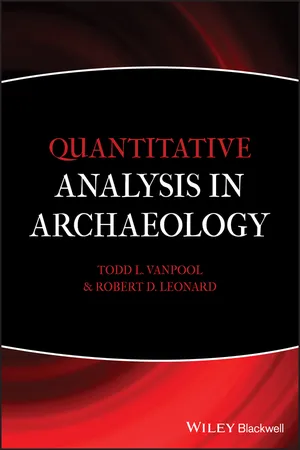
Quantitative Analysis in Archaeology introduces the application of quantitative methods in archaeology. It outlines conceptual and statistical principles, illustrates their application, and provides problem sets for practice.
Information
1
Quantifying Archaeology
If archaeologists do anything, it is count. We count stones, bones, potsherds, seeds, buildings, settlements, and even particles of earth – virtually everything that constitutes the archaeological record. We also measure essentially everything that we touch. Length, weight, thickness, depth, volume, area, color, and height are only some of the simplest measurements taken. We are exaggerating only slightly when we state that our predilection for counting and measuring ensures fame (if not fortune) to anyone who brings to our attention some forgotten or never known aspect of the archaeological record that archaeologists should be counting and/or measuring.
Most archaeologists are in the counting and measuring business not for its own sake, but to help us fashion a meaningful perspective on the past. Quantification isn’t required to back up every proposition that is made about the archaeological record, but for some propositions it is absolutely essential. For example, suppose we proposed an idea about differences in Hallstatt assemblages in Central Europe that could be evaluated by examining ceramic variation. Having observed hundreds of the pots, we could merely assert what we felt the major differences and similarities to be, and draw our conclusions about the validity of our original idea based upon our simple observations. We might be correct, but no one would take our conclusions seriously unless we actually took the relevant measurements and demonstrated that the differences and/or similarities were meaningful in a way that everyone agreed upon and understood. Quantification and statistics serve this end, providing us with a common language and set of instructions about how to make meaningful observations of the world, how to reduce our infinite database to an accurate and understandable set of characterizations, and how to evaluate differences and similarities. Importantly, statistics do this by using a framework that allows us to specify the ways in which we can be wrong, and the likelihood that we are mistaken. Statistics consequently provide archaeologists with a means to make arguments about cause that will ultimately help us construct explanations.
Statistical thinking plays an important role in archaeological analysis because archaeologists rely so heavily on samples. The archaeological record contains only the material remains of human activity that time and the vagaries of the environment (including human activity) have allowed to be preserved. The artifacts, features, and other material manifestations of human behavior that enter the archaeological record are only a small subset of those originally produced. Funding constraints, time limits, and our emphasis on conserving the archaeological record further dictate that archaeologists generally recover only a small subset of those materials that have been preserved. Thus, we have a sample of the material remains that have been preserved, which is only a sample of all of the materials that entered the archaeological record, which is only a sample of all of the materials that humans have produced.
Archaeologists are consequently forced to understand and explain the past using imperfect and limited data. Connecting our sample to a meaningful understanding of the past necessitates the application of a statistical framework, even when quantitative methods are avoided as part of a purportedly humanistic approach. It is only through statistical reasoning, no matter how implicit, that any form of general conclusion can be formed from the specifics of the archaeological record. Regardless of whether an archaeologist studies the social differentiation of Cahokia’s residents, subsistence shifts during the Mexican colonial occupation of New Mexico, or the religious systems of Upper Paleolithic cave dwellers, they are going to employ a statistical approach, even if they don’t acknowledge it. Quantitative methods allow us to make this approach explicit and make our arguments logically coherent and thereby facilitate their evaluation. Even the most ardent humanist should appreciate this.
As important as statistics are, we must remember that they are only tools, and subservient to theory. Our theoretical perspectives tell us which observations are important to make and how explanations are constructed. Statistics are useful only within this larger context, and it is important to remember their appropriate role. It is also important to recognize that the use of statistics does not equal science. The historical confluence of events that brought statistics, computers, the hypothetico-deductive method, and the theoretical advances of the New Archaeology to our discipline in a relatively brief span of time in the 1960s make it appear that they are inseparable. Nothing could be farther from the truth. While this might seem self-evident, at least one quite popular introductory archaeology textbook overstates the relationship, as a discussion of the role of science in archaeology begins with a brief discussion of statistics. Not the role of theory, not the scientific method, but statistics! Statistics do not a science make, and statistical analyses conducted in the absence of theory are merely vacuous description.
This book approaches quantification and statistics from the perspective that they are a simple set of tools that all competent archaeologists must know. Most readers will use statistics innumerable times throughout their career. Others may never calculate a mean or standard deviation willingly, but at least they will know the basics of the statistical tool kit. Choosing not to use a tool is fine. Remaining ignorant is unfortunate and unnecessary. At the very least, knowledge of statistics is needed to evaluate the work of others who do use them.
So, why should two archaeologists write a book about statistics when there are thousands of excellent statistics books in existence? Here are our reasons in no particular order. First, few of us entered archaeology because we wanted to be mathematicians. In fact, many archaeologists became interested in archaeology for very humanistic (or even romantic) reasons, and many avoided math in school like the plague. There definitely needs to be a book that is sympathetic to those coming from a non-quantitative background. We seek to achieve this goal by presenting the clearest description of techniques possible, with math no more complicated than simple algebra, but with enough detail that the reader will be able to actually understand how each technique operates.
Second, most statistics textbooks use examples that are not anthropological, and are very hard to relate to the archaeological record. While knowledge of dice examples is useful when playing craps in Las Vegas, the implications of these examples for archaeological studies are often difficult to decipher. Our examples are almost exclusively archaeological, and we hope that they provide good illustrations of how you might approach various archaeological data sets from a statistical perspective.
Third, archaeologists do not always need the standard set of statistics that are presented in popular textbooks. Some techniques of limited importance to archaeology are overemphasized in these texts, while other extremely important statistical methods are underemphasized or do not appear at all.
Fourth, it is our observation that many degree-granting programs in archaeology focus solely on computer instruction in quantitative methods rather than on the tried and true pencil and paper method. We have nothing against the use of computers and statistical software, as long as it is done by people who first learn statistical techniques by putting pencil to paper. However, our experience has shown us that when all training is focused on using a statistical package instead of learning a statistical method, the computer becomes a magic black box that produces “results” that students who don’t know what actually happened inside the box are (hopefully) trained to interpret. This lack of understanding causes confusion and, more importantly, embarrassment when insupportable or erroneous conclusions are drawn. These students need a friendly text to which they can refer to help clarify how the quantitative methods work and how their results should be understood.
Finally, many disciplines use samples, but few are as wholly reliant on them as is archaeology. This in turn means that the application of quantitative reasoning has special significance in archaeological research that needs to be explored if we are to produce the best archaeological analyses we can. This consideration is absent from statistical texts written for general audiences, but should be central to those specifically for archaeologists. It certainly will be central to the discussions that follow this chapter.
Ultimately, our goal is to illustrate the utility and structure of a quantitative framework to the reader (i.e., you), and to provide a full understanding of each statistical method so that you will understand how to calculate a statistical measure, why you would want to do so, and how the statistical method works mathematically. If you understand these issues, you will find each method to be intuitively meaningful and will appreciate the significance of its assumptions, limitations, and strengths. If you don’t understand these factors, your applications will be prone to error and misinterpretations, and, as a result, archaeology as a discipline will suffer. Hopefully, this text will serve to aid you, gentle reader, as we all work to accomplish our collective goals as a discipline.
Practice Exercises
1 Identify five attributes of artifacts or features that archaeologists routinely measure. Why do archaeologists find these attributes important? What information do they hope to gain from them?
2 Identify an archaeological problem that might interest you. What attributes of archaeological materials might be useful for your research problem? Why would you select these attributes as opposed to any others that might be possible?
2
Data
Quantitative methods and statistics are applied to data. Data are observations, not things. Data are not artifacts. They are not pots or stones or bones or any other component of the phenomenological world. We build data by making systematic observations on pots and stones and bones. What constitutes data is determined by our research questions and theoretical perspective. We create data to serve a purpose defined by a pre-existing intellectual framework. Most certainly, the real world exists in terms of various arrangements of matter and energy, but that real world is not to be confused with the observations that we make about it.
In addition to the theoretical perspective that we bring to bear and the research question we address, the tools with which we look at the world also influence what our data look like. As Gulliver’s travels taught us, the world looks very different to Lilliputians and Brobdingnags, and the view is very different when the instrument we hold to our eye switches from a telescope to a microscope. There is no “high court” of archaeologists that makes the rules about what kind of observations we are restricted to make or what tools we use to make them. Data are what we determine them to be. Certainly, there is a range of observations that many archaeologists agree are useful for addressing particular problems. Michael Shott (1994: 79–81), for example, outlines a “minimum attribute set” for flaked stone debitage that archaeologists have found to be consistently useful for answering the questions they frequently ask. His list includes the “usual suspects” of weight, cortex, platform angle and raw material, among others. Despite the utility of these attributes for addressing certain questions, we, as archaeologists, are by no means restricted to looking at the world from a single perspective or using only these attributes. Shott (1994) in fact discusses how scholars have employed these and other attributes using a variety of perspectives to answer many different questions.
Because we create our data by making observations of the world, we must ensure that we build our data in a systematic manner. Otherwise our data do not measure the same thing(s). All measurements and observations must have unambiguous definitions and they must be consistently recorded in the same way in order to eliminate measurement bias, if the resulting data are to be analytically useful (Lyman and VanPool, 2009). The first step to making systematic observations about the world is specifying what variables our data measure. A variable is any quality of the real world that can be characterized as having alternative states. The color of soil is a variable, as is projectile point length. With the former, the color spectrum is partitioned arbitrarily into segments with labels. The labels can be commonsensical (e.g., reddish brown) or we can use a standardized labeling system with more rigorous definitions for each label; archaeologists often use Munsell color charts, with standardized labels such as 10YR 4/1. With respect to projectile point length, archaeologists typically use the metric system where length is arbitrarily partitioned into usefully sized segments. How the measurement used to characterize a variable is partitioned depends on our theoretical perspective, methodology, and research problem. For example, millimeters might be the perfect sized segment with which to measure the height of a ceramic vessel, but likely are inappropriate for measuring the size of a settlement or a grain of corn pollen. Furthermore, a different analytic framework might not consider ceramic vessels, settlement size, or corn pollen worthy of measurement for addressing the same research problem.
An individual observation of a variable is called a variate. If we measure the rim angles of 10 ceramic vessels, we have manufactured 10 variates. These variates constitute data. Again, note that data are not variables. They are the totality of our observations, or variates. Also note that the word “data” is plural. A single observation is a variate and multiple variates are data. It is consequently improper to refer to data as a singular object; your data “are”.
Scales of Measurement
A factor that is central to properly constructing data is identifying at what scale we should measure data. When we create data our observations can be recorded in one of four measurement scales: nominal; ordinal; interval; and ratio. The statistical tools available for analysis differ depending upon which measurement scale is being used.
Nominal level measurement
Nominal levels of measurement exist either when we use numbers as labels (hence the term “nominal”), or when we use numbers to represent the abundance of a class of phenomena (i.e., counts). This can be confusing, but the literature refers to both uses of numbers as being nominal level measurement, so it is best to understand the distinction.
Using numbers as labels is common in the world; we only need to turn the TV channel to ESPN to see numbers as labels on volleyball players, football players, field hockey players, horses, racecars and innumerable other rapidly moving objects. These numbers constitute labels only, and anyone performing arithmetic operations on football players’ jersey numbers is wasting his or her time. The numbers simply aren’t useful except as arbitrary names. The differences among numbers don’t reflect an increase or decrease in the specific variable. Archaeologists use numbers or letters quite frequently as labels to code data. A ceramic analyst might use the label “1” to designate partially oxidized sherd cross-sections (sherds that exhibit oxidation on their edges but not in the center of the paste), “2” to designate sherds that exhibit no oxidation at all, and “3” for sherds that are fully oxidized. These labels have no mathematical significance, and to perform meaningful arithmetic operations on them is impossible. Our fictitious analyst could have used labels such as Sally and Harry almost as easily.
There is a distinction, however, between how our analyst used numbers as labels and the use of numbers to label racecars. While there is no analytic utility to considering the abundance and distribution of racecars labeled “1” through “8” across racetracks, a researcher might be interested in the abundance and distribution of eight classes of ceramic firing attributes across the landscape. This information can be used to evaluate ideas about differences in technology and site function. Additionally, if variation is present across sites or site components in terms of class abundance, most analysts will ultimately seek to explain those differences.
A number of good statistical tests exist to determine if differences in such abundances are meaningful, including the chi-square test, which is one of the first statistical tests used in archaeology (Spaulding, 1953). In archaeology, nominal level data are typically attributes of qualitative variables. These kinds of variables are called discrete variables (they are also referred to as discontinuous variables, or meristic variables) because they reflect differences that are fixed in the sense that there are only a limited number of mutually exclusive possible outcomes. The analyst then determines which of these possible outcomes is applicable for each variate (e.g., the species of animal from which a bone originated). Counting is the only appropriate arithmetic operation to be used on discrete variables, and the values assigned are always whole numbers. For example, we cannot have 5.5 pieces of Edwards Plateau Chert on a site, nor can we have 20.3 bison bones. Common discrete variables for different kinds of artifacts include:
- Bone: species, skeletal element (e.g., tibia), presence or absence of burning, type of butchering marks.
- Ceramics: temper type, extent of paste oxidation, type of decoration, type of paint, presence or absence of design elements, cultural-historical type.
- Ground stone: type of abrasion, direction of abrasion, artifact shape, number of used surfaces.
- Flaked stone: raw material type, the presence or absence of edge wear, type of edge wear, number of flake scars, presence or absence of heat treatment.
Ordinal level measurement
Ordina...
Table of contents
- Cover
- Half title page
- Title page
- Copyright page
- Dedication
- Tables
- Figures
- Equations
- Acknowledgments
- 1 Quantifying Archaeology
- 2 Data
- 3 Characterizing Data Visually
- 4 Characterizing Data Numerically: Descriptive Statistics
- 5 An Introduction to Probability
- 6 Putting Statistics to Work: The Normal Distribution
- 7 Hypothesis Testing I: An Introduction
- 8 Hypothesis Testing II: Confidence Limits, the t-Distribution, and One-Tailed Tests
- 9 Hypothesis Testing III: Power
- 10 Analysis of Variance and the F-Distribution
- 11 Linear Regression and Multivariate Analysis
- 12 Correlation
- 13 Analysis of Frequencies
- 14 An Abbreviated Introduction to Nonparametric and Multivariate Analysis
- 15 Factor Analysis and Principal Component Analysis
- 16 Sampling, Research Designs, and the Archaeological Record
- References
- Appendix A Areas under a Standardized Normal Distribution
- Appendix B Critical Values for the Student’s t-Distribution
- Appendix C Critical Values for the F-distribution
- Appendix D Critical Values for the Chi-Square Distribution
- Appendix E Critical Values for the Wilcoxon Two-Sample U-Test
- Index
Trusted by 375,005 students
Access to over 1.5 million titles for a fair monthly price.
Study more efficiently using our study tools.
Frequently asked questions
Yes, you can cancel anytime from the Subscription tab in your account settings on the Perlego website. Your subscription will stay active until the end of your current billing period. Learn how to cancel your subscription
No, books cannot be downloaded as external files, such as PDFs, for use outside of Perlego. However, you can download books within the Perlego app for offline reading on mobile or tablet. Learn how to download books offline
Perlego offers two plans: Essential and Complete
- Essential is ideal for learners and professionals who enjoy exploring a wide range of subjects. Access the Essential Library with 800,000+ trusted titles and best-sellers across business, personal growth, and the humanities. Includes unlimited reading time and Standard Read Aloud voice.
- Complete: Perfect for advanced learners and researchers needing full, unrestricted access. Unlock 1.5M+ books across hundreds of subjects, including academic and specialized titles. The Complete Plan also includes advanced features like Premium Read Aloud and Research Assistant.
We are an online textbook subscription service, where you can get access to an entire online library for less than the price of a single book per month. With over 1.5 million books across 990+ topics, we’ve got you covered! Learn about our mission
Look out for the read-aloud symbol on your next book to see if you can listen to it. The read-aloud tool reads text aloud for you, highlighting the text as it is being read. You can pause it, speed it up and slow it down. Learn more about Read Aloud
Yes! You can use the Perlego app on both iOS and Android devices to read anytime, anywhere — even offline. Perfect for commutes or when you’re on the go.
Please note we cannot support devices running on iOS 13 and Android 7 or earlier. Learn more about using the app
Please note we cannot support devices running on iOS 13 and Android 7 or earlier. Learn more about using the app
Yes, you can access Quantitative Analysis in Archaeology by Todd L. VanPool,Robert D. Leonard in PDF and/or ePUB format, as well as other popular books in Social Sciences & Archaeology. We have over 1.5 million books available in our catalogue for you to explore.