- English
- ePUB (mobile friendly)
- Available on iOS & Android
eBook - ePub
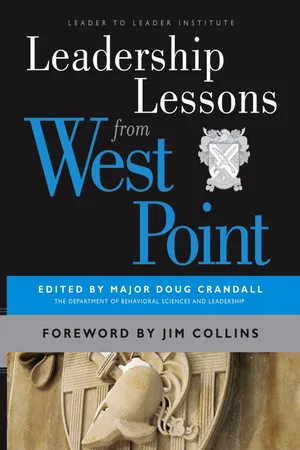
Leadership Lessons from West Point
About this book
With Leadership Lessons from West Point as a guide, leaders in the business, nonprofit, and government sectors can learn leadership techniques and practices from contributors who are teaching or have taught at the U.S. Military Academy at West Point and have served in positions of leadership that span the globe. These military experts cover a broad range of topics that are relevant to any leadership development program in any sector. The articles in this important resource offer insight into what leadership means to these experts—in both war and peacetime—and describe their views on quiet leadership, mission, values, taking care of people, organizational learning, and leading change.
Information
PART ONE
LEADERSHIP AND VALUES DEVELOPMENT
CHAPTER ONE
BECOMING A LEADER DEVELOPER
Eric G. Kail
—JOHN WOODEN, HALL OF FAME BASKETBALL COACH
I was one month away from promotion to major in 1998 when my father, a career Army officer of thirty-two years, passed away. In our final conversation, I asked him how I would know if I was a successful leader. His answer provided me a definition of success that changed the way I see myself as leader, whether leading as a soldier, husband, father, or community member. He told me not to look at my rank or, for that matter, any of the medals or badges on my uniform: these are just things created to make ourselves feel important, and they are really the results of the efforts of others. He told me not to read my efficiency reports or performance reviews: these were merely overinflated pieces of paper designed to get me promoted. He also told me not to ask my boss: the boss might tell me only what I wanted to hear or whatever it took to get me out of his office so he could get back to work.
My father told me that for a leader, the true measure of success is found in the eyes of your direct reports, the embrace of your spouse, and the hearts of your children. I believe him. The embrace of your spouse and the hearts of your children are subjects for another venue. But when was the last time you looked into the eyes of those who work for you in order to measure yourself as a leader?
When you look into the eyes of your soldiers, or employees, or direct reports, you cannot escape your real worth as a leader. Every time I have turned the leadership of my soldiers over to another officer, I gathered them around me for one last face-to-face good-bye, one last chance to thank them for their service to me, each other, and our nation. What my boss had written in my performance reviews about my leadership performance faded from my mind as I looked each soldier in the eye for the last time. Their eyes told me they would be better leaders not because of who I was but because of the time and effort I had invested in the deliberate development of them as men and women. No medal can trump that feeling.
One of the most important things you can do as a leader is to develop other leaders. Those leaders will affect hundreds, if not thousands, of other people.
Leader Development: The True Measure of a Leader’s Success
Are you successful as a leader? Before you answer, consider this scenario. I am looking for a master carpenter to produce a handcrafted wooden desk for you as a token of appreciation for all you have done for the organization. This is not just any desk, but a great desk that reflects the strength and integrity of both giver and recipient. I have selected a master carpenter based on the quality of the products of his labor. By selecting this carpenter to build your desk, I passed up other carpenters with more impressive woodworking power tools and state-of-the-art showrooms. I also ignored some carpenters who have created thousands of production-line desks in their manufacturing plants. These others are very efficient, but to them, your desk was just another dollar figure in their profit margins. The bottom line is that I judged each carpenter by evaluating the wood on which they labored, not the carpenters themselves or their tools.
That brings me back to my original question. Are you a successful leader developer? Along with managing resources and setting direction for your group or unit, you have a responsibility to develop your subordinate leaders. As leaders, we often place heavy emphasis on the bottom line and our personal accomplishments. But think ahead to your retirement dinner or ceremony: Would you prefer a slide show and handouts detailing all the deals you made, complete with statistics and charts demonstrating your prowess at leading within the organization, or do you want to share one last evening with those whose lives your leadership changed? These are the people who will carry on in your place primarily because of your investment in their lives. One of the most important things you can do as a leader is to develop other leaders. Those leaders will affect hundreds, if not thousands, of other people.
Leader Development Is a Deliberate Process
Being a leader is harder today than ever before because information processing and decision-making requirements are temporally compressing every year (in other words, you need to assess situations and make decisions faster than ever before), and risks that were once easy to recover from may in fact be fatal in today’s environment. One critical decision you must make is whether to let your subordinate leaders develop themselves in a do-it-yourself style or deliberately exert your energy and resources to develop them. And keep in mind that making no decision on this matter is the same as deciding to let your subordinate leaders develop themselves. Leader development must be done deliberately for three reasons.
One critical decision you must make is whether to let your subordinate leaders develop themselves in a do-it-yourself style or deliberately exert your energy and resources to develop them.
First, it is bad reasoning to believe that you were a total self-starter and others wanting to be leaders should be self-starters too. There are psychologically valid theories to support this, but suffice it to say that our memory tricks us into believing that we owe our successes to our own efforts, but our failures are the result of other people or factors beyond our control. If you really believe that you developed yourself into a great leader and somehow dodged the efforts of fate and others to drag you down, you are not only wrong but most likely lonely too.
Second, a good leader would never leave to chance factors that he or she could directly affect; that would be negligence. We exert tremendous energy in setting the conditions for the success of our organizations, whether on the battlefield or in the commercial market. Investing energy and resources to develop subordinate leaders—people who will execute your organization’s business at hand and eventually fill your shoes—is a great form of condition setting.
Third, if you do not get personally involved in leader development, you will miss out on the significantly rewarding experience of watching leaders grow personally and professionally. If you have experienced firsthand the satisfaction of watching a subordinate leader grow in confidence and competence, you know what I mean. But if you have not or if this reward sounds pointless, you really should change your title from “leader” to simply “gatekeeper.”
Three Phases of Leader Development
There are several ways to develop leaders, and what works for one leader may not work so well for another. My experiences as a leader developer, as a developed leader, and as a formal student of leadership research have convinced me that leader development takes time, focused energy, and even risk. (This risk, by the way, is the reason leaders get the big bucks. Reading one book or article or attending a seminar is not enough.)
Three phases of leader development require understanding: learning, leading, and reflecting. These three seasons of reflective leader development form a perpetual cycle, and as a leader matures, the phases occur concurrently as well as sequentially. As a leader developer, you have a role in each phase.
Does your organization value the learner, the teacher, and the learning process itself? By “value,” I mean respecting and providing resources for all three, not merely tolerating the process of formal leadership education as something to complete prior to starting a “real” job.
Phase One: Learning from the Best Leaders
Not all leaders are given the opportunity of a formal leadership education process prior to leading, but it most certainly helps those who get it. The average Army officer spends most of his or her first year in uniform in a formal leadership education system, and the benefits are apparent for these leaders and the soldiers they lead.
If your organization includes formal leadership training and education, take a close look at it. Does your organization value the learner, the teacher, and the learning process itself? By “value,” I mean respecting and providing resources for all three, not merely tolerating the process of formal leadership education as something to complete prior to starting a “real” job. The military, and many other organizations as well, has improved dramatically in this area since the war on terror began.
For example, the BP Group, a petroleum merger of British Petroleum, Amaco, and ARCO, has developed a model program for formally educating and developing its first-line leaders. Its leader development program was not mapped out at a one-weekend leadership summit or decided on by a single leader. Instead, the senior leadership of BP Group met repeatedly to determine why their junior leaders were not performing well, and they devised and carried out experiments to back up their perceptions. The key to its junior leader development program is the energy and focus the senior leadership of the organization placed on it. This was not just another initiative the company was undertaking; it was a priority. Today, graduates from BP Group’s first-line leader training program are running petroleum operations on every continent, and their performance ratings are significantly better than those of nongraduates.
There are specific things you can look at within your organization to assess how valued your leader education and training systems are. Who trains and educates emerging leaders? If your organization truly values the process of leadership development, some of the very best and most experienced leaders will be directly involved as instructors and trainers. Is this the case with your organization? Or is your leader development cadre made up of those who have outlived their usefulness in the organization’s operational endeavors?
Not so long ago, there was a time in the Army when being assigned as an instructor or trainer was tantamount to being put out to pasture. That sends a message to everyone in an organization that leader education is unworthy of precious personnel resources, and therefore that it belongs at or near the bottom of the list in terms of priority.
The good news is that the Army has gotten smarter about who trains and educates its leaders. The cadre of leaders in any officer basic course or captain’s career course are the Army’s best warriors and leaders, most of whom have led troops in combat within the past six months. Assigning the best and brightest as leader trainers benefits the Army significantly. Its leader development systems gain credibility, as does what is taught in the leadership curricula.
Let us say that you are a brand-new second lieutenant attending your officer basic course and your instructor has just returned from commanding a company of 120 soldiers in combat in Iraq or Afghanistan. What he or she teaches becomes more real and relevant by how that instructor teaches it. The experiences of these instructors will directly relate to what their students will experience on graduation.
For example, suppose it is a typical Monday morning at Fort Benning, Georgia, and Second Lieutenant John Doe is seated in a classroom ready to learn how to provide leadership while reacting to enemy sniper fire. In strides Captain Jim Smith, walking with a slight limp: the bullet wound in his left thigh still aches from where he was shot by an enemy sniper in Mosul, Iraq, just three months ago. His unit was two weeks away from returning home when he and several others in the company were on their last combat patrol. Smith does not have to make up a scenario; he is going to be teaching today’s class using his own unit’s reaction to an enemy sniper.
The class begins with, “There I was . . .” and ends with the honest recounting of how Smith’s actions as the company commander that day saved the lives of several of his soldiers and how his mistakes could have cost others their lives. His students ask questions like, “What did you do? and “What were you thinking?”
What the students learn now becomes personally and professionally inspirational and gripping. Captain Smith remembers when he was Lieutenant Smith just four years ago, sitting through the same class and staring at the clock waiting for the class to end; he cannot even remember which fictional vignette his instructor used that day. Today his students stay late to hear more of his story and how much he misses leading soldiers. The story continues tomorrow for the class as Smith reminds them that not every soldier was as fortunate as he was that day in Mosul. The subject for tomorrow is casualty evacuation, and Smith’s primary training aid for the class is the dirty, blood-stained scrap of paper he used to record the battle roster numbers and nature of wounds for his unit’s casualties that day.
You do not have to have a limp to be an inspirational and gripping leader developer in your organization. You just have to be willing to talk about your scars to those who will be in similar situations in the near future. Find the Captain Smiths in your organization, and show the organization that you care enough about developing leaders—and those they will lead—by valuing their development enough to give them instructors fresh from your battlefields.
Do you ever look at your subordinate leaders, especially those holding jobs that you once performed so well, and wonder why they are not as good as you were? It is unfair to expect your subordinate leaders to know what they have not yet learned or experienced.
Phase Two: Leading
Think back to what it was like to lead for the first time professionally, that is, when it was your job to do so. You may have been a leader on a high school or college sports team or a leader in a Girl or Boy Scout troop or some other civic group. All those experiences are good preparation, but leading in your chosen line of work and getting paid to do so is different from them. This first professional leadership opportunity becomes the cornerstone of your life as a formal leader. It can be many things: a realization of a calling to lead, a test of perseverance, or even a sense that leadership is not for you.
There is one universal truth, though, to every leadership opportunity: it is your chance to lead and take ultimate responsibility for whatever your group or unit does or fails to do. This is a critical fact for all leaders to embrace, but if there is one group of leaders that needs to be reminded of this, it is the leaders who lead other leaders.
Here is an example of what I mean. As a young lieutenant, I was a platoon leader. I led thirty-three men in training and in combat, and I loved every minute of it, especially the cold and rainy days when we were accomplishing difficult missions together. To be certain, I am not the best platoon leader in the history of the U.S. Army, but I was good.
Three years later, I was a captain commanding a howitzer battery roughly triple the size of my old platoon. I got a lot of advice the day I took command, but the phrase I heard more than any other was, “Remember, you’re not a platoon leader any more, so make the ones you have do their job. Don’t do it for them.”
That was great advice but hard to follow at first. In order to move from b...
Table of contents
- Praise
- Other Publications from the Leader to Leader Institute
- Title Page
- Copyright Page
- leader to leader
- A NOTE FROM THE LEADER TO LEADER INSTITUTE
- Foreword
- Acknowledgements
- ABOUT THE CONTRIBUTORS
- Introduction
- PART ONE - LEADERSHIP AND VALUES DEVELOPMENT
- PART TWO - LEADERSHIP STYLES AND SITUATIONS
- PART THREE - LEADING ORGANIZATIONS
- INDEX
Trusted by 375,005 students
Access to over 1.5 million titles for a fair monthly price.
Study more efficiently using our study tools.
Frequently asked questions
Yes, you can cancel anytime from the Subscription tab in your account settings on the Perlego website. Your subscription will stay active until the end of your current billing period. Learn how to cancel your subscription
No, books cannot be downloaded as external files, such as PDFs, for use outside of Perlego. However, you can download books within the Perlego app for offline reading on mobile or tablet. Learn how to download books offline
We are an online textbook subscription service, where you can get access to an entire online library for less than the price of a single book per month. With over 1.5 million books across 990+ topics, we’ve got you covered! Learn about our mission
Look out for the read-aloud symbol on your next book to see if you can listen to it. The read-aloud tool reads text aloud for you, highlighting the text as it is being read. You can pause it, speed it up and slow it down. Learn more about Read Aloud
Yes! You can use the Perlego app on both iOS and Android devices to read anytime, anywhere — even offline. Perfect for commutes or when you’re on the go.
Please note we cannot support devices running on iOS 13 and Android 7 or earlier. Learn more about using the app
Please note we cannot support devices running on iOS 13 and Android 7 or earlier. Learn more about using the app
Yes, you can access Leadership Lessons from West Point by Doug Crandall, Major Doug Crandall in PDF and/or ePUB format, as well as other popular books in Business & Leadership. We have over 1.5 million books available in our catalogue for you to explore.