Post-Traumatic Stress Disorder For Dummies
eBook - ePub

Post-Traumatic Stress Disorder For Dummies

  1. English
  2. ePUB (mobile friendly)
  3. Available on iOS & Android
eBook - ePub

Post-Traumatic Stress Disorder For Dummies

About this book

As Dr. Mark Goulston tells his patients who suffer from post-traumatic stress disorder (PTSD), "The fact that you're still afraid doesn't mean you're in any danger. It just takes the will and the way for your heart and soul to accept what the logical part of your mind already knows." In Post-Traumatic Stress Disorder For Dummies, Dr. Goulston helps you find the will and shows you the way.

A traumatic event can turn your world upside down, but there is a path out of PTSD. This reassuring guide presents the latest on effective treatments that help you combat fear, stop stress in its tracks, and bring joy back into your life. You'll learn how to:

  • Identify PTSD symptoms and get a diagnosis
  • Understand PTSD and the nature of trauma
  • Develop a PTSD treatment plan
  • Choose the ideal therapist for you
  • Decide whether cognitive behavior therapy is right for you
  • Weight the pros and cons of PTSD medications
  • Cope with flashbacks, nightmares, and disruptive thoughts
  • Maximize your healing
  • Manage your recovery, both during and after treatment
  • Help a partner, child or other loved one triumph over PTSD
  • Know when you're getting better
  • Get your life back on track

Whether you're a trauma survivor with PTSD or the caregiver of a PTSD sufferer, Post-Traumatic Stress Disorder For Dummies, gives you the tools you need to win the battle against this disabling condition.

Frequently asked questions

Yes, you can cancel anytime from the Subscription tab in your account settings on the Perlego website. Your subscription will stay active until the end of your current billing period. Learn how to cancel your subscription.
No, books cannot be downloaded as external files, such as PDFs, for use outside of Perlego. However, you can download books within the Perlego app for offline reading on mobile or tablet. Learn more here.
Perlego offers two plans: Essential and Complete
  • Essential is ideal for learners and professionals who enjoy exploring a wide range of subjects. Access the Essential Library with 800,000+ trusted titles and best-sellers across business, personal growth, and the humanities. Includes unlimited reading time and Standard Read Aloud voice.
  • Complete: Perfect for advanced learners and researchers needing full, unrestricted access. Unlock 1.4M+ books across hundreds of subjects, including academic and specialized titles. The Complete Plan also includes advanced features like Premium Read Aloud and Research Assistant.
Both plans are available with monthly, semester, or annual billing cycles.
We are an online textbook subscription service, where you can get access to an entire online library for less than the price of a single book per month. With over 1 million books across 1000+ topics, we’ve got you covered! Learn more here.
Look out for the read-aloud symbol on your next book to see if you can listen to it. The read-aloud tool reads text aloud for you, highlighting the text as it is being read. You can pause it, speed it up and slow it down. Learn more here.
Yes! You can use the Perlego app on both iOS or Android devices to read anytime, anywhere — even offline. Perfect for commutes or when you’re on the go.
Please note we cannot support devices running on iOS 13 and Android 7 or earlier. Learn more about using the app.
Yes, you can access Post-Traumatic Stress Disorder For Dummies by Mark Goulston in PDF and/or ePUB format, as well as other popular books in Medicine & Psychiatry & Mental Health. We have over one million books available in our catalogue for you to explore.

Information

Publisher
For Dummies
Year
2011
Print ISBN
9780470049228
eBook ISBN
9781118050903
Part I

The Basics of PTSD

In this part . . .
H aving some basic facts under your belt can be a big help if you’re tackling PTSD. In this section, I look at the history of this disorder, the number of people it affects, and the big reasons getting help for PTSD is so important. Next, I talk about what doctors mean by stress and trauma and why some people are more vulnerable than others to PTSD. After that, I go through the signs and symptoms of PTSD, talk about other disorders that often are part of the package, and discuss why PTSD in kids and teens is different from the adult version. Finally, I talk about preventive treatments for PTSD and explain their benefits and limitations — and why you may still have PTSD even if you received one of those treatments.
Chapter 1

The Invisible Epidemic of PTSD

In This Chapter

bullet
Diagnosing PTSD
bullet
Tracing the history of PTSD
bullet
Counting the number of people PTSD affects
bullet
Recognizing the most common causes of PTSD
bullet
Adding up PTSD’s cost to society
You jump out of your skin if you hear a police siren or a car backfiring. You wake up screaming after terrible nightmares. You feel cut off from your life and the people around you, and you’re angry or sad all the time. Worst of all, you experience moments of sheer terror when your mind pulls you out of the present and drags you into a horrifying time in your past.
If you suffer from symptoms like these, you probably feel very much alone — but in reality, you aren’t. Instead, you’re likely one of millions of people around the world who suffer from a disorder called post-traumatic stress disorder (PTSD).
If so, you’re facing a problem as old as humankind. The difference between the past and now, as you discover in this book, is that for today’s PTSD sufferers, effective help for this pain is available. In the chapters that follow, I talk about the many ways to treat PTSD and explain why you can be very optimistic about your future.
As you begin your journey into a better tomorrow, it’s a good idea to gain a little knowledge about the adversary you’re facing. In this chapter, I take a quick look at what PTSD is, as well as why treating this disorder is crucial. I also offer an overview of the history of PTSD as a diagnosis and explain how people’s understanding of this disorder has evolved over time. Next, I talk about the numbers of people (both adults and children) affected by PTSD, as well as the many types of traumatic experiences that can set PTSD in motion. In addition, I look at the toll PTSD takes not just on each individual sufferer but also on society as a whole.

The Diagnosis of PTSD: A Serious Matter That Requires Serious Intervention

PTSD is a major, life-altering disorder that strikes many people who survive traumatic experiences. I use the phrase invisible epidemic to describe this disorder because it affects millions of people of every age and in every walk of life, and many of them suffer alone and in silence. They feel scared, anxious, and isolated from the rest of the world — and they feel like no one can understand what they’re going through.
To a casual observer, these people often seem to be doing just fine. But in reality, they’re battling devastating symptoms that, if left untreated, make it difficult or impossible for them to hold down jobs, have meaningful relationships, or achieve their goals and dreams.
PTSD short-circuits people’s lives by causing disabling symptoms that include a hyper-alert nervous system, numbness and detachment, and intrusive thoughts or flashbacks about the trauma (see Chapter 3 for an in-depth discussion of these problems). Living with these symptoms is a huge challenge, made even bigger by the fact that other problems such as depression or substance abuse often come along for the ride (another topic I cover in Chapter 3). People with complex PTSD, which stems from multiple traumas, may develop an even wider range of severe problems, including dangerous and self-destructive behaviors (see Chapter 2).
Remember
Getting treatment if you have PTSD is crucial because this disorder doesn’t simply go away on its own. Unlike the normal, temporary stress symptoms that often occur after a life crisis, PTSD involves profound biochemical and psychological changes that cause the toxic memories of a trauma to remain strong instead of fading. (See Chapter 2 for more on the differences between normal stress responses and PTSD.) As a result, people with PTSD become trapped in their trauma, unable to process what happened and move on with their lives. In addition, untreated PTSD often leads to secondary wounding (a topic I cover in Chapter 8) because the problems caused by PTSD can lead to broken relationships, lost jobs, and other new traumas.
The good news — and it’s very good news indeed — is that PTSD is highly treatable, and the vast majority of people with this disorder gain freedom from the disabling symptoms and get control of their lives again. In Chapters 8 through 10, I describe the wide range of treatments doctors and therapists now have to help adults with this disorder, and in Chapter 13, I look at interventions that can benefit children and teens. In addition, as I explain in Chapter 12, you can combine therapy with self-help steps that boost your healing power. So take heart: If you’re in the depths of PTSD right now, the solutions are within your reach.

A Little Background on PTSD

PTSD is an age-old problem, but in a sense, it’s also a new disorder because professionals are still learning about its causes, symptoms, and treatment.
As I explain in Chapter 2, PTSD can stem from any type of traumatic experience. However, much of the current knowledge about PTSD comes from one particular source — the military — for an obvious reason: ...
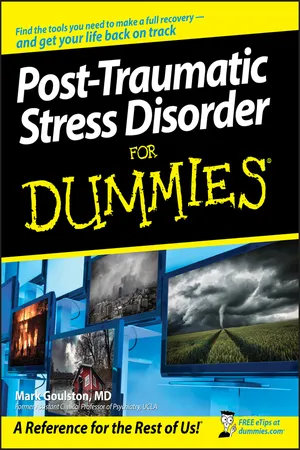
Table of contents

  1. Title
  2. Contents
  3. Introduction
  4. Part I : The Basics of PTSD
  5. Part II : Getting a Diagnosis and Drafting a Plan
  6. Part III : Choosing the Right Treatment Approach
  7. Part IV : Healing and Rebuilding during and after Treatment
  8. Part V : Stepping In: When You’re Not the One Who’s Suffering
  9. Part VI : The Part of Tens
  10. : Further Reading