![]()
Chapter 1
Electromagnetic Environment1
1.1. Electromagnetic radiation sources
In his environment, man is subjected to radiations due to various electromagnetic fields. These fields are either of natural origin, or of domestic or industrial origins. In the following, we present this electromagnetic environment by separating the optical irradiations (i.e. low wavelengths) from the radio frequency (RF) irradiations (i.e. long wavelengths).
1.1.1. Optical sources
Light can be regarded either as an electromagnetic wave or as a beam of photons (phôs or photos = light). Thus, when frequencies ν of the electromagnetic waves are increasing (and thus the wavelengths λ are decreasing), energies of the photons Ephoton are also increasing (E = h ν, h being Planck's constant).
1.1.1.1. Solar radiation
Energy from the Sun, produced by thermonuclear reaction, is emitted in space in the form of electromagnetic waves. This solar energy reaching the Earth drives almost every known physical and biological energy cycle in Earth's system.
The Sun is a giant fusion reactor, located 150 million km from Earth, radiating 2.3 billion times more energy than the energy that strikes the Earth — which itself is more energy in a hour than the entire human civilization directly uses in a year. Our Sun is the largest known energy resource in the solar system. Near the Earth at the top of the Earth's atmosphere, every square meter receives 1.366 kW of solar radiation. To reach the ground, this luminous energy must cross the Earth's atmosphere at a thickness that depends on the slope of the rays of the sun compared to the horizon. The average value of the vertical thickness of the atmosphere is equal to 7.8 km under normal conditions. In fact, various components of the solar radiation are received at the ground level:
– direct radiation coming from the Sun to be diffused or emitted back by the obstacles;
– diffuse radiation by different gases present in the atmosphere;
– the albedo which is the part of the radiation reflected by the ground (intensified by snow).
The total radiation is the sum of these three components, and the average illumination, in clear air, is equal to 1,000 W/m2 (100 mW/cm2). By taking account of the weather, season and day-night cycles the usable mean energy is reduced to less than an average of 250 W/m2.
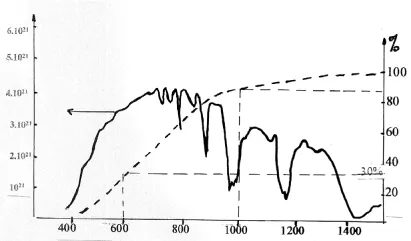
The Sun emits light primarily in the visible and infrared spectrum, but it also emits at other wavelengths. Note that the visible part of the spectrum extends from about 400 nm up to 700 nm in wavelength and that more than 90% of solar energy arriving on Earth is provided by photons of the wavelength band 400 nm to 1,400 nm with 45.6% in IR, 48.0% in the visible, and 6.4% in UV. Figure 1.1 gives the curve distribution spectrum relating to a radiation arriving on the ground with an incidence angle of 48°, which is used as reference for the photometric characterization of the solar cells. Note the absorption bands induced by atmosphere gases, in particular by CO2 and water vapor.
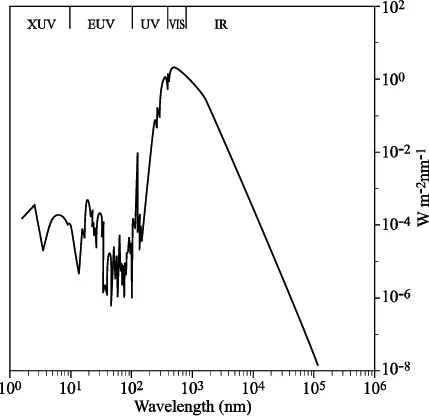
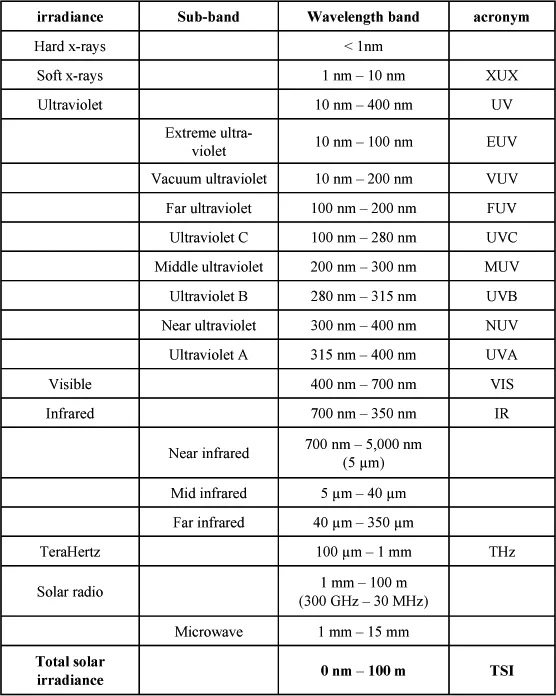
Figure 1.2 shows the complete solar spectrum from 1 nm to 1,000,000 nm. We clearly see the entire spectral extent of the solar irradiation, even if it is outside the visible spectral field, the flows of irradiation are weak (4 decades lower in the UV field than in the visible field). The solar radiation power flux, also called the solar constant, is the integrated solar spectral irradiance over all wavelengths. Its accepted value is 1,366.1 Wm−2. Total solar irrradiance is divided into various spectral categories according to uses of various communities. Table 1.1 below lists these different categories.
Beyond 300 GHz, solar irradiance is very weak. From the ground, the spectral areas between the absorption lines (especially due to oxygen and water vapor), constitute several windows which are less and less transparent as the frequency increases (see Chapter 5).
1.1.1.2. Artificial optical sources
1.1.1.2.1. Lighting
Ambient lighting is certainly the principal domestic optical source. Incandescent lamps (a tungsten filament in a bulb of glass filled with an inert gas like argon or krypton) are used. In gas-discharge lamps, according to the properties of fluorescence or luminescence radiation, the light is generated by electric discharges in rare gases or mercury vapor contained in a tube of glass. Mercury vapor lamps, fluorescent and neon tubes are the most widespread examples. The neon lamp is a tube that generates a bright red light (or, if treated with mercury, bright blue light) when the neon gas inside it is ionised by an electric current. These are commonly used in outdoor signs and as indicator lights. In the case of a xenon lamp, a brilliant artificial light is produced in a tube filled with xenon gas, by an electric arc passing between two electrodes and through the xenon gas.
Bright light-emitting diodes (LEDs) already form part of our daily life. The red diodes are already established in many visualization and display devices: for example, road traffic lights and high range rear lights for vehicles. Thanks to their very small size and low power consumption, they are also used in large video screens (100 inches), their quantities reaching several million per panel.
Use of LEDs to emit a white light is also on the way to replacing traditional lamps. This white light is obtained using a blue diode to excite a luminescent material. Energetic efficiencies of these diodes expressed in Lumens per electric Watt applied, largely exceed the incandescent lamp and are thus very close relations of of the sodium high pressure lamps (100 Lumens per Watt). Their energetic efficiency is 5 times greater than that of an incandescent lamp. These diodes, which are seen today in certain architectural lightings or for the back lighting of liquid crystal displays, are in the lead for traditional lighting, but with solutions 100 times more expensive than with traditional incandescent lamps. We expect an increasingly significant diffusion with a very significant reduction the production costs.
1.1.1.2.2. Screens
The immense development of communication and information technologies leads to a great need for the use of posting screens involving data and images. The systems used to carry out visualization (for example, television/computer screens, radarscope and medical imagery) were dominated by the cathode-ray tube (CRT). New requirements in posting (mobile apparatuses in particular: portable computers and telephones, watches, calculators…), which require light systems that are not very bulky and fed under weak tension, caused the development of new components: electroluminescent diodes, LEDs, liquid crystal displays (LCD), electroluminescent screens. Today we note new possibilities related to the evolution of certain technologies (plasma screens, electroluminescent screens containing organic materials): screen diagonals higher than 90 cm for television sets with high definition, light and ultra screens mean they are easy to move or arrange, new ergonomics related to ...