- Assessing them for rightness and integrity
- Addressing moral failures
- Following through with dialogue and direct action
- English
- ePUB (mobile friendly)
- Available on iOS & Android
eBook - ePub
About this book
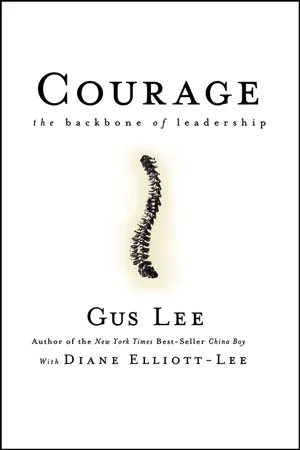
In Courage, Gus Lee captures the essential component of leadership in measurable behaviors. Using actual stories from Whirlpool, Kaiser Permanente, IntegWare, WorldCom and other organizations, Lee shows how highly successful executives face and overcome their fears to develop moral intelligence. These real-world examples offer practical lessons for rooting out unethical practices and behaviors by
Information
Part One
BACKBONE AT THE POINT OF DECISION
Here’s a truth: principled leaders solve moral problems. They have the courage to act rightly. They consistently demonstrate principled conduct under pressure.
This gives them the strong spine to be effective and envied leaders. Backbone is what everyone admires, everyone needs, everyone wants, and everyone follows.
Courage is the single most decisive trait in a leader. This is because personal and organizational crises are as routine and predictable as midtown cabs and sirens, and a manager without courage is as useful as a rowboat in a bullfight.
Leaders with courage lend backbone to their organizations. Then, when institutions face their Points of Decision—when serious crises test actual core values and therefore an institution’s future—both leaders and institutions can act rightly and powerfully.
In Part One, we’ll meet actual executives in real firms who strive to apply courage and high core values to the types of problems and challenges we all face. We’ll watch as they develop courage and backbone in themselves, their companies, and their families.
1
CHRIS’S STORY
Courage is not simply one of the virtues but the form of every virtue at the testing point.
—C. S. Lewis
IntegWare is a product life cycle management software company that serves Accenture, Agilent, Apple, General Electric, General Motors, Hewlett-Packard, Johnson & Johnson, NEC, Siemens, TRW, and many other Fortune 1000 firms.
IntegWare’s CEO is Christopher Armstrong Kay, a square-shouldered, clean-cut, tightly organized Hewlett-Packard engineering veteran who took IntegWare’s helm when it was trying to choose between breaking into pieces and diving off a cliff.
Like most executives, he didn’t think that courage would be at the center of his recovery operation. He was focused on staff, deliverables, productivity, brains, quality, speed, and revenues.
Like most execs, Chris didn’t relish crisis. A glance at his organized desk and the neat press of his clothing suggests that he prefers a well-disciplined shop to one with trash fires, cracking floors, and nervous customers. Chris was acutely conscious of high operating principles when he took the helm. This put him ahead in a tough game, but this is one of those deep advantages that is not immediately visible.
Chris had arrived long after IntegWare had sped past its first major crises and Points of Decision—those key moments when crisis tests principles. Years earlier, key IntegWare managers should have been replaced by leaders with character. Years earlier, ethical relationships should have been preserved against the pressures of expediency, denial, puffery, self-interest, and favoritism.
Weeks after he had positioned his family pictures in his new office, the historical bills for low and poorly performed core values came due. The firm was no longer beguiled by a choice of a stark either-or; it was now actively breaking up and sliding down a cliff.
In its free fall down Darwin’s ladder, IntegWare had lost its moorings. Its people wrestled for survival using prehistoric tools: backstabbing, gossip, rumors, and panic followed by the departure of some and the fears of all. This is super material for a teen horror film but unwelcome conditions for a good company.
Infighting had split the firm; debt capacity was at redline; printers spat out résumés; customers were worried; and work had become as much fun as exchanging gunfire in evening traffic. Yet it somehow continued to deliver products. IntegWare needed cash, customers, talent, strategic planning, core values, leadership, teamwork, a retreat, and new coffeemakers. But in what order?
Order is elusive when hearts and minds are lost in the fogs of economic struggle, fearful choices, and family despair.
Chris, like Aristotle, could separate the essential from the important, the necessary from the pressing. The Greeks called this ability diaphoranta. It enables great decision making.
In the winds of unit disorder and private miseries, Chris saw the essential fact about his firm: We have no operating principles around which to mount a recovery, no core values serving as the unifying behavioral standard for the firm’s next level of performance. He saw that everything other than values was secondary.
Chief Operating Officer Will Sampson, a big, steady Iowan, would help. Sampson agreed to run the shop, maintain quality, and manage internal customer relations. Most important, he would work with the staff to develop new company core values while Chris sprinted around the globe reassuring customers and meeting with employees, asking them to stay and trust him.
Chris quickly set sample core values (integrity, teamwork, innovation, customer focus, borrowed from an earlier firm) for company consideration, wrote code in emergencies, brought in meals for late-night workers, picked up trash to suggest good order, got new contracts for down-range revenues, gave up sleep for Lent, and quashed vicious company rumors for fun. Attrition stopped. His efforts were allowing a glimpse of sunlight.
It was then that a history of IntegWare delays and unresolved internal and external conflicts caught up with the company. These issues had been hounding the company and now they arrived, panting, tired, angry, and demanding. They cost cash, damaged relationships, and reduced supplementary support needed for key deliverables. Soured relationships turned bitter. Blaming became viral. Sullen silence settled like a Grand Banks fog. People began leaving again. You could feel it: the ship was sinking. Emergency funds were urgently needed, and strategy was out. The company was down to finding immediate tactical responses for the hour and the moment.
Chris met with Will Sampson, who had failed to begin the core values process or solve a single office conflict. But Sampson agreed to carry 35 percent of the debt to refloat a crucial line of credit. Chris would shoulder the rest. But Will missed the key bank appointment, apologized, and then missed the rescheduled meetings.
Standing alone in a sunny parking lot after another canceled bank meeting, Chris grimaced, as if small muscular flexions could dispel all bad feeling. To the casual observer, Chris appeared intact, but his insides were flopping on the concrete.
He thought: Look at the facts. You’re on notice that Will is a major problem. For a moment, Chris wasn’t standing in the Rockies. He was back being a second-grader in his Dallas home. His parents had quietly closed the kitchen door to say whatever sad things they said to each other when they tried, without success, to fix their problems. He and Ellen, his five-year-old sister, tried to listen through the thick door, hoping to hear good things but needing even more to deny the truth.
The truth was that their parents couldn’t resolve their differences. They were good people, but they lacked the skills. For years, they had unintentionally been installing the vast childhood fears of separation and abandonment deep into the psyches of their small children. The parents resorted, as many of us do, to trying to cover up reality for others instead of learning new skills for themselves.
Chris’s father left the home that year, never to return. Chris’s dad remained active in the Boy Scouts and camping. A few times, he took Chris fishing at big, blue Lake Texarkana. There the father and son sat silently and uncomfortably, studying their bobbers, praying for the nibble that would let them feel something together and magically recover the father’s lost commitment.
Chris shook his head. He had to confront Will Sampson and figure out why his COO was a no-do and a no-show. Why would a man say he’d do something and not do it? What do I do about this now? We’re in a punctured lifeboat fighting for our lives.
Chris returned to the office to plug holes. He realized that he couldn’t afford the possibility that Will Sampson wasn’t going to come through. IntegWare couldn’t survive the year without a bailout, and that required Will. Chris set another appointment with him. In the next weeks, he kept accepting Will’s increasingly weak excuses for not delivering the goods in core values development, results, and cash.
Chris was worried about Dornier Klein, a major Fortune 500 client whose overseas financial firms IntegWare had served for years. Chris’s predecessor had warned him about this company.
“Dornier Klein doesn’t like us. They only love Gene Stingley.”
Gene Stingley was one of IntegWare’s most brilliant thinkers and its most relationally challenged manager. He had performed intellectual wonders for Klein and had an unusually tight relationship with Klein’s CIO, CTO, and COO. Klein had included Gene in every major in-house corporate event and party in Europe, Asia, and North America.
Then Chris received a call from Klein’s CEO. Chris greeted him.
The Klein CEO bluntly told Chris that he should name Gene Stingley COO of IntegWare. “If you don’t, I’m going to hire Stingley away from you. Chris, I’d save a lot of money having him in my own shop. My guess is that naming him COO is easier than all the alternatives.”
Chris politely said he’d think about the idea and get back to the man. Quickly calling HR, Chris was told that Gene Stingley had refused to update his noncompete clause for over a decade. Thus Gene was probably free to work for Klein or for anyone else.
Chris checked the time, which was running unnaturally fast. He thought of speaking directly to Gene Stingley, remembering how difficult it was to even mention his special relationship with Klein.
A project engineer came to a scheduled appointment to explain that a major product data management proposal had been critically underbid by a sales exec.
“This isn’t the first time this has happened,” she said. It needed immediate modification before key consultants became unavailable. Chris was asking her cost questions when an essential contracting administrator, on the edge of tears, opened the door, stood awkwardly, and blurted out that he needed a month off, immediately.
“I’ll be right with you,” said Chris. “Be in your office in ten.”
Chris’s investment banker called, saying it was urgent. Chris asked the engineer to begin the modification orders and made a note to talk to the VP of sales. He picked up the phone to learn that the call truly was urgent; he now had major treasury and investment issues.
His assistant placed the two late and troubled operations summaries—needing his immediate quality and cost review—on his desk, next to his uneaten lunch and untouched breakfast burrito.
He scanned his e-mail. One of his department hea...
Table of contents
- Praise
- Gus Lee with Diane Elliott-Lee
- Title Page
- Copyright Page
- Dedication
- Introduction
- Part One - BACKBONE AT THE POINT OF DECISION
- Part Two - COURAGE IN ACTION
- Part Three - GROWING YOUR COURAGE
- Notes
- Acknowledgements
- The Authors
- Index
Trusted by 375,005 students
Access to over 1.5 million titles for a fair monthly price.
Study more efficiently using our study tools.
Frequently asked questions
Yes, you can cancel anytime from the Subscription tab in your account settings on the Perlego website. Your subscription will stay active until the end of your current billing period. Learn how to cancel your subscription
No, books cannot be downloaded as external files, such as PDFs, for use outside of Perlego. However, you can download books within the Perlego app for offline reading on mobile or tablet. Learn how to download books offline
Perlego offers two plans: Essential and Complete
- Essential is ideal for learners and professionals who enjoy exploring a wide range of subjects. Access the Essential Library with 800,000+ trusted titles and best-sellers across business, personal growth, and the humanities. Includes unlimited reading time and Standard Read Aloud voice.
- Complete: Perfect for advanced learners and researchers needing full, unrestricted access. Unlock 1.5M+ books across hundreds of subjects, including academic and specialized titles. The Complete Plan also includes advanced features like Premium Read Aloud and Research Assistant.
We are an online textbook subscription service, where you can get access to an entire online library for less than the price of a single book per month. With over 1.5 million books across 990+ topics, we’ve got you covered! Learn about our mission
Look out for the read-aloud symbol on your next book to see if you can listen to it. The read-aloud tool reads text aloud for you, highlighting the text as it is being read. You can pause it, speed it up and slow it down. Learn more about Read Aloud
Yes! You can use the Perlego app on both iOS and Android devices to read anytime, anywhere — even offline. Perfect for commutes or when you’re on the go.
Please note we cannot support devices running on iOS 13 and Android 7 or earlier. Learn more about using the app
Please note we cannot support devices running on iOS 13 and Android 7 or earlier. Learn more about using the app
Yes, you can access Courage by Gus Lee,Diane Elliott-Lee in PDF and/or ePUB format, as well as other popular books in Business & Management. We have over 1.5 million books available in our catalogue for you to explore.