eBook - ePub
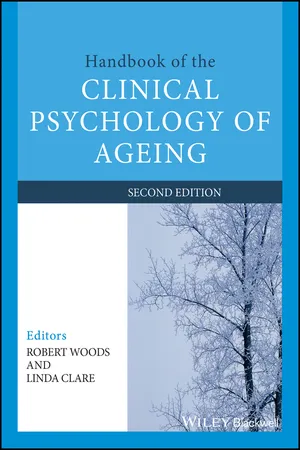
Handbook of the Clinical Psychology of Ageing
- English
- ePUB (mobile friendly)
- Available on iOS & Android
eBook - ePub
Handbook of the Clinical Psychology of Ageing
About this book
The first authoritative reference on clinical psychology and aging, the Handbook of the Clinical Psychology of Ageing was universally regarded as a landmark publication when it was first published in 1996. Fully revised and updated, the Second Edition retains the breadth of coverage of the original, providing a complete and balanced picture of all areas of clinical research and practice with older people. Contributions from the UK, North America, Scandinavia and Australia provide a broad overview of the psychology of aging, psychological problems (including depression, anxiety, psychosis, and dementia), the current social service context, and assessment and intervention techniques.
Information
1
Introduction
Bob Woods
University of Wales Bangor, Bangor, UK
This volume marks the continuing growth and development of clinical psychology with older people. Since the first edition of this handbook was published (Woods, 1996) research activity has continued to increase in relation to all aspects of ageing. Both ‘normal’ and ‘abnormal’ aspects have been extensively studied; the area of overlap between the two has become more evident, although still not well understood. Opportunities to develop clinical psychological services for older people have been apparent in the UK and elsewhere and no longer can the contribution of clinical psychology to services for older people be seen as simply one of ‘promising potential’. There is now ample evidence of psychological practice with older people in a wide range of contexts working with most of the common problems experienced by older people and their supporters. Within the broader family of clinical psychology, work with older adults has, perhaps belatedly, achieved recognition and is less likely to be seen as a rather esoteric, minority interest.
This volume stands as witness to a remarkable degree of progress in the field. Although there remain large gaps in the evidence base for interventions with older people, there are now sufficient indications of effectiveness to underpin a number of evidence-based reviews (e.g. Gatz et al., 1998; Livingston et al., 2005; Woods & Roth, 2005) and to inform evidence-based guidelines, such as the NICE-SCIE guideline on supporting people with dementia and their carers (NICE-SCIE, 2006). The latter document includes recommendations on psychological therapies for depression and anxiety in dementia, and for psychological distress experienced by family caregivers, a psychological approach to behaviour that challenges, and psychological interventions, such as cognitive stimulation, to enhance cognition in people with mild to moderate dementia. In addition, it is recommended that a neuropsychological assessment be carried out in all cases of suspected dementia.
This volume aims to provide an up-to-date review and synthesis of theory and research evidence relevant to clinical practice. Although there are a number of chapters that specifically address issues relating to dementia, the range of psychological problems experienced by older people is addressed. A brief first section covers the key aspects of the psychology of ageing, as well as providing a health psychology perspective on the physical health problems experienced by older people. This section provides the necessary underpinning for a consideration of psychological problems in later life. Detailed discussion of important aspects of the service context for clinical psychology in later life includes primary care, residential care and the situation of people with intellectual disabilities. Two sections address the key aspects of clinical practice – assessment and intervention. A wide range of intervention approaches are discussed, for the range of psychological problems, and interventions with family care-givers are addressed in Chapter 16, based on a well-developed model of understanding and assessing the care-giving situation and also in Chapter 32, based on an analysis of the extensive evidence-base.
However, for all that has been achieved, it is important to acknowledge some of the challenges that this now-mature specialism will be likely to face in its next phase of development. These challenges arise from several interacting factors. Firstly, there is the nature of the ageing population, which will define the target group for psychological services for older people. Second, there are challenges arising from the position of older people in society, and the diverse experiences of later life that results from a society that has embraced the active older person, but where disability and dependency lead to a risk of social exclusion. Third, there are developments and pressures specifically relating to the profession of clinical psychology, including training and issues of recruitment and service development. Finally, there are personal challenges that arise in working with older people, which are by no means new, but must be encountered by each new cohort of clinical psychologists entering this field.
WHO ARE OLDER PEOPLE?
Across the world, there are an unprecedented number of older people. Taking the age of 65 as an arbitrary dividing line, in 1950 there were, according to United Nations statistics (United Nations, 2006), just under 131 million older people in the world, representing 5.2% of the total population; by 2005, there were estimated to be 477 million (7.3% of the total population), and by 2025 older people are projected to form 10.5% of the global population, with 839 million older people – a six-fold increase in 75 years.
There are differences in the overall level and rate of change between regions of the world and individual countries. In general, northern European countries were at the vanguard of population ageing, with many parts of Africa showing the smallest proportions of older people. Population ageing is now very rapid in parts of Asia. Table 1.1 shows the changes in the population of people aged 65 and over in five selected countries from 1985–2025. The UK and Sweden represent the northern European countries, which have shown relatively little change over the last 20 years, already constituting over 15% of the population in 1985. The US has also shown relatively little change in this proportion, but has yet to reach the level seen in the UK and Sweden 20 years ago. Australia has had a slightly more rapid growth, but it is in Japan where the most dramatic changes have occurred, with the proportion of older people having nearly doubled in 20 years, almost reaching 20% by 2005. This trend looks set to continue in Japan, with more modest, but clear and important, growth in the population aged 65 and over in the other selected countries too. Table 1.2 indicates the changes over the similar time period in the population aged 80 and over. In the UK and the USA, the numbers of people in this age group are projected to have doubled over the period 1985–2025. Again, Japan is showing the most dramatic rate of change, with 10% of the population projected to be aged 80 and over by the year 2025.
Table 1.1 Population (thousands) and percentage of total population, aged 65 and over in selected countries
Source: Population Division of the Department of Economic and Social Affairs of the United Nations Secretariat, World Population Prospects: The 2006 Revision and World Urbanization Prospects: The 2005 Revision, http://esa.un.org/unpp.
| UK | US | Sweden | Japan | Australia | |
| 1985 | 8 578 | 28 423 | 1 491 | 12 450 | 1 588 |
| 15.2 | 11.7 | 17.9 | 10.3 | 10.1 | |
| 1995 | 9 169 | 33 399 | 1 542 | 18 264 | 2 151 |
| 15.8 | 12.4 | 17.5 | 14.6 | 11.9 | |
| 2005 | 9 684 | 36 751 | 1 557 | 25 255 | 2 662 |
| 16.1 | 12.3 | 17.2 | 19.7 | 13.1 | |
| 2015 | 11 358 | 46 355 | 1 909 | 33 120 | 3 600 |
| 18.1 | 14.1 | 20.2 | 26.2 | 16.1 | |
| 2025 | 12 986 | 63 203 | 2 155 | 35 835 | 4 788 |
| 19.9 | 17.8 | 21.9 | 29.5 | 19.6 |
Table 1.2 Population (thousands) and percentage of total population, aged 80 and over in selected countries
Source: Population Division of the Department of Economic and Social Affairs of the United Nations Secretariat, World Population Prospects: The 2006 Revision and World Urbanization Prospects: The 2005 Revision, http://esa.un.org/unpp.
| UK | US | Sweden | Japan | Australia | |
| 1985 | 1 802 | 5 916 | 332 | 2 215 | 267 |
| 3.2 | 2.4 | 4.0 | 1.8 | 1.7 | |
| 1995 | 2 272 | 7 565 | 411 | 3 881 | 466 |
| 3.9 | 2.8 | 4.7 | 3.1 | 2.6 | |
| 2005 | 2 685 | 10 625 | 482 | 6 178 | 712 |
| 4.5 | 3.5 | 5.3 | 4.8 | 3.5 | |
| 2015 | 3 049 | 11 958 | 497 | 9 849 | 944 |
| 4.9 | 3.6 | 5.3 | 7.8 | 4.2 | |
| 2025 | 3 597 | 14 642 | 638 | 12 929 | 1 254 |
| 5.5 | 4.1 | 6.5 | 10.6 | 5.1 |
Typically, at present, life expectancy at birth is greater for females than males. For example, in the UK, in 2005 it was 80.7 years for women and 76.1 years for men; in Japan, it was 85.2 for women and 78.3 for ...
Table of contents
- Cover
- Title page
- Table of Contents
- About the Editors
- Contributors
- Preface
- 1 Introduction
- PART ONE: Ageing
- PART TWO: Psychological Problems
- PART THREE: Service Context
- PART FOUR: Assessment
- PART FIVE: Intervention
- Index
- End User License Agreement
Trusted by 375,005 students
Access to over 1.5 million titles for a fair monthly price.
Study more efficiently using our study tools.
Frequently asked questions
Yes, you can cancel anytime from the Subscription tab in your account settings on the Perlego website. Your subscription will stay active until the end of your current billing period. Learn how to cancel your subscription
No, books cannot be downloaded as external files, such as PDFs, for use outside of Perlego. However, you can download books within the Perlego app for offline reading on mobile or tablet. Learn how to download books offline
Perlego offers two plans: Essential and Complete
- Essential is ideal for learners and professionals who enjoy exploring a wide range of subjects. Access the Essential Library with 800,000+ trusted titles and best-sellers across business, personal growth, and the humanities. Includes unlimited reading time and Standard Read Aloud voice.
- Complete: Perfect for advanced learners and researchers needing full, unrestricted access. Unlock 1.5M+ books across hundreds of subjects, including academic and specialized titles. The Complete Plan also includes advanced features like Premium Read Aloud and Research Assistant.
We are an online textbook subscription service, where you can get access to an entire online library for less than the price of a single book per month. With over 1.5 million books across 990+ topics, we’ve got you covered! Learn about our mission
Look out for the read-aloud symbol on your next book to see if you can listen to it. The read-aloud tool reads text aloud for you, highlighting the text as it is being read. You can pause it, speed it up and slow it down. Learn more about Read Aloud
Yes! You can use the Perlego app on both iOS and Android devices to read anytime, anywhere — even offline. Perfect for commutes or when you’re on the go.
Please note we cannot support devices running on iOS 13 and Android 7 or earlier. Learn more about using the app
Please note we cannot support devices running on iOS 13 and Android 7 or earlier. Learn more about using the app
Yes, you can access Handbook of the Clinical Psychology of Ageing by Robert T. Woods, Linda Clare, Robert T. Woods,Linda Clare in PDF and/or ePUB format, as well as other popular books in Psychology & Clinical Psychology. We have over 1.5 million books available in our catalogue for you to explore.