eBook - ePub
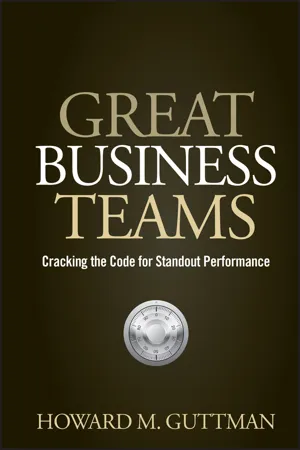
Great Business Teams
Cracking the Code for Standout Performance
- English
- ePUB (mobile friendly)
- Available on iOS & Android
eBook - ePub
About this book
Understand and decode the inner workings of great business teams with the more than 30 in-depth examples in Great Business Teams: Cracking the Code for Standout Performance. Author Howard Guttman examines and dissects teams at top-management, business-unit, and functional levels and isolates five key factors that drive team performance to offer you insight into the ways these teams achieve success. Using this book, go directly to the marketplace to scrutinize teams in a variety of industries, evaluating the challenges they face and the methods they choose to manage these challenges.
1
Cracking the High-Performance Code
The Great, the Bad, and the Consequences
Even to sharp-eyed sports commentator John Feinstein, the golfers who compete in the National Qualifying Tournament, or Q School, are indistinguishable from those who make it to the pro tour.They have picture-perfect swings, and they can drive a golf ball 300 yards.
What distinguishes the Tiger Woods and Phil Michelsons from those who never graduate from the Q School? According to Feinstein, it is the ability to perform supremely well under the pressure of a high-stakes tournament and, most tellingly, within the five feet of space separating the golf ball from the cup.
The ability to consistently excel under pressure is not just the hallmark of great golfers; it also separates great business teams from the merely good ones. Great teams rise time and again to overcome great challenges. It is a remarkable achievement—in some ways more impressive than what the pros in tournament golf accomplish, considering that it takes not just one star performer, but a team of stars, to pull it off.
At 5 AM on November 26, 2006, a thousand people stood in line in Chicago, waiting for Best Buy to open its doors—and they were the latecomers. In Philadelphia, despite wind, rain, and 40-degree temperatures, lines at the King of Prussia Mall began forming at 3 AM. In Murray, Utah, 15,000 shoppers poured into the Fashion Place Mall just after midnight. According to newspaper accounts, entire shelves of merchandise were cleared in minutes, and retail stores were as packed as nightclubs.
It is called “Black Friday” for a reason. Each year, retailers count on this day to move their balance sheets from red to black. On Black Friday 2006, over $622 million was spent every minute. Every second that a retail cash register stayed silent on that day was a major loss. At Chico’s, a women’s clothing chain with more than 500 stores, traffic was slow. The company had planned a nationwide marketing event for Black Friday, with easels in front of each store advertising “40% off already marked-down merchandise.” But the customers just were not buying. Store managers were calling the company’s Florida headquarters looking for direction—and fast.
On Black Friday speed and the ability to turn on a dime are next to godliness.
At 11 AM, the company’s head of marketing picked up the phone and called his store leadership team, asking, “Is our current marketing approach working? Is that easel out front getting shoppers into our stores instead of Talbot’s or Ann Taylor?” “No,” he was told by the team leader, “most of the store managers report that it’s not working.” After a quick huddle to appraise the situation, Marketing swung into action, calling the stores with a new strategy: bring in the easels and the markdowns, and replace them with front-of-the store tables displaying accessories. New signs would read, “Buy one accessory, get the second one 50% off.” “Great!” came the response, and the 500 outlets and their teams moved swiftly to execution.
“We changed our nationwide marketing approach before noon,” says Chico’s CEO, Scott Edmonds.“That change delivered strong same-store sales. It saved Black Friday for Chico’s, and it happened in the snap of a finger.”
In a second organization, Novartis Oncology, a number of key teams were about to take on a major challenge that would test their ability to win under pressure.
In 2003, executives at Novartis Oncology awoke to a potentially disastrous development. The company’s marquee product, Glivec—until then the only drug available to treat a very rare and deadly form of leukemia—was being threatened by the introduction of a new product from a rival pharmaceutical company. The new product was projected by analysts to grab 20 to 30% of the market once it gained approval.
With Glivec representing nearly half of Novartis Oncology’s revenue, implications were grim.The outlook was not much better for the company’s critically ill customers, who might be switched to the new drug prematurely, before doctors knew its long-term survival rates and side effects. Nothing less than the lives of its customers and Novartis Oncology’s number-one revenue driver were at stake.
CEO David Epstein swiftly called on his division vice presidents to put together action teams capable of “gaming” business scenarios. Each team represented a different aspect of the market: Glivec team; competitor team; and a team representing Tasigna, a potential second-generation leukemia drug that was in Novartis’s R&D pipeline.
They ran no-holds-barred simulations that played out how the competition might position itself, how Novartis might respond, and what the market might look like in five years. No option or potential outcome was left unexplored. “The teams had the chance to beat each other up under different scenarios,” Epstein says. “Then they developed strategies to help them win in those scenarios.”
And they did win.
As a result of the games, the teams realized that Tasigna would have to be brought to market much more quickly than scheduled and that personnel shifts were needed.Tasigna development was accelerated, becoming one of the fastest developments of a pharmaceutical product—from discovery to filing—in history.
Since Glivec was effective in about 90% of patients, and trying to displace Glivec could create an opening for the new competition, Novartis Oncology needed a unique strategy. It boldly positioned the newer drug as a “more selective” second-line therapy to be prescribed for patients whose illness has progressed. It further identified that the competitor’s product might make a good third-line therapy, due to its multiple mechanisms of action.
This team-built strategy allowed Novartis Oncology to integrate two of its products while sidelining the competition. When the competitor’s drug came on line it took a meager 6% of the market in its first 18 months, leaving Novartis Oncology’s bottom line—and its patients—healthy.
In yet another case, a team in Latin America was forced to reinvent itself—or suffer the consequences.
When Brian Camastral took over Mars Inc.’s Latin American division in 2005, the 3,000-associate operation had been consistently underperforming. Many millions of dollars had been invested in the region, with no return.
The division’s yearly financials were a constant surprise. Smaller units would consistently report healthy numbers 10 months in a row, then—with 60 days left on the calendar—reveal $10 to 20 million shortfalls.
Leadership was practically nonexistent. In two years, the division had gone through four presidents. Camastral was the fifth.The entire executive level of the organization was rife with churn, as star associates fled faster than they could be promoted. Not surprisingly, any notion of team cohesion had long since evaporated.
As a result, Mars Inc. Latin America was starving in a land of plenty. The organization’s growth was stagnant amidst a population of over 560 million potential customers. Brian Camastral knew the stakes and took charge. It was time to win.
Camastral’s top agenda: make his organization flat, fast, and team driven. To do so, Camastral divided the organization’s three lumbering operational segments—South America, Mexico, and the Caribbean—into a sleeker, more manageable geography. Brazil, for instance, became an independent unit, as did the Southern Cone, comprised of Argentina, Chile, Uruguay, and Paraguay. Out of the original three units, Camastral and his team created seven focused and nimble teams.
Accountability became the go word. Camastral engaged team members one on one, making them keenly aware of where responsibilities began, ended, and overlapped.
Results were measurable and incentives were rich. It was not long before each unit wanted to be a winning team and a division wide esprit de corps prevailed.
Turnover became a nonissue, and more than 70% of management-level openings have been filled from within the company.
In just 12 months, the division began experiencing double-digit growth. The annual budget surprises became nothing but a memory as the agile teams met all earnings targets and blew away bottom-line expectations.
“We have created so many business opportunities in the last two years that we don’t have the capacity to take advantage of them all,” says Camastral. It is the kind of dilemma that every organization longs to face, and one that Camastral and his team will be dealing with for some time to come.
Meanwhile, at Applied Biosystems, a life sciences company, senior executives struggled to regain the health and vitality of their organization.
When Catherine Burzik became president of Applied Biosystems (AB), she knew she faced stiff challenges. The company she was about to lead had been stagnant for several years, with little revenue growth and falling stock prices. Worse yet, it seemed that the company’s R&D glory days were behind it. Despite significant R&D expense, there were few new products in the pipeline. Those that had been brought to market were not making the expected ROI. Both Wall Street and AB employees had lost confidence in the company.
What the company lacked in commercial performance, it made up for in a noble mission. AB aimed at nothing short of improving the human condition. And it backed up its mission with impressive past scientific accomplishment. AB created every instrument used in the sequencing of the human genome. AB’s systems enable researchers around the globe to uncover the basic laws of nature and to further their understanding of human disease. AB’s forensic DNA kits enable police to catch criminals and exonerate the innocent.
But in 2004, when Burzik assumed the top position, she saw that AB—which had enabled unparalleled scientific research for nearly 25 years—was about to flat line. Past glory would not be enough to secure the company’s future.
Burzik’s mission: work with her executive team of 15 vice presidents to craft and execute a strategy to get the company moving again. She quickly moved to push decision making down from her office to the team—a significant shift, given the command-and-control style of leadership in the company. A Division Presidents’ Council, made up of the presidents of AB’s four global business divisions, became the forum in which to raise and resolve tactical issues common to all. An Executive Strategy Team was created to identify and evaluate possible mergers and acquisitions. A third subteam, run by the vice president of finance, was charged with keeping a close watch on the numbers. A fourth focused strictly on R&D.
Speedy decision making and implementation began to replace bottlenecks and impasses. The new decentralized team structure, the minimalist approach to decision making—fewer decision makers per issue and more decision making per capita—and greater individual accountability freed up Burzik to pursue the next round of competitive advantage.
As a result of these changes, business accelerated. AB’s stock price nearly doubled, as did its market cap. Revenue began to grow and the bottom line has seen double-digit performance. After several years of no acquisitions, two significant ones were successfully completed.
“Now AB’s teams confront and deconstruct business challenges with confidence,” says Burzik.“They know they have the tools to win.”
Contrast the responses of these four great teams with those at a number of high-profile private and public organizations that have made the news in recent years. For example:
• K-Mart’s inability to fend off competition from Wal-Mart. Ignoring the handwriting on the wall for over a decade, Big K was always a step or two behind. Now, the once-number-one discount retailer in the world ranks a distant third, behind both Wal-Mart and Target.
• Merck’s attempts to squelch reports of safety concerns about Vioxx, which were revealed by the Wall Street Journal. Amid a storm of criticism and ill-will, the company was forced to withdraw the drug, got hit with dozens of lawsuits, and saw its stock price plunge 27%.
• Mitsubishi executives’ cover-up of defects in 580,000 vehicles. The revelation of the attempt to avoid recalls knocked $200 million off the price DaimlerChrysler paid for a stake in the Japanese automaker, destroyed consumer confidence in the brand, and cost hundreds of thousands of yen in government fines.
• FEMA’s botched response to Hurricane Katrina: lucrative, no-bid contracts handed out to politically connected firms; families housed in high-priced hotels while rows of government trailers sat empty; $1 billion squandered on fraudulent assistance. And, several years later, a large portion of the U.S. Gulf Coast still uninhabitable.
• The failed DaimlerChrysler merger. German management refused to fully integrate the two companies for fear of tarnishing the Mercedes brand, and CEO Jurgen Schrempp admitted publicly that he had never intended the deal to be a “merger of equals.”1 Employees and investors who felt betrayed left the company and dumped their stock, and the ailing and emasculated Chrysler Corporation ended up on the auction block.
• Airbus’s delivery of only one new behemoth plane, the A380, in 2007, down from the 25 originally promised. Once expected to revolutionize air travel and leave top rival Boeing in the dust, the aircraft was two years behind schedule and $2 billion over budget. And, while Airbus still has only half the A380 orders it needs to break even, Boeing is churning out its new, souped-up 747—which has almost the same capacity as the A380.
There are no Q Schools in the world of hypercompetitive global business. Losing teams, especially those at the top of an organization, do not often get to play another round.
What Makes the Standouts Stand Apart?
Whether a CEO and top-management team charged with setting strategy; a plant manager and shop-floor personnel committed to getting a defect-free product out the door; or a cross-functional, global project team dedicated to a worldwide product launch, teams are today’s locus of power, responsibility, and action.
Great teams make great organizations. Period. Good and mediocre teams make good and mediocre organizations. They meet deadlines; they stay within budget; they maintain the status quo. But they do not push the envelope. They do not typically reach for performance breakthroughs. It is unlikely they will set the world on fire. And, over the long haul, they will take you out of the game.
Inept teams, especially at senior levels, can do irreparable damage to a company’s brand, product line, customer relationships, and share value. Even those organizations with deep pockets in these areas can teeter and crash. Just ask former employees of Arthur Andersen, PanAm, Texas Instruments, Westinghouse, Zenith, and many of the other companies that have fallen off the radar screen.
For over 25 years, we have been helping clients create great business teams and great business organizations. Great business teams are not necessarily top management teams.They can be found in the boardroom or on the plant floor. But, when a top executive team is great, it has the authority and positional charisma to set in motion a chain reaction that can transform the performance of teams throughout the organization.
What makes great business teams stand apart? And how can they be replicated throughout an organization? We have thought long and hard about these questions. We searched for the answers not in theory but in practice—in the experiences of our clien...
Table of contents
- Title Page
- Copyright Page
- Epigraph
- Dedication
- Preface
- Acknowledgements
- Chapter 1 - Cracking the High-Performance Code
- Chapter 2 - The New High-Performance Leader
- Chapter 3 - The New High-Performance Player
- Chapter 4 - Aligning for High Performance
- Chapter 5 - Accelerating to High Performance
- Chapter 6 - How Great Teams Make Decisions
- Chapter 7 - How Great Teams Manage Meetings
- Chapter 8 - How Great Teams Communicate
- Chapter 9 - From Great Teams to a Great Organization
- Chapter 10 - Great Leaders and Teams: Challenges, Responses, and Remaining Issues
- Appendix A - Player-Centered Leadership
- Appendix B - The Skills of a Great Team Member
- Index
Trusted by 375,005 students
Access to over 1.5 million titles for a fair monthly price.
Study more efficiently using our study tools.
Frequently asked questions
Yes, you can cancel anytime from the Subscription tab in your account settings on the Perlego website. Your subscription will stay active until the end of your current billing period. Learn how to cancel your subscription
No, books cannot be downloaded as external files, such as PDFs, for use outside of Perlego. However, you can download books within the Perlego app for offline reading on mobile or tablet. Learn how to download books offline
We are an online textbook subscription service, where you can get access to an entire online library for less than the price of a single book per month. With over 1.5 million books across 990+ topics, we’ve got you covered! Learn about our mission
Look out for the read-aloud symbol on your next book to see if you can listen to it. The read-aloud tool reads text aloud for you, highlighting the text as it is being read. You can pause it, speed it up and slow it down. Learn more about Read Aloud
Yes! You can use the Perlego app on both iOS and Android devices to read anytime, anywhere — even offline. Perfect for commutes or when you’re on the go.
Please note we cannot support devices running on iOS 13 and Android 7 or earlier. Learn more about using the app
Please note we cannot support devices running on iOS 13 and Android 7 or earlier. Learn more about using the app
Yes, you can access Great Business Teams by Howard M. Guttman,Howard M. Guttman in PDF and/or ePUB format, as well as other popular books in Business & Management. We have over 1.5 million books available in our catalogue for you to explore.