Geological Society of London Handbook Series Edited by KeithCox
Founded in 1807, the Geological Society of London has beenpublishing since 1845 and now distributes its journal to Fellowsthroughout the world. This Handbook is published as part ofa series of authoritative practical guides to field geology.
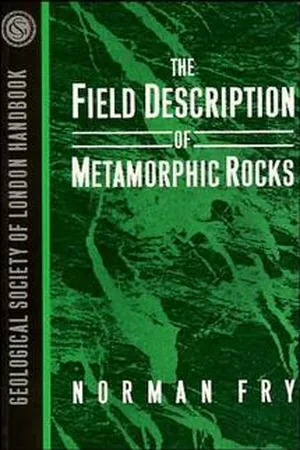
The Field Description of Metamorphic Rocks
"This handbook describes how metamorphic rocks and rock masses maybe observed, recorded and mapped in the field. Written at a levelsuitable for undergraduate students of geology, this book (as withits companion volumes in the series) has firmly established itselfas an essential tool for any geologist -- student, professional oramateur -- faced with the task of making a general description ofan area of metamorphic rocks. A clear, systematic frameworktogether with numerous diagrams, illustrations and checklistsenables readers to produce useful and broadly similar descriptions,despite possible differences of background or specialist interest.This well-written and well-produced little text will, I am certain,become standard reading for most geology undergraduates. It willalso interest many geologists who do not regularly work inmetamorphic terrains and will be particularly useful to engineeringgeologists and civil engineers who are often concerned withdescribing the fabrics of metamorphic rocks without being concernedabout their origins."
--M.E. Jones, Mineralogical Magazine
Contents:
* Metamorphic Fieldwork and Mapping
* Names and Categories of Metamorphic Rocks and Rock Units
* Rock Banding
* Minerals
* Compositions
* Grade
* Textures
* Fabric Types
* Relations to Structures
* Undeformed Pods
* Augen
* Pseudomorphs
* Veins
* Igneous Contacts
* Metasomatism
* Reaction Zones
* Fault-Zones and Mylonites
* Reference Tables and Checklists
- English
- ePUB (mobile friendly)
- Available on iOS & Android
eBook - ePub
The Field Description of Metamorphic Rocks
About this book
Information
Table of contents
- Cover
- Contents
- Title Page
- Copyright
- Acknowledgements
- 1 Introduction
- 2 Background
- 3 Mapping metamorphic rocks
- 4 Banding
- 5 Minerals, rock-types, compositions and grades
- 6 Textures, fabrics, cleavage and schistosity
- 7 Scattered entities: pods, boudins, augen, pseudomorphs, veins and pegmatites
- 8 Contacts and reaction zones
- 9 Faults, mylonites and cataclasites
- 10 Reference tables and checklists
Trusted by 375,005 students
Access to over 1.5 million titles for a fair monthly price.
Study more efficiently using our study tools.
Frequently asked questions
Yes, you can cancel anytime from the Subscription tab in your account settings on the Perlego website. Your subscription will stay active until the end of your current billing period. Learn how to cancel your subscription
No, books cannot be downloaded as external files, such as PDFs, for use outside of Perlego. However, you can download books within the Perlego app for offline reading on mobile or tablet. Learn how to download books offline
We are an online textbook subscription service, where you can get access to an entire online library for less than the price of a single book per month. With over 1.5 million books across 990+ topics, we’ve got you covered! Learn about our mission
Look out for the read-aloud symbol on your next book to see if you can listen to it. The read-aloud tool reads text aloud for you, highlighting the text as it is being read. You can pause it, speed it up and slow it down. Learn more about Read Aloud
Yes! You can use the Perlego app on both iOS and Android devices to read anytime, anywhere — even offline. Perfect for commutes or when you’re on the go.
Please note we cannot support devices running on iOS 13 and Android 7 or earlier. Learn more about using the app
Please note we cannot support devices running on iOS 13 and Android 7 or earlier. Learn more about using the app
Yes, you can access The Field Description of Metamorphic Rocks by Norman Fry in PDF and/or ePUB format, as well as other popular books in Physical Sciences & Geology & Earth Sciences. We have over 1.5 million books available in our catalogue for you to explore.