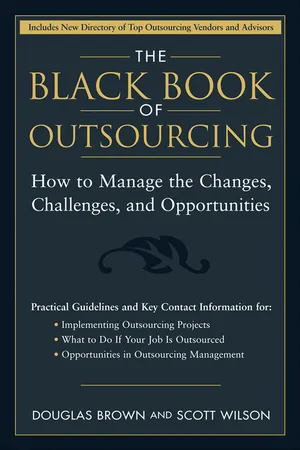
eBook - ePub
The Black Book of Outsourcing
How to Manage the Changes, Challenges, and Opportunities
- English
- ePUB (mobile friendly)
- Available on iOS & Android
eBook - ePub
The Black Book of Outsourcing
How to Manage the Changes, Challenges, and Opportunities
About this book
Revised for 2009 and beyond, The Black Book of Outsourcing is a comprehensive guide and directory for the evolving field of outsourcing, including expert advice on how to operate an outsourcing program. Valuable governance checklists, offshoring insights, best practices and one-of-kind resources are featured in this bible of the outsourcing industry. First published in 2005, this topical, bestselling manual explores the evolution of both outsourcing buyers and suppliers. Outsourcing and research gurus Douglas Brown and Scott Wilson chart a course of advice for business leaders charged with managing sourcing initiatives, present a wealth of opportunities for job seekers, and offer insights for entrepreneurial thinkers and investors worldwide
Information
PART ONE
HOW TO PLAN, LEAD, AND MANAGE OUTSOURCING INITIATIVES
CHAPTER 1
OVERVIEW OF THE OUTSOURCING PROCESS
Outsourcing is not a threat to this nation’s economy—it is an opportunity to raise American paychecks, productivity, and prosperity. It’s an opportunity we will squander if we let the alarmists stampede us into bone-headed solutions.
—John Castellani, president of The Business Roundtable to the Detroit Press Club, February 24, 2004
The purpose of this book is to establish guidelines, offer insight, and provide inspiration, so that you will be able to realistically identify, analyze, and maximize outsourcing opportunities. You’ll learn how to:
1. Evaluate your business processes.
2. Identify outsourcing opportunities in processes.
3. Select vendors/suppliers/partners.
4. Negotiate successful contracts with vendors.
5. Establish successful working relationships with vendors.
6. Manage a multiple vendor environment.
7. Turn around a failing outsourcing relationship, or, when necessary, replace vendors.
8. Govern vendor relationships on a day-to-day basis.
9. Implement and track service level agreements (SLAs).
10. Anticipate, and avoid when possible, outsourcing problems; solve problems when they do arise.
11. Ensure success.
OUTSOURCING TERMINOLOGY
It would be impossible to achieve the objectives just described without first ensuring that everyone reading this book understands the terminology of outsourcing as it is used here (see Chapter 3 and the Glossary). Therefore, we’ll begin with two definitions:
Outsourcing. The act of obtaining services from an external source.
Business process outsourcing (BPO). Outsourcing as referred to in the corporate environment. BPO occurs when an organization turns over the management of a particular business process (such as accounting or payroll) to a third party that specializes in that process. The underlying theory is that the BPO firm can complete the process more efficiently, leaving the original firm free to concentrate on its core competency.
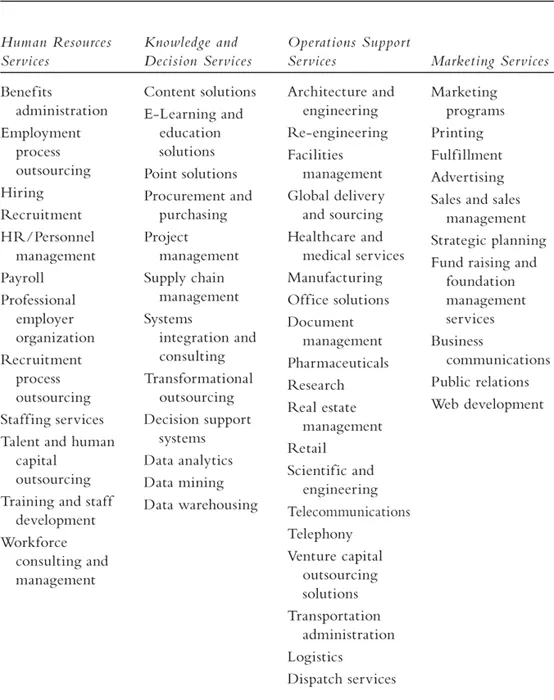
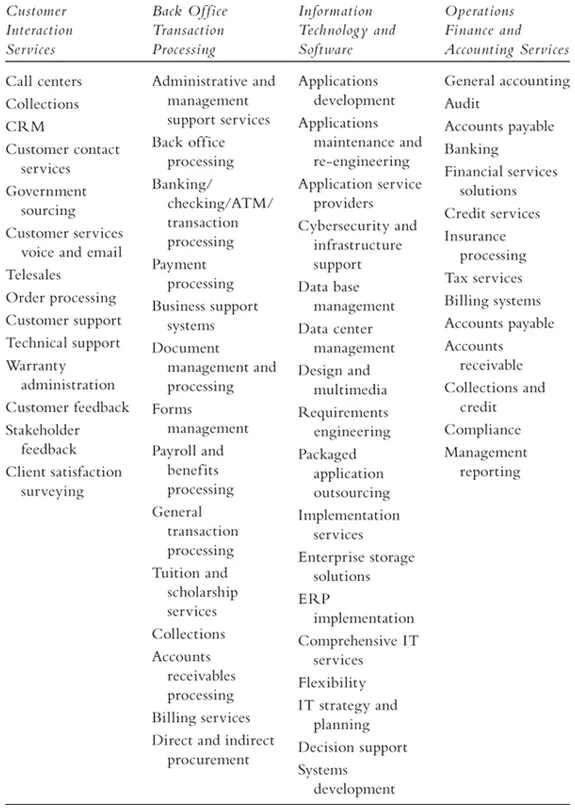
Outsourcing is essentially a basic redefinition of the corporation around core competencies and long-term outside relationships. These core competencies and outside relationships are identified with two objectives in mind: (1) to bring in the greatest value to the end customer and, (2) to ensure the highest level of productivity for the corporation itself. A number of BPO functions are listed in Table 1.1 on pages 22 and 23.
Table 1.1 Elements of Business Outsourcing
The benefits of corporate outsourcing are numerous. The following list is not intended to be comprehensive, but to stimulate your enthusiasm for this process:
- Increase sales opportunities.
- Improve corporate image and public relations.
- Prevent missed opportunities.
- Reduce annual costs almost immediately.
- Enable business to focus on core competencies.
- Reduce or eliminate customer complaints.
- Increase customer loyalty.
- Lower costs on projects and events.
- Beat competition.
- Make time and resources available.
LEVELS OF OUTSOURCING
There are three levels of outsourcings: tactical, strategic, and transformational.
Tactical Outsourcing
On the first level, tactical, the reasons for outsourcing are usually tied to specific problems being experienced by the firm. Often the firm is already in trouble and outsourcing is seen as a direct way to address problems. Typical examples of “trouble” are: the lack of financial resources to make capital investments, inadequate internal managerial competence, an absence of talent, or a desire to reduce headcount. Not surprisingly, tactical outsourcing often accompanies large-scale corporate restructuring. Thus, many tactical relationships are forged to:
- Generate immediate cost savings.
- Eliminate the need for future investments.
- Realize a cash infusion from the sale of assets.
- Relieve the burden of staffing.
The focus of tactical outsourcing is the contract, specifically, constructing the right contract and, subsequently, holding the vendor to the contract. Traditionally, the expertise for making these arrangements came from the purchasing department. However, there is an emerging expectation that every manager involved in the supply chain process understand and be accountable for the aspects of outsourcing that affect their area of charge. Establishing and maintaining tactical outsourcing relationships, specifically functional or comprehensively, is the responsibility of the entire organizational team. Frequently, the contract was simply a fee for services, with much of the value stemming from the discipline of spending dollars externally. When managers formed successful tactical relationships, the value of using outside providers was clear: better service for less investment of capital and management time.
Strategic Outsourcing
Over time, as businesses sought greater value from outsourcing relationships, the goals of these relationships changed. Executives realized that, rather than losing control over the outsourced function, they gained broader control over all of the functions in their area of responsibility, hence, were freer to direct their attention to the more strategic aspects of their jobs. Facilities managers, for example, could focus more on infrastructure issues, instead of worrying about staffing janitorial positions. Technology executives could hand over running of the data center to a service provider and turn their attention to serving the needs of internal customers. This logic remains compelling.
To meet the requirement of earning greater value from outsourcing, how it was used and where it was applied had to change. The scope of outsourcing relationships grew significantly, as did the service provider’s involvement. By virtue of the increasing dollar value of the relationships, the integrated scope of services, and the length of the new relationships, outsourcing was no longer a tactical tool but a strategic tool. Most important, the managerial mind-set regarding the nature of these relationships matured, from one between buyer and supplier to one between business partners.
Strategic outsourcing relationships are about building long-term value. Instead of working with a large number of vendors to get the job done, in a strategic model, corporations work with a smaller number of best-in-class integrated service providers. These relationships thus evolve from vendor-supplier arrangements (which are often adversarial) to long-term partnerships between equals,...
Table of contents
- Cover
- Contents
- Title
- Copyright
- Preface
- Introduction: Outsourcing: Opportunities and Challenges
- Part One: How to Plan, Lead, and Manage Outsourcing Initiatives
- Part Two: the Indispensable Guide to Finding an Outsourcing Career
- Part Three: the Indispensable Guide for Outsourcing Entrepreneurs
- Glossary
- Index
Trusted by 375,005 students
Access to over 1.5 million titles for a fair monthly price.
Study more efficiently using our study tools.
Frequently asked questions
Yes, you can cancel anytime from the Subscription tab in your account settings on the Perlego website. Your subscription will stay active until the end of your current billing period. Learn how to cancel your subscription
No, books cannot be downloaded as external files, such as PDFs, for use outside of Perlego. However, you can download books within the Perlego app for offline reading on mobile or tablet. Learn how to download books offline
Perlego offers two plans: Essential and Complete
- Essential is ideal for learners and professionals who enjoy exploring a wide range of subjects. Access the Essential Library with 800,000+ trusted titles and best-sellers across business, personal growth, and the humanities. Includes unlimited reading time and Standard Read Aloud voice.
- Complete: Perfect for advanced learners and researchers needing full, unrestricted access. Unlock 1.5M+ books across hundreds of subjects, including academic and specialized titles. The Complete Plan also includes advanced features like Premium Read Aloud and Research Assistant.
We are an online textbook subscription service, where you can get access to an entire online library for less than the price of a single book per month. With over 1.5 million books across 990+ topics, we’ve got you covered! Learn about our mission
Look out for the read-aloud symbol on your next book to see if you can listen to it. The read-aloud tool reads text aloud for you, highlighting the text as it is being read. You can pause it, speed it up and slow it down. Learn more about Read Aloud
Yes! You can use the Perlego app on both iOS and Android devices to read anytime, anywhere — even offline. Perfect for commutes or when you’re on the go.
Please note we cannot support devices running on iOS 13 and Android 7 or earlier. Learn more about using the app
Please note we cannot support devices running on iOS 13 and Android 7 or earlier. Learn more about using the app
Yes, you can access The Black Book of Outsourcing by Douglas Brown,Scott Wilson in PDF and/or ePUB format, as well as other popular books in Business & Management. We have over 1.5 million books available in our catalogue for you to explore.