![]()
1 Overview of the Treatment of Medical Emergencies
Philip Jevon
INTRODUCTION
Medical emergencies can be life-threatening. Prompt recognition and effective early treatment of a patient with a medical emergency is paramount if deterioration of the patient is to be prevented and the chances of recovery are to be maximised. The aim of this book is to understand the treatment of medical emergencies.
The assessment and treatment of any patient with a medical emergency should follow the ABCDE approach advocated by the Resuscitation Council UK (Resuscitation Council UK, 2006). In this chapter a brief overview to this generic approach will be provided (a more detailed and comprehensive guide can be found in Treating the Critically Ill Patient, Jevon, 2007) and throughout the book its importance will be continually emphasised.
The aim of this chapter is to provide an overview to the treatment of medical emergencies.
LEARNING OUTCOMES
At the end of the chapter the reader will be able to:
list what emergency equipment should be available,
describe the assessment of a patient with a medical emergency,
state the aim of treating a patient with a medical emergency.
EMERGENCY EQUIPMENT
Wherever patients with medical emergencies are treated, procedures should be in place to ensure that all the essential monitoring and emergency equipment and emergency drugs/fluids are immediately available, accessible and in good working order (Jevon, 2001).
Oxygen
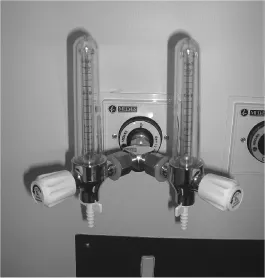
Facilities should be available for the delivery of high concentrations of oxygen: either piped oxygen to a wall-outlet behind the patient’s bed (preferable), or a portable oxygen cylinder, fitted with a variable oxygen-flow-rate meter capable of delivering up to 15 litres/min (Figure 1.1). There should also be adequate stocks of various oxygen-delivery devices, particularly non-rebreathe masks (see Figure 1.4, below).
Figure 1.1 A wall mounted oxygen cylinder, fitted with a variable oxygen-flow-rate meter capable of delivering up to 15 litres/min
Suction
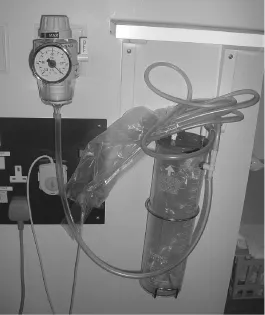
Every clinical area should have access to a portable suction device. In addition, it is preferable if a wall-mounted suction device is available behind each patient’s bed (Figure 1.2). As suction is sometimes required immediately in a life-threatening situation, it is standard practice to store appropriate suction connection tubing, together with suction catheters (rigid and flexible), with the suction source; that is, suction can be quickly administered.
Monitoring devices
At the very least, an ECG monitor and a pulse oximeter should be available. Other monitoring facilities, for example capnography, may also be required in some clinical areas.
Figure 1.2 A wall-mounted suction device
Cardiopulmonary resuscitation trolley
A carefully set out and fully stocked cardiac arrest trolley is paramount, following Resuscitation Council guidelines (Box 1.1) (Resuscitation Council UK, 2004). The trolley should be spacious, sturdy, easily accessible and mobile; ideally each trolley in a healthcare establishment should be identically stocked to avoid confusion. A defibrillator should be immediately available and, where appropriate, for example on general wards, it should have an automatic or advisory facility (Jevon, 2001). Defibrillators with external pacing should be strategically located, for example in emergency departments, intensive care units (ICUs) and coronary care units (CCUs).
Box 1.1 Cardiopulmonary resuscitation equipment that should be available
Airway equipment
Pocket mask with oxygen port (should be widely available in all clinical areas)
Self-inflating resuscitation bag with oxygen reservoir and tubing (ideally, the resuscitation bag should be single-use; if not, it should be equipped with a suitable filter)
Clear face masks, sizes 3, 4 and 5
Oropharyngeal airways, sizes 2, 3 and 4
Nasopharyngeal airways, sizes 6 and 7
Portable suction equipment
Yankauer suckers
Tracheal suction catheters, sizes 12 and 14
Laryngeal mask airways (LMAs; sizes 4 and 5), or ProSeal LMAs (sizes 4 and 5), or Combitube (small)
Magill forceps
Tracheal tubes, oral, cuffed, sizes 6, 7 and 8
Gum elastic bougie or equivalent device
Lubricating jelly
Laryngoscope handles (×2) and blades (standard and long blade)
Spare batteries for laryngoscope and spare bulbs (if applicable)
Fixation for tracheal tube (e.g. ribbon gauze/tape)
Scissors
Selection of syringes
Oxygen mask with reservoir (non-rebreathing) bag
Oxygen cylinders
Cylinder key
Circulation equipment
Defibrillator (shock advisory module and or external pacing facility to be decided by local policy)
ECG electrodes
Defibrillation gel pads or self-adhesive defibrillator pads (preferred)
Selection of intravenous cannulae
Selection of syringes and needles
Cannula fixing dressings and tapes
Seldinger central venous catheter kit
Intravenous infusion sets
0.9% sodium chloride, 1000 ml × 2
Arterial blood gas syringes
Tourniquet
Drugs
(a) Immediately available prefilled syringes
(b) Other readily available drugs
IV injections
Adenosine 6 mg × 10
Adrenaline 1 mg (1 : 10,000) × 4
Adrenaline 1 mg (1 : 1000) × 2
Amiodarone 300 mg × 1
Calcium chloride 10 ml of 100 mg/ml × 1
Chlorphaniramine 10 mg × 2
Furosemide 50 mg × 2
Glucose 10% 500 ml × 1
Hydrocortisone 100 mg × 2
Lignocaine 100 mg
Magnesium sulphate 50% solution 2 g (4 ml) × 1
Midazolam 10 mg × 1
Naloxone 400 mg × 5
Normal saline, 10 ml ampoules
Potassium chloride for injection (see National Patient Safety Agency Alert, www.npsa.nhs.uk)
Sodium bicarbonate 8.4%, 50 ml × 1
Other medications/equipment
Salbutamol (5 mg × 2) and ipratropium bromide (500 mg × 2) nebules
Nebulizer device and mask
Glyceryl trinitrate spray
Aspirin 300 mg
Additional items
Source: Resuscitation Council UK (2004).
Routine checking of emergency equipment
All emergency equipment should be checked routinely following local protocols. It is recommended that cardiopulmonary resuscitation equipment should be checked on a daily basis by each ward or department responsible for it (Resuscitation Council UK, 2000). A system for daily documented checks of the equipment inventory should be in place (Jevon, 2001). The electronic equipment should be stored, maintained and checked following the manufacturer’s recommendations and those of the local electrobiomedical engineers’ department (EBME).
ASSESSMENT OF A PATIENT WITH A MEDICAL EMERGENCY
ABCDE assessment
A patient with a medical emergency will be critically ill. The Resuscitation Council UK (2006) has issued gu...