![]()
1
Introduction to the Profession of Landscape Architecture
The profession of landscape architecture has a client, the and its creatures. In order to meet this challenge, to respond to our client in a sustainable manner, the profession must ensure that it forms an alliance with the environmental sciences and that we come to be seen by them and the public as their agents for achieving felicitous, ecological adaptations.
—IAN L. McHARG, To Heal the Earth1
Overview of Landscape Architecture
Those less familiar with landscape architecture tend to think of the profession in relatively basic terms, involving plantings around a building or in a park, for example. The reality is quite different; much broader, richer, and far-reaching. The profession of landscape architecture is much more diverse than the public may imagine. So wide is the range of opportunities, in fact, that people with a variety of interests and from many different types of backgrounds are able to fit comfortably under the title “landscape architect” and build exciting careers for themselves. Landscape architects do, however, no matter what their specialty, have a number of important things in common: a deep appreciation for the environment, a commitment to the highest standards of design and planning, and pride in knowing that their work directly enhances the quality of people’s lives.
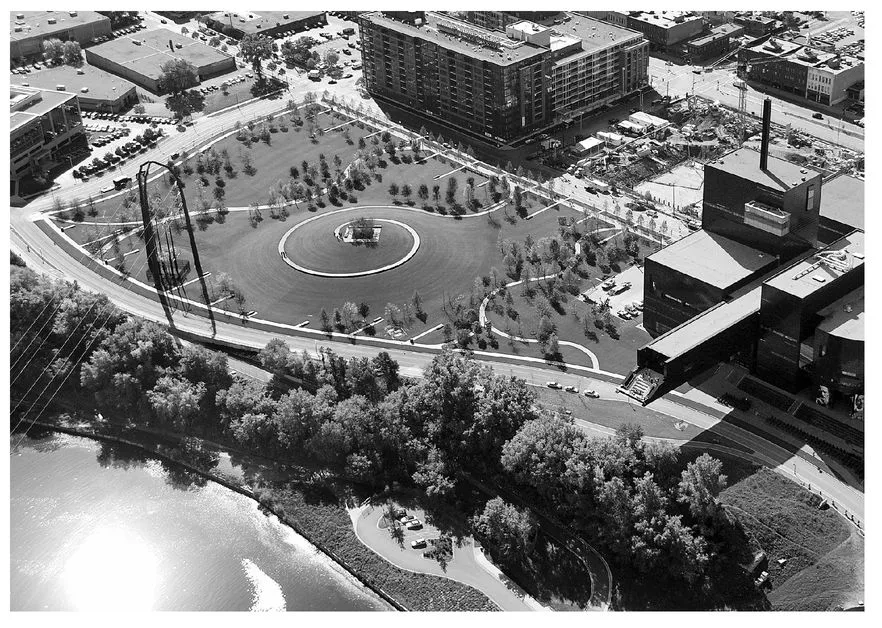
Gold Medal Park, Minneapolis, Minnesota. Designed by oslund.and.assoc. Photographer: Michael Mingo.
Landscape architecture can be thought of as a 360-degree profession because there are literally hundreds of different directions one can go with a degree in this field. Landscape architects design at many scales, ranging from a tiny roof deck terrace to thousands of acres of National Forest lands; from the private realm of a corporate office courtyard to the public realm of a neighborhood park and playground; from the specialized creation of a healing garden at a hospital to a customized rehabilitation of a native wetland. The next few chapters will highlight in greater depth the diversity of practice types, along with the professional possibilities available to someone with a background in landscape architecture.
Eighty-three percent of the earth’s land surface has come under the influence of humans.2 It is now recognized that much of that influence has not been positive, for either humans or the natural environment. However, every time humans interact with the land—whether to solve a problem, to move between places, orto build—there is an opportunity for landscape architects to become involved and assist in producing a positive outcome. A growing understanding of the capabilities of landscape architects and the value they bring to many types of projects accounts for the ongoing expansion of the profession.
The Many Definitions of Landscape Architecture
Many landscape architects would agree it is anything but straightforward to define their profession. The inherent diversity of the field is both an advantage and a disadvantage. The disadvantage is that, in being so broad, it is not easy to define, which makes it difficult for those outside the profession to understand it fully. The advantages are that its diversity enables so many people to benefit from the work of landscape architects, and, as mentioned above, allows individuals with a variety of interests and strengths to find a satisfying career in landscape architecture.
Perhaps a good place to start to define the field is with the American Society of Landscape Architects (ASLA), the national organization that represents the profession. It offers this definition of landscape architecture:
Landscape architecture encompasses the analysis, planning, design, management and stewardship of the natural and built environment through science and design.... It is a profession that is broad in scale and scope. Landscape architects receive training in site design, historic preservation, and planning, as well as in technical and scientific areas such as grading, drainage, horticulture, and environmental sciences. With this diverse background, landscape architects possess a unique blend of abilities to help address important local, regional, and national priorities.3
How do you define landscape architecture or a landscape architect?
〉 A landscape architect is one who designs outdoor environments. * When asked that question by clients, we typically tell them it’s conceivable that our scope of work could be anything outside of a habitable structure.
Jeffrey K. Carbo, FASLA
Principal, Jeffrey Carbo Landscape Architects and Site
Planners
〉 Landscape architecture is truly an art that integrates the idea of the built environment with nature and, most importantly, how it relates to the individual—what a person feels like in a space is critical to the success of our profession.
Frederick R. Bonci, RLA, ASLA
Founding Principal, LaQuatra Bonci Associates
*Author’s emphasis added throughout.
〉 Landscape architecture is a discipline where design and research intersect, and more specifically, it is the hybridization of art, science, economics, and politics at different scales.
Julia Czerniak
Principal, CLEAR; Associate Professor of Architecture,
Syracuse University
〉 Landscape architecture is about trying to find something that’s really wonderful about the environment around you, and something that’s really unique about the culture around you, and combining all those things into a rich experience.
Kofi Boone, ASLA
Assistant Professor, Department of Landscape Architecture,
North Carolina State University
〉 Design of the exterior environment that benefits humans, animals, and the planet.
Ruben L. Valenzuela, RLA
Principal, Terrano
〉 I often quip that it is “any modification of the surface of the planet,” but I find that definition too restrictive because it doesn’t adequately address issues of landscape preservation. By defining the profession this broadly, creative work can be found in areas not historically considered within the bounds of the profession, such as mined land reclamation and end-use planning.
Kurt Culbertson, FASLA
Chairman of the Board, Design Workshop
〉 Landscape architects work at the interface of cultural and natural issues. Landscape architecture is a unique profession in that it houses a very wide range of scales and environments, allowing for designers to work at the micro scale of designing playground equipment or benches, to macro considerations of urban development or environmental restoration.
Mikyoung Kim
Principal, mikyoung kim design
〉 Landscape architecture is planning and designing the structure of the land, human-made and nature-made. Nature-made is a green infrastructure of living things, including plant communities and their landforms. Nature-made infrastructures are remade by where and how we place them. Human-made constructions are things we design or place. They form a mosaic of circulation corridors, both animal and machine, buildings for shelter and gathering, utilities and familiar site amenities that grace the communities where we live.
Edward L. Blake, Jr.
Founding Principal, The Landscape Studio
〉 I think that, finally, the economic and cultural climate is such that landscape architects can really prevail in design. Landscape architecture offers an opportunity to meld creativity with a love of the land and the ability to create places that are everlasting in a way that is not detrimental to the ecology and the quality of a community’s life.
Roy Kraynyk
Executive Director, Allegheny Land Trust
〉 A landscape architect is more like a sculptor who manipulates the earth, and the g...