![]()
1
Introduction and overview
This book looks at nutrition as an exciting discipline that draws on all branches of biology. Nutrition is both an art and a science: it observes, measures and tries to explain the constantly changing process of the optimal mix of chemicals necessary for the functioning of an individual at all stages of life.
This book is written at a number of levels to encompass:
- traditional nutrition (Chapters 2–6, 8–17, 39–45)
- evolving nutrition (Chapters 20, 22–26, 31–37, 46)
- complex concepts, which although not currently central will influence the future of nutrition: an awareness of these will be necessary for the next generation of nutritionists (Chapter 7, and parts of Chapters 11, 18, 19, 21, 27–30, 38).
Take what is appropriate for your requirements at different stages of your development in nutrition.
The selection, processing and manner of eating food will be strongly influenced by what is available and by the history, social stability and economy of the community. What and how a person eats is significantly affected by their family background and traditions, although travel is increasingly changing food choices. War, pestilence and famine can restrict food availability, and food may also be contaminated by pollutants from the environment.
Being able to eat optimal amounts is dependent on agriculture and the political, educational and social organisation in which the person lives. The chemical substances should be available in optimal amounts and in an attractive form for metabolism. Nutrition identifies, measures and recommends optimal dietary intakes of the nutrient chemicals in health and disease.
All living creatures require a range of dietary chemicals for metabolism, growth and activity. These chemicals are obtained from a range of sources. The digestion, absorption and metabolism of ingested nutrients are determined in each individual by many factors, including inherited constitution, gender, age, activity, growth, fecundity and lactation. A person needs an adequate energy intake as well as essential nutrients to provide for the needs and control of a genetically determined constitution (genome), which dictates protein and enzyme structure and hence metabolism. This brings nutrition to a central role in the story. The synthesis, maintenance, functioning and control of the protein complex and hence overall metabolism rely on ingested nutrients.
This book is written in the belief that the basis of nutrition lies in molecular biology, genetic make-up, biochemistry and physiology. Even the mysteries of the cooking art are dependent on physicochemical transformations of raw food into available edible food.
The book is divided into seven parts.
Parts I and II deal with food in the community. The first part deals with the historical influences that decide what food a community eats and how it is cooked. This is followed by a description of those environmental factors that can adversely affect food availability. Part II looks at the calculation of how much food a community requires and actually eats. The remaining parts deal with the individual.
Part III looks at how a person metabolises nutrients in an individual manner dictated by genetic make-up, then Part IV describes the measurement of the individual nutritional status.
Part V describes the core nutrients, essential, nonessential and non-nutrients, and Part VI their selection for eating, ingestion and subsequent digestion, absorption and metabolism. Part VII looks at special nutritional requirements in the normal condition and for some specific diseases.
At the end of each part there are key points for understanding and learning, and thinking points. Important references are listed at end of each chapter.
Some companion material relating to this book will be available on Blackwell Publishing’s web pages: please look at details of the book, which can be found on the publisher’s website: www.blackwellpublishing.com.
LITERATURE
The enjoyable and productive analysis of the literature is important, and there are many great books and journals. The following may be of help and interest to the reader:
- Biological dictionary
Oxford Dictionary of Biochemistry and Molecular Biology (1997). Oxford University Press, Oxford. - Nutrition reference books
Sadler, M.J., Strain, J.J. and Caballero, B. (eds) (1999) Encyclopedia of Human Nutrition. Academic Press, San Diego, CA. - Biochemistry and biology reference books
Nelson, D.L. and Cox, M.M. (eds). (2000) Lehninger’s Principles of Biochemistry, 3rd edn. Worth, New York. - Lodish, H., Berk, A., Zipursky, S.L. et al. (eds) (2000) Molecular Cell Biology, 4th edn. WH Freeman, New York.
Jones, L. and Atkins, P. (2000) Chemistry, Molecules, Matter and Change. WH Freeman, New York. - Journals
American Journal of Clinical Nutrition, British Journal of Medicine, British Medical Journal, Nutrition Journal, Nutrition Review, New England Journal of Medicine, Science, Annual Review of Nutrition, British Journal of Nutrition, European Journal of Clinical Nutrition, Lancet, Nature and Proceedings of the Nutrition Society. - The Internet
The manner in which written information is handed on is changing rapidly with the availability of the World Wide Web. The printed textbook can be seen as a primer, an introduction at varying levels of sophistication. From this sound knowledge base educated forays can be made into the Internet for retrieval of information. This book is intended to provide a good basic knowledge for such rewarding searches. It is recommended that this book is supplemented by using Medline and other searches, e.g. Google or Metacrawler. These are a starter pack and it is suggested that readers develop their own list of favourite websites which can be upgraded. The website associated with this book will be kept up to date with new references and links. Navigating around the Internet is facilitated by the use of helpful search engines. Even so, the top 11 search engines only reach 42% of the Web. The search engines can be based on the directory model placing sites into categories and subcategories. This requires human input and has the potential for error. ‘Robots’, ‘spiders’ and ‘crawlers’ navigate through the following links pages and return to the database with the result.
Specialist sites dealing with a subject are more specific, e.g. PubMed and Medline. PubMed was developed by the National Library of Medicine and developed in conjunction with publishers of biomedical literature as a search tool for accessing literature citations and linking to full-text journals at websites of participating publishers.
Medline is the National Library of Medicine’s premier bibliographic database covering the fields of medicine, nursing, dentistry, veterinary medicine, the health-care system and the preclinical sciences. Medline contains bibliographic citations and author abstracts from more than 4000 biomedical journals published in the USA and 70 other countries. The file contains over 11 million citations dating back to the mid-1960s. However, it is important to appreciate that the citations miss the massive literature preceding the 1960s and these have to be traced by traditional library methods. Coverage is world-wide, but most records are from English-language sources or have English abstracts.
WEBSITES OF INTEREST
www.arbor.com Clinical information
www.health.gov.au/index.htm Australian Government Health and Ageing
www.bda.uk.com British Dietetic Association
www.eufic.org European Food Information Council
www.europa.eu.int European Communitiy
www.afssa.fr Agence Française de Sécurité Sanitaire des Aliments (France’s food safety agency)
www.defra.gov.uk UK Department for Environment and Rural Affairs (DEFRA)
www.foodstandards.gov.uk UK Food Standards Agency
www.nutrition.org.uk British Nutrition Foundation: general food and nutrition information
www.nutrition.org American Society for Nutritional Sciences
www.nutsoc.org.uk British Nutrition Society
www.usda.gov USA Department of Agriculture
www.healthfinder.gov US Department of Health and Human Services, US dietary advice
www.who.int World Health Organisation
www.soilassociation.org UK Soil Association
www.medbioworld.com Medical and biosciences journal link system, 25 000 links
www.FreeBooks4Doctors.com Free medical texts online
www.canada.gc.ca/depts/major Canadian government site
OVERVIEW
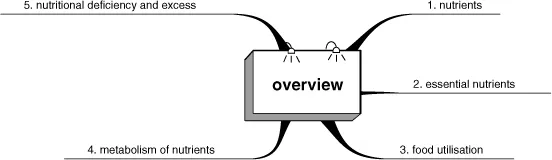
Fig. 1.1 Chapter outline.
NUTRIENTS
A definition of a nutrient is any chemical substance that can be used by an organism to sustain its metabolic activities. These metabolic activities in humans and other animals include the provision of energy, growth, renewal of tissues, reproduction and lactation.
The status of some chemicals as nutrients is assured: amino acids, carbohydrates, essential fatty acids, vitamins and trace elements. Other chemicals, such as dietary fibre and secondary plant metabolites, are part of the food but may not so readily be classified as nutrients.
ESSENTIAL NUTRIENTS
Some nutrients are essential in that these molecules cannot be synthesised within the body and can only be provided by the diet. Such essential nutrients provide for metabolic processes: vitamins, e.g. ascorbic acid, and trace elements, e.g. selenium; and for structure, e.g. proteins, essential amino acids, vitamins and trace elements.
The science of nutrition is devoted to defining requirements for essential nutrients, amino acids, essential fatty acids, vitamins and trace elements. Recommendations for daily requirements of nutrients made by expert committees are dependent on diverse factors such as growth, pregnancy and illness and are only carefully determined approximations. Implicit in the requirement for essential dietary constituents is that the human race is not independent of the environment. Thus, people are part of a food chain as recipients or producers of food.
FOOD UTILISATION
An important aspect of nutrition is the availability of dietary sources of nutrients. Causes of dietary deficiencies range from a lack of all nutrients (famine), to absence or omission of individual food items from the diet for social, economic, cultural, religious or personal reasons. Nutrients may not be absorbed from the intestine in some illnesses. A deficiency or excess of overall calorie intake or of individual nutrients may result in nutritional disorders.
Ingested food is broken down to...