![]()
Section 1
The First Two Days on the Job
This section is for the new employee who has an active interest in learning the fundamentals of being a part of the veterinary team. It is a training manual that outlines what all team members should know on the first 2 days on the job.
![]()
Chapter 1
Basic Terminology
Introduction
As with the study of any science or profession, there is a language and terminology unique to this knowledge; veterinary medicine is no different. Understanding the basics of veterinary terminology is a critical aspect of becoming an excellent team member and will better serve your clients and patients. Many clients will use terminology that they pick up from other hospitals, the Internet, or human medicine, and if a team member does not fully understand what the client is asking for, miscommunication and poor client service can occur. For example, consider the following situations.
- A client calls and informs you that their pet needs to come in for “an allergy injection.” This could refer to a steroid injection for allergies or an allergen vaccine for a pet that has been skin tested for allergies.
- A client comes in and requests that “their pet needs to be put to sleep.” In most cases this suggests that their pet is to be euthanized, but clients use this terminology to ask for sedation for a pet that may need to be groomed or that is going on a car trip.
- A client brings their male cat in for a “spay.” If the sex of the animal is not quickly determined, the cat may be prepped and possibly surgically set up for an ovariohysterectomy.
All these situations sound amusing, but they have occurred in everyday clinical settings. Therefore, it becomes the veterinary professional’s responsibility to understand and educate the clients so that they can make an informed choice.
Directional Terminology
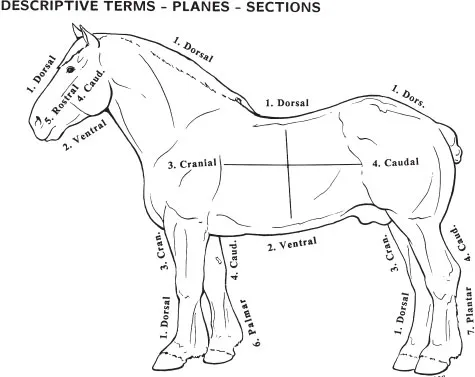
To properly describe a lesion, injury, or other problem, the first thing that must be mastered is the directional terminology that helps locate the problem on the pet’s body (Figure 1.1). To systematically do this, we create a series of planes that split the pet into sections. The most important plane we deal with is the median plane that splits the pet into two symmetrical halves.
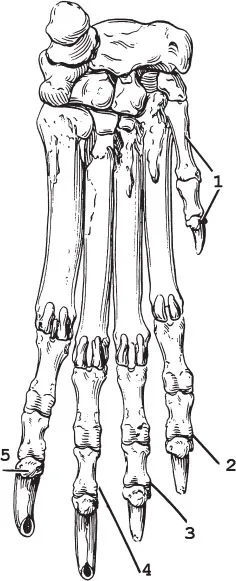
Once this plane is established, we compare where a body part or injury falls in relation to the proximity of the median plane. For example, the forelimb of a dog is illustrated in Figure 1.2. Each toe or finger is closely related to our fingers and toes. The first digit, which represents our thumb, is the dog and cat’s dewclaw, a small digit that does not directly have a function in weight bearing and is often removed when the animal is young (3–4 days old).
The first digit is closest to the medial plane of the animal and hence we say that the first digit is the most medial. The other digits are farther away from the medial plane from the first digits and hence we refer to these digits as being lateral to the first digit.
Therefore, the third digit is medial to the fifth digit and lateral to the first and second digits, and the fourth digit is medial to the fifth digit and lateral to the first, second, and third digits.
Also, we must be able to inform the medical team where a region, mass, or injury lies in relation to its position on the limb. Hence the closer the area of concern lies to the body, the more proximal it is. The farther away the injury or area lies from the body the more distal it is said to be. In the illustration in Figure 1.2, the wrist is proximal to the toes, or the toes are said to be distal to the wrist. This directional terminology refers only to limbs.
When discussing the main torso of the animal’s body, we define areas closer to the spine as having a dorsal position to regions that are closer to the pet’s sternum and belly, which have a ventral position. Hence a dog’s ears are generally dorsal to their eyes, or the eyes sit more ventral to the canine’s ears.
Further directional terminology occurs when we explain where the body part lies in its relation to the head or tail. Body parts that lie closer to the head of the pet are cranial in their position, whereas body parts that are closer to the tail are caudal in their location. Thus a pet’s ears are cranial to their shoulders, or their shoulders are caudal to the ears.
For a review, see Figures 1.3 and 1.4.
History Terminology
Taking a good medical history is one of the chief focuses of this book and will be discussed in detail in Chapter 5. However, there are certain abbreviations that are used in taking an accurate history and relaying this information to the medical team. Some abbreviations used in taking the animal’s history are as follows:
Figure 1.1. Descriptive terms. (Courtesy of Anatomy of Domestic Animals, 7th Edition. Pasquini, Chris, and Pasquini, Susan. Sudz Publishing, Pilot Point, Tx 1989. Used with permission from Sudz Publishing.)
- C: coughing
- S: sneezing
- V: vomiting
- D: diarrhea
- PD: polydipsia (increased thirst)
- PU: polyuria (increased urination)
- BM: bowel movement
- Anorexia: not eating
- Lethargy: depressed/decreased energy and activity
Terminology of the Physical Exam
There is specific nomenclature that is also used in discussing the pet and aspects of the pet’s body system based on the physical exam. To properly communicate with the medical team, the team member must have an understanding of this terminology. Although we will discuss the physical exam in detail in Chapter 5, there are medical abbreviations that are commonly used to describe an animal properly.
Cat description abbreviations include
- DLH: domestic long hair,
- DMH: domestic medium hair, and
- DSH: domestic short hair.
There are many abbreviations for physical examination nomenclature, as well. For mentation (how the pet presents mentally), the abbreviations are as follows:
- BAR: bright, alert, and responsive
- QAR: quiet, alert, and responsive
- Depressed: animal is not active or normally responsive to stimuli
- Comatose/obtund: animal is not responding to any stimuli, severe depression without consciousness
For the baseline parameters of overall health the terms used are as follows:
- T: temperature
- P: pulse
- R: respiration
- MM: mucous membrane
- CRT: capillary refill time
- Hydration
Abbreviations for the body systems are as follows:
- CV: cardiovascular system (heart and vascular system)
- Resp: respiratory system (trachea, bronchi, and lungs)
- Abd: abdomen
- LN: lymph nodes
- MS: musculoskeletal system
- E-E-N-T: eyes, ears, nose, and throat
- Neuro: neurologic system
- Int: integumentary system (skin)
- Uro: urogenital system (reproductive organs)
Figure 1.2. The forelimb of a dog. (Courtesy of Anatomy of Domestic Animals, 7th Edition. Pasquini, Chris, and Pasquini, Susan. Sudz Publishing, Pilot Point, Tx 1989. Used with permission from Sudz Publishing.)
Disease Terminology
When obtaining a thorough history and understanding the concerns of the client, it is important to define the onset and progression of the pet’s disease. In these cases, the following terms are used to help define these parameters.
- Acute onset of disease refers to a disease entity that has affected the patient rapidly as the patient went from good health to illness in a short period of time.
- Chronic onset of disease refers to a disease entity that a patient has been dealing with over longer periods of time. Symptoms can worsen or stay the same during the duration of the illness, but the patient is still affected over the long term.
- Progressive disease refers to disease entities that have worsening symptoms over time. Both acute and chronic disease can have progressive symptoms.
Pharmacological Terminology
When dispensing medication to an animal there are specific abbreviations and terms that apply to the route by which the drug is given, how often it is given, and to what part of the anatomy it is applied. Understanding these terms is extremely important because a mistake can produce serious side effects.
Dosing
The abbreviations used for dosing, particularly the frequency of administration of medication per day, are as follows:
- EOD: every other day
- SID: once per day
- BID: twice per day
- TID: three times per day
- QID: four times per day
- PRN: as needed
- ETD: every third day
- q: normally written in lowercase case, q translates to every (i.e., q 8 hrs means every 8 hours).
See examples of using this terminology in clinical settings next.
Example 1: You are a part of a busy medical team. Your doctor has talked with Mr. Doe about his dog Rufus at length. Rufus is on phenobarbital. Mr. Doe left a message for the doctor that Rufus is still seizing and asks what he should do about the medication. The doctor leaves you the following message: “Please call John Doe about Rufus. Instruct him to increase Rufus’s phenobarbital from 1–25 mg tablet SID to 1–25 mg tablet BID by mouth (PO). If the seizing continues, I will need to see Rufus.” This message indicates that you need to instruct Ms. Doe to increase Rufus’s phenobarbital from 1–25 mg tablet 1 ×/day to 1–25 mg tablet 2×/day by mouth.
Example 2: Your veterinarian asks you to assist her in filling a prescription for 500 mg aspirin. The chart indicates the following instructions: Give one (1) tablet q 12 hours PRN. This transl...