![]()
Part One
Introduction
![]()
1
Motivation for a Network of Wireless Sensor Nodes
Introduction
Sensors link the physical with the digital world by capturing and revealing real-world phenomena and converting these into a form that can be processed, stored, and acted upon. Integrated into numerous devices, machines, and environments, sensors provide a tremendous societal benefit. They can help to avoid catastrophic infrastructure failures, conserve precious natural resources, increase productivity, enhance security, and enable new applications such as context-aware systems and smart home technologies. The phenomenal advances in technologies such as very large scale integration (VLSI), microelectromechanical systems (MEMS), and wireless communications further contribute to the widespread use of distributed sensor systems. For example, the impressive developments in semiconductor technologies continue to produce microprocessors with increasing processing capacities, while at the same time shrinking in size. The miniaturization of computing and sensing technologies enables the development of tiny, low-power, and inexpensive sensors, actuators, and controllers. Further, embedded computing systems (i.e., systems that typically interact closely with the physical world and are designed to perform only a limited number of dedicated functions) continue to find application in an increasing number of areas. While defense and aerospace systems still dominate the market, there is an increasing focus on systems to monitor and protect civil infrastructure (such as bridges and tunnels), the national power grid, and pipeline infrastructure. Networks of hundreds of sensor nodes are already being used to monitor large geographic areas for modeling and forecasting environmental pollution and flooding, collecting structural health information on bridges using vibration sensors, and controlling usage of water, fertilizers, and pesticides to improve crop health and quantity.
This book provides a thorough introduction to the fundamental aspects of wireless sensor networks (WSNs), covering both theoretical concepts and practical aspects of network technologies and protocols, operating systems, middleware, sensor programming, and security. The book is targeted at researchers, students, and practitioners alike, with the goal of helping them to gain an understanding of the challenges and promises of this exciting field. It has been written primarily as a textbook for graduate or advanced undergraduate courses in wireless sensor networks. Each chapter ends with a number of exercises and questions that will allow students to practice the described concepts and techniques. As the field of wireless sensor networks is based on numerous other domains, it is recommended that students have taken courses such as networking and operating systems (or comparable courses) before they take a course on sensor networks. Also, some topics covered in this book (e.g., security) assume previous knowledge in other areas or require that an instructor provides an introduction into the basics of these areas before teaching these topics.
1.1 Definitions and Background
1.1.1 Sensing and Sensors
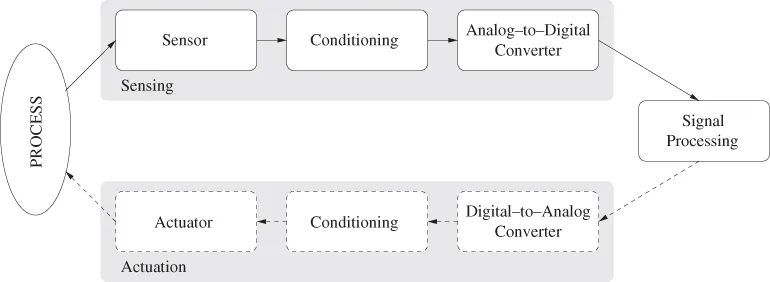
Sensing is a technique used to gather information about a physical object or process, including the occurrence of events (i.e., changes in state such as a drop in temperature or pressure). An object performing such a sensing task is called a sensor. For example, the human body is equipped with sensors that are able to capture optical information from the environment (eyes), acoustic information such as sounds (ears), and smells (nose). These are examples of remote sensors, that is, they do not need to touch the monitored object to gather information. From a technical perspective, a sensor is a device that translates parameters or events in the physical world into signals that can be measured and analyzed. Another commonly used term is transducer, which is often used to describe a device that converts energy from one form into another. A sensor, then, is a type of transducer that converts energy in the physical world into electrical energy that can be passed to a computing system or controller. An example of the steps performed in a sensing (or data acquisition) task is shown in Figure 1.1. Phenomena in the physical world (often referred to as process, system, or plant) are observed by a sensor device. The resulting electrical signals are often not ready for immediate processing, therefore they pass through a signal conditioning stage. Here, a variety of operations can be applied to the sensor signal to prepare it for further use. For example, signals often require amplification (or attenuation) to change the signal magnitude to better match the range of the following analog-to-digital conversion. Further, signal conditioning often applies filters to the signal to remove unwanted noise within certain frequency ranges (e.g., highpass filters can be used to remove 50 or 60 Hz noise picked up by surrounding power lines). After conditioning, the analog signal is transformed into a digital signal using an analog-to-digital converter (ADC). The signal is now available in a digital form and ready for further processing, storing, or visualization.
Many wireless sensor networks also include actuators which allow them to directly control the physical world. For example, an actuator can be a valve controlling the flow of hot water, a motor that opens or closes a door or window, or a pump that controls the amount of fuel injected into an engine. Such a wireless sensor and actuator network (WSAN) takes commands from the processing device (controller) and transforms these commands into input signals for the actuator, which then interacts with a physical process, thereby forming a closed control loop (also shown in Figure 1.1).
1.1.1.1 Sensor Classifications
Which sensors should be chosen for an application depends on the physical property to be monitored, for example, such properties include temperature, pressure, light, or humidity. Table 1.1 summarizes some common physical properties, including examples of sensing technologies that are used to capture them. Besides physical properties, the classification of sensors can be based on a variety of other methods, for example, whether they require an external power supply. If the sensors require external power, they are referred to as active sensors. That is, they must emit some kind of energy (e.g., microwaves, light, sound) to trigger a response or to detect a change in the energy of the transmitted signal. On the other hand, passive sensors detect energy in the environment and derive their power from this energy input — for example, passive infrared (PIR) sensors measure infrared light radiating from objects in the proximity.
Table 1.1 Classification and examples of sensors
| Temperature | Thermistors, thermocouples |
| Pressure | Pressure gauges, barometers, ionization gauges |
| Optical | Photodiodes, phototransistors, infrared sensors, CCD sensors |
| Acoustic | Piezoelectric resonators, microphones |
| Mechanical | Strain gauges, tactile sensors, capacitive diaphragms, piezoresistive cells |
| Motion, vibration | Accelerometers, gyroscopes, photo sensors |
| Flow | Anemometers, mass air flow sensors |
| Position | GPS, ultrasound-based sensors, infrared-based sensors, inclinometers |
| Electromagnetic | Hall-effect sensors, magnetometers |
| Chemical | pH sensors, electrochemical sensors, infrared gas sensors |
| Humidity | Capacitive and resistive sensors, hygrometers, MEMS-based humidity sensors |
| Radiation | Ionization detectors, Geiger–Mueller counters |
The classification of sensors can also be based on the methods they apply and the electrical phenomena they utilize to convert physical properties into electrical signals. Resistive sensors rely on changes to a conductor's electrical resistivity, ρ, based on physical properties such as temperature. The resistance, R, of a conductor can be determined as:
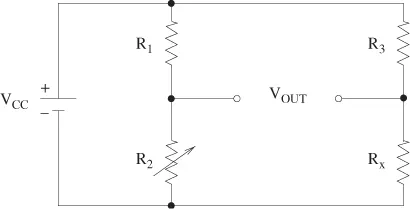
where l is the length of the conductor and A is the area of the cross-section. For example, the well-known Wheatstone bridge (Figure 1.2) is a simple circuit that can be used to convert a physical property into an observable electric effect. In this bridge, R1, R2, and R3 are resistors of known resistance (where the resistance of R2 is adjustable) and Rx is a resistor of unknown value. If the ratio R2/R1 is identical to the ratio Rx/R3, the measured voltage VOUT will be zero. However, if the resistance of Rx changes (e.g., due to changes in temperature), there will be an imbalance, which will be reflected by a change in voltage VOUT. In general, the relationship between the measured voltage VOUT, the resistors, and the supply voltage (VCC) can be expressed as:
A similar principle can be applied to capacitive sensors, which can be used to measure motion, proximity, acceleration, pressure, electric fields, chemical compositions, and liquid depth. For example, in the parallel plate model, that is, a capacitor consisting of two pa...