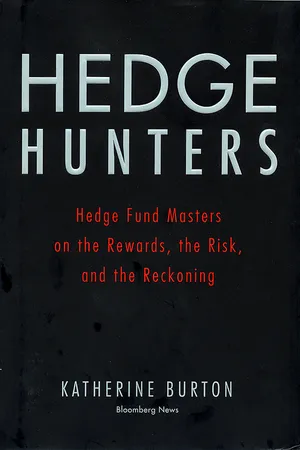
The hedge fund industry's top managers have a penchant for high returns and low profiles. The combination makes them a regular focus of the media, eager to know what makes them tick. Now, thanks to Katherine Burton, who's been covering these noteworthy traders for Bloomberg News for more than a decade, we know considerably more about them. With candor and detail, the industry's most successful hedge fund managers describe the events that shaped their personal journeys, the strategies they use to produce returns even in uncooperative markets, and the attributes that make a smart investor. Hedge Hunters offers a rare look at the industry's top performers and an introduction to some of the most talented new managers, handpicked by the masters themselves.
eBook - ePub
Hedge Hunters
Hedge Fund Masters on the Rewards, the Risk, and the Reckoning
- English
- ePUB (mobile friendly)
- Available on iOS & Android
eBook - ePub
About this book
Information
Chapter 1
Mark Yusko
What It Takes to Be the Best
IN 2004, a twenty-one-year-old New York University student named Hakan Yalincak told the world he was going to run a hedge fund. With his mother, Ayferafet, he rented office space in Greenwich, Connecticut, and filled it with computers, fancy furniture, and Bloomberg terminals. They hired temps to man the screens. Wealthy investors paraded through the offices to check out the boy wonder and were told the story of a young stock-picking genius born into a wealthy Turkish family worth $800 million. The mother-son duo raised more than $7 million.
Yalincak never bought any stocks. Instead, prosecutors said he used the money to purchase a Porsche and expensive jewelry and gave $1.25 million—the first installment of what he said would be a $21 million gift—to New York University, where he was then a senior studying history. The young Turkish national was later arrested and pleaded guilty to bank and wire fraud. Yalincak was sentenced to forty-two months in prison; his mother’s sentence was two years in prison, after she pleaded guilty to conspiracy to commit wire fraud.
This sad tale speaks volumes about the world of hedge funds. A con can happen in any industry. But it’s the golden aura of hedge funds, with its promise of unparalleled riches, that made this unlikely scam possible and allowed a kid barely old enough to order a beer to raise millions of dollars from adults with real jobs and big bank accounts.
Everyone, it seems, wants a piece of the hedge fund business. MBA students across the country are eschewing jobs at major investment banks to join the funds, many of which won’t be around in ten years. Managers trying to find an edge have opened funds trading such unlikely assets as art and wine.
The hedge fund world didn’t always garner such attention. One friend in the industry tells of a visit home to his parents during which the mother of a childhood pal asked how his successful landscaping business was going: “Your mother said something about hedges?” The history of hedge funds—private partnerships in which the manager bets on falling as well as rising prices of stocks, bonds, and other financial instruments and then takes a piece of the profits—dates back at least as far as 1923, when Benjamin Graham, the godfather of value investing, opened just such a fund. Yet it’s taken almost eighty years for the trend to become widely known.
Nowadays, the bartender, the massage therapist, and just about everybody’s neighbors all know that hedge fund managers are the new masters of the universe. They make the cover of New York magazine; in fact, just about every kind of publication—from the New York Post to Vanity Fair—runs stories about them. They’re even hip enough for HBO to develop a series about them. The amount of money they manage isn’t huge compared with other large capital pools. Even accounting for leverage, the hedge fund industry’s assets probably come to less than half the $10 trillion that mutual funds control. Yet the biggest hedge fund managers wield power far beyond the world of stocks and bonds. They are the Carnegies and Rockefellers of the twenty-first century: some of the biggest philanthropists, the largest political donors, and the most influential art collectors.
In 1990, there were only a few hundred hedge fund managers, with $39 billion in assets. At the end of 2006, the two biggest hedge fund operators together managed more than $65 billion. In total that year, there were roughly twenty-four hundred managers, with $1.5 trillion in assets. New entrants continue to rush in, and average returns have fallen as competition increases. As the number of hedge funds grows, so do the odds of their having mediocre leadership. Finding the best managers is even harder than it used to be.
But Mark Yusko seems to have the knack. He has been investing in hedge funds for more than a dozen years, first as senior investment director at the University of Notre Dame and later as chief investment officer at the University of North Carolina at Chapel Hill (UNC). In his six-and-a-half-year tenure at UNC, he increased the endowment’s investment in hedge funds to about 55 percent of its $1.2 billion in assets. In 2004, he left UNC to form Morgan Creek Capital Management in Chapel Hill. The firm advises institutions and wealthy individuals on how and where to invest their money and farms out money to hedge funds and other investment firms.
In the years that Yusko has been picking managers, he has invested with most of the established hedge fund managers interviewed in this book and many others in the top tier. He has worked closely with Julian Robertson, who managed money for UNC for almost a decade and who owns a small minority stake in Morgan Creek. Robertson also provided seed capital for Tiger Select Fund Management, a group of funds Yusko runs that invests in other hedge funds.
“I joke that it may take me five years to figure out if I want to invest with someone,” says Yusko, “but I know in five minutes if I’ll never invest with somebody. When they don’t have it, it’s immediately obvious.” The it—that special something that characterizes managers who seem to be divining rods for investment returns—is hard to define. Yusko has not found any one identifiable characteristic they all share that’s central to success, but in some cases, that edge—whatever it may be—is apparent from the first meeting. “The moment I met David Bonderman [founder of buyout firm Texas Pacific Group], I threw my wallet at him and said, ‘Here. Take all my money.’ The guy has it,” says Yusko. “I had a similar experience with Julian and with John Griffin.” Griffin was once president of Robertson’s Tiger Management and now runs hedge fund Blue Ridge Capital in New York.
The essentials for success may be elusive, but in his years of picking hedge fund managers, Yusko has developed some ideas about what constitutes great talent and how it can be nurtured. At its core, it’s all about the people, he says, and mentoring is a vital part of the process. “Money is managed by people, not institutions,” says Yusko. “A lot of people get hung up on the idea that a great manager has to come out of a certain educational institution, or requires a certain credential, or has to have worked at one of the big uglies like Goldman Sachs. It’s exactly the opposite.” The investment business is about craftsmanship, he says, and a craftsman is an apprentice first.
Yusko likens the process of learning how to manage a fund to the way artists learned to paint hundreds of years ago. The master would set up his easel, and the apprentices would set up their easels in a circle around him. They would proceed by copying his palette, his brushstrokes, his use of light. Eventually, great painters—with styles all their own—were born from the great masters. “When Julian ran Tiger, they sat around a big round table,” says Yusko. “Julian was the master and these young guys were there to copy his brushstrokes.” They paid attention to how he made decisions and processed information and wisely followed suit.
Paying attention has always paid off. Before, say, the 1990s, many of the biggest winners were those who knew things before other investors did. But these days, information is much easier to get, and there are many more managers trying to parse it. With such intense competition, having a good mentor to show you the ropes has gone from necessary to critical. “Once the industry shifted into information overload, running a fund became more about process and practices and the ability to synthesize,” says Yusko. “Those are learned skills.”
But whether it’s gleaned from a mentor or a Ouija board, what managers must learn is how to gain the advantage and identify the opportunity. In markets, when one person wins, another one loses. “Ultimately, we buy managers for their edge. You pay those high fees to great managers because they know how to extract alpha, or wealth, from the pool, where it’s a zero-sum game.”
When Robertson launched Tiger Management in 1980, Yusko explains, he believed he had a great advantage over most institutional investors, which were primarily mutual funds or traditional investors who bought and held stocks. “Julian had a great line when he got into the business: ‘It’s me and the patsies,’ ” says Yusko. Robertson didn’t mean that his competition lacked smarts, but he saw that they were rule bound. The fund’s prospectus forced them to stay inside the box. The rules might allow them to own one type of security and not another. They might prohibit short selling or forbid ownership of more than a certain percentage of a company. “These managers were like poker players who can’t hold aces,” says Yusko. “If you can’t hold aces, you’re going to have a tough time winning a poker hand.”
As time went on, a swarm of new players looked to join the fun. “People who didn’t have these rules came into the business,” says Yusko. All the young analysts and portfolio managers wanted to leave the Fidelity Investments of the world and open the next Soros Fund Management. There were more traders with fewer restrictions, yet many of them didn’t know the finer points of the game so the renegade no longer had the advantage.
“Now, with the explosion of hedge funds,” says Yusko, “there is a whole new set of patsies in the game again.” This new generation of pigeons wasn’t trained by the masters; they don’t understand portfolio construction. Many of them presume that because they were talented analysts, they will be superb portfolio managers, says Yusko. In fact, he argues, the personality traits of a good analyst and a good portfolio manager are completely different. “What you need to be an analyst is an attention to detail, a fundamental research mindset, the ability to do active due diligence, and the skill to do financial modeling. It’s very quantitative. Being a portfolio manager is almost the direct opposite. It’s all about nuance and extrapolation and interpolation. It’s about reading between the lines, understanding the elements that aren’t printed in the factual statements, what the management doesn’t say when they make a public statement, what they omitted when they were writing up their notes for the financial statements.”
And ultimately it’s about having the courage to pull the trigger, to put the money on the line.
The right combination of skills is not the set that most people would expect in a fund manager, says Yusko. The best in the business today are not necessarily the finest analysts, and many of them are not even the most quantitatively oriented. “Great portfolio managers are great thinkers,” says Yusko. “They’re smart guys who were drawn to the work and were trained about the markets by great thinkers.”
Robertson is probably the best at spotting that kind of talent. “He has a process for it,” says Yusko. “He is wired that way. He’s a mentor. He guides them. He passes them the tools.” The tools are critical: Managers need a process and a philosophy—a vision. If they don’t have the tools, they won’t succeed.
Some great managers are not so great at cultivating top talent, a deficiency that Yusko says may simply be a function of age—or rather the lack of it. “You cannot have wisdom without age. To be a great mentor, you have to be older, more mature, and wiser.” Yusko believes that the younger the manager, the harder it is for him to command the respect of an apprentice: “ ‘He’s not that much older than I am,’ the apprentice is thinking, ‘Can he really be so much better?’”
Having interviewed and worked with hundreds of hedge fund managers over the years, Yusko has come up with some attributes that he believes are essential to being the best.
Independence. The word contrarian is often linked to investment smarts, but Yusko prefers the term independent thinker. After all, merely doing the opposite of what other investors are doing doesn’t necessarily put you ahead of the crowd. “Sometimes the consensus is right and momentum can work for a period of time,” he says.
Likewise, the modus operandi for some contrarians is to work on the assumption that things like interest rates and stock market returns are mean reverting, a conviction that markets get out of whack but eventually revert back to long-term average values. “The problem, of course, is that markets can remain irrational longer than the rational investor can remain solvent,” says Yusko, quoting economist John Maynard Keynes. Being early, he points out, is often a euphemism for being wrong.
To capture the essence of the true nonconformist, Yusko prefers the definition used by Dean LeBaron, founder and former chairman of Batterymarch Financial Management in Boston: “Contrary thinking is most like intellectual independence, with a healthy dash of agnosticism about consensus views.”
Managers who are independent thinkers are constantly challenging consensus and doing their own research. “You can’t just accept what other people say,” says Yusko, “or accept what other people put in reports.”
Guts. What distinguishes a great investor is the willingness to take intelligent risk, says Yusko. Even for the willing, the odds are intimidating. “A legendary investor like Michael Steinhardt, Julian Robertson, or George Soros is right 58 or 59 percent of the time,” says Yusko. “That’s frightening when you think about it. Most investors are right only about 30 to 40 percent of the time. If you can be right even 51 percent, the odds work in your favor.”
Clearly, without risk, there can be no substantial return. Around 2000, more institutions, like pension funds, began investing in hedge funds, and these institutions demand steadier returns, even if that means lower profits. To meet the needs of their new clients, some managers have tended to reduce the magnitude of the swings in their performance, a tendency that makes for lower gains and smaller losses.
Some managers are inclined to be less aggressive because they focus more on the 2 percent management fee they earn on the assets they oversee than on the 20 percent performance fee they pocket on the money they make. If a hedge fund manager oversees, say, $20 billion, he earns $400 million just for coming to work every day, and only a portion of that goes to keeping the lights on and paying employees. Why take unnecessary chances and risk losing lots of money and clients?
“The people you really want,” Yusko insists, “are the ones who understand intelligent risk and have the guts to bet big.” They have that rare chutzpah depicted in Ocean’s Eleven, the movie about a casino heist, starring George Clooney and Brad Pitt. Clooney’s character, Danny Ocean, is talking about why it’s so hard to win at gambling in Vegas: “ ’Cause the house always wins. You play long enough, never change the stakes, the house takes you. Unless, when that perfect hand comes along, you bet big, and then you take the house.”
To illustrate, Yusko points to Soros and Stanley Druckenmiller, Soros’s chief investment strategist, who bet on a fall in the British pound, loaded up the boat, and earned $1 billion, and to Sir John Templeton, a legendary value investor, who in 1939 bought $100 worth of every stock listed on the New York Stock Exchange that was trading below a dollar, wagering that World War II was about to start and these stocks would soar. Within three years, 100 of the 104 made him money.
Humility and Intellectual Honesty. Top managers constantly reevaluate their positions, says Yusko. They look for data that contradict their thesis, rather than focusing on information that bolsters their view. When a position moves against them, their first question is: Am I early or am I wrong? Is this conviction or pigheadedness?
The best managers aren’t afraid to say they made a mistake, says Yusko. “When they’re wrong, they change their minds. Arrogance doesn’t work in this business because the market will smack you down. You can be confident, but you can’t be arrogant.”
Roy Neuberger, founder of money management firm Neuberger Berman, whom Yusko lists among the greatest investors of all time, is widely believed to have said there are three rules to managing money: Rule 1: Do not lose money. Rule 2: Do not lose money. Rule 3: Never forget rules 1 and 2. And if adhering to those rules means you may have to eat crow, the only decision remaining is which fork to use. “The difference between a mistake and an error,” says Yusko, “is that an error is a mistake you don’t correct. Managers who press a bad position, insisting the market is wrong, usually don’t survive it. The good managers don’t cling to the mast as the ship goes down. They jump in a lifeboat and go look for another ship.”
And they jump quickly. On the Friday before the October 1987 stock market crash, Druckenmiller famously decided to switch his portfolio. He shifted from wagering that U.S. stocks would fall to betting that shares would rise. He even borrowed money to goose returns. After the close that day, he had a conversation with Soros (who was not yet his boss), and over the weekend a talk with Jack Dreyfus, founder of the Dreyfus Fund, that convinced him he was dead wrong. On Black Monday, the market opened 200 points lower, and Druckenmiller acted with lightning speed, selling his entire position early in the day and going net short. He ended the month with a profit.
Connections. The best ma...
Table of contents
- Praise
- Title Page
- Copyright Page
- Dedication
- Preface to the 2009 Edition
- Preface to the 2007 Edition
- Acknowledgements
- Chapter 1 - Mark Yusko
- Chapter 2 - Michael Steinhardt
- Chapter 3 - John Armitage
- Chapter 4 - Marc Lasry
- Chapter 5 - Craig Effron
- Chapter 6 - Lee Ainslie
- Chapter 7 - Bernay Box
- Chapter 8 - Boone Pickens
- Chapter 9 - Brian Bradshaw, David Meaney, Michael Ross, and Alex Szewczyk
- Chapter 10 - Josh Friedman and Mitch Julis
- Chapter 11 - Jeffrey Schachter and Burton Weinstein
- Chapter 12 - Dwight Anderson
- Chapter 13 - Roberto Mignone
- Chapter 14 - Bruce Ritter
- Chapter 15 - Julian Robertson
- Chapter 16 - Jim Chanos
- Chapter 17 - Richard Perry
- Chapter 18 - Daniel Loeb
- Index
- About the Author
- About Bloomberg
Trusted by 375,005 students
Access to over 1.5 million titles for a fair monthly price.
Study more efficiently using our study tools.
Frequently asked questions
Yes, you can cancel anytime from the Subscription tab in your account settings on the Perlego website. Your subscription will stay active until the end of your current billing period. Learn how to cancel your subscription
No, books cannot be downloaded as external files, such as PDFs, for use outside of Perlego. However, you can download books within the Perlego app for offline reading on mobile or tablet. Learn how to download books offline
Perlego offers two plans: Essential and Complete
- Essential is ideal for learners and professionals who enjoy exploring a wide range of subjects. Access the Essential Library with 800,000+ trusted titles and best-sellers across business, personal growth, and the humanities. Includes unlimited reading time and Standard Read Aloud voice.
- Complete: Perfect for advanced learners and researchers needing full, unrestricted access. Unlock 1.5M+ books across hundreds of subjects, including academic and specialized titles. The Complete Plan also includes advanced features like Premium Read Aloud and Research Assistant.
We are an online textbook subscription service, where you can get access to an entire online library for less than the price of a single book per month. With over 1.5 million books across 990+ topics, we’ve got you covered! Learn about our mission
Look out for the read-aloud symbol on your next book to see if you can listen to it. The read-aloud tool reads text aloud for you, highlighting the text as it is being read. You can pause it, speed it up and slow it down. Learn more about Read Aloud
Yes! You can use the Perlego app on both iOS and Android devices to read anytime, anywhere — even offline. Perfect for commutes or when you’re on the go.
Please note we cannot support devices running on iOS 13 and Android 7 or earlier. Learn more about using the app
Please note we cannot support devices running on iOS 13 and Android 7 or earlier. Learn more about using the app
Yes, you can access Hedge Hunters by Katherine Burton in PDF and/or ePUB format, as well as other popular books in Business & Investments & Securities. We have over 1.5 million books available in our catalogue for you to explore.