Part I
AutoCAD 101
In this part . . .
AutoCAD 2010 is more than just another drawing program; it’s a complete environment for drafting and design. So if you’re new to AutoCAD, you need to know several things to get off to a good start – especially how to use the command line area and how to set up your drawing properly. These key techniques are described in this part of the book.
If you’ve used earlier versions of AutoCAD, you’ll be most interested in the high points of the new release, including some newer interface components. The lowdown on what’s new is here, too.
Chapter 1
Introducing AutoCAD and AutoCAD LT
In This Chapter
Getting the AutoCAD advantage
Using AutoCAD and DWG files
Meeting the AutoCAD product family
Using AutoCAD LT instead of AutoCAD
Finding out what’s new in 2010
Maybe you’re one of the few remaining holdouts who continue to practice the ancient art of manual drafting with pencil and vellum. If so, I must tell you, you’re a dwindling breed. Or maybe you’re completely new to drafting and yearn for the wealth and fame (would I lead you on?) of the drafter’s life. Maybe you’re an engineer or architect who needs to catch up with the young CAD hotshots in your office. Maybe you tried to use AutoCAD a long time ago, but gave up in frustration or just got rusty. Or maybe you currently use an older release, such as AutoCAD 2006 or even (if you’re into antiques) AutoCAD 2000.
Whatever your current situation or motivation, I hope that you enjoy the process of becoming proficient with AutoCAD. Drawing with AutoCAD is challenging at first, but it’s a challenge worth meeting. AutoCAD rewards those who think creatively about their work and look for ways to do it better. You can always find out more, discover a new trick, or improve the efficiency and quality of your drawing production.
AutoCAD first hit the bricks in the early 1980s, around the same time as the first IBM PCs. It was offered for a bewildering variety of operating systems, including CP/M (ask your granddad about that one!), various flavors of UNIX, and even Apple’s Macintosh. By far the most popular of those early versions was for MS-DOS (your dad can tell you about that one). Eventually, Autodesk settled on Microsoft Windows as the sole operating system for AutoCAD. AutoCAD 2010 is officially supported in all Windows Vista versions (32- and 64-bit) except Home Basic, as well as 32-bit and 64-bit Windows XP Professional and Windows XP Home (32-bit only). Although it’s not officially supported, it can also run in Windows XP Tablet 2005 Edition and make use of the tablet functionality included in Windows Vista (again, except for the Home Basic edition). Trying to do production drafting on a tablet isn’t a great idea due to limitations in the graphics system, but I know it works, because I’m running it that way myself!
Because of AutoCAD’s MS-DOS heritage and its emphasis on efficiency for production drafters, it’s not the easiest program to master, but it has gotten easier and more consistent over the past decade or so. AutoCAD is pretty well integrated into the Windows environment now, but you still bump into some vestiges of its MS-DOS legacy — especially the command line (that text area lurking at the bottom of the AutoCAD screen — see Chapter 2 for details). But even the command line — oops! command window — is kinder and gentler in AutoCAD 2010. This book guides you around the bumps and minimizes the bruises.
Why AutoCAD?
AutoCAD has been around a long time — since 1982, which I suspect, dear readers, is longer than some of you! AutoCAD ushered in the transition from really expensive mainframe and minicomputer CAD systems costing tens of thousands of dollars to merely somewhat expensive microcomputer CAD programs costing a few thousand dollars.
AutoCAD is, first and foremost, a program for creating technical drawings: drawings in which measurements and precision are important because these kinds of drawings often get used to build something. The drawings you create with AutoCAD must adhere to standards established long ago for hand-drafted drawings. The up-front investment to use AutoCAD is certainly more expensive than the investment needed to use pencil and paper, and the learning curve is much steeper, too. So why bother? The key reasons for using AutoCAD rather than pencil and paper are
Precision: Creating lines, circles, and other shapes of the exact dimensions is easier with AutoCAD than with pencils.
Modifiability: Drawings are much easier to modify on the computer screen than on paper. CAD modifications are a lot cleaner, too.
Efficiency: Creating many kinds of drawings is faster with a CAD program — especially drawings that involve repetition, such as floor plans in a multistory building. But that efficiency takes skill and practice. If you’re an accomplished pencil-and-paper drafter, don’t expect CAD to be faster at first!
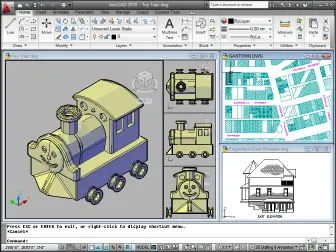
Figure 1-1 shows several kinds of drawings in AutoCAD 2010.
Figure 1-1: Cities, houses, little toy trains — what do you want to draw today?
Why choose AutoCAD? AutoCAD is just the starting point of a whole industry of software products designed to work with AutoCAD. Autodesk has helped this process along immensely by designing a series of programming interfaces to AutoCAD (but not, alas, to AutoCAD LT — see the “Seeing the LT” section later in the chapter) th...