This book, designed for engineers, technicians, designers and operators working with electrical networks, contains theoretical and practical information on the design and set-up of protection systems.
Protection of Electrical Networks first discusses network structures and grounding systems together with problems that can occur in networks. It goes on to cover current and voltage transformers, protection functions, circuit breakers and fuses.
Practical explanations of how protection systems function are given, and these, together with tables of settings, make this book suitable for any reader, irrespective of their initial level of knowledge.
- English
- ePUB (mobile friendly)
- Available on iOS & Android
eBook - ePub
Protection of Electrical Networks
About this book
Information
Chapter 1
Network Structures
Definition
Standard IEC 60038 defines voltage ratings as follows:
– Low voltage (LV): for a phase-to-phase voltage of between 100 V and 1,000 V, the standard ratings are: 400 V - 690 V - 1,000 V (at 50 Hz).
– Medium voltage (MV): for a phase-to-phase voltage between 1,000 V and 35 kV, the standard ratings are: 3.3 kV - 6.6 kV - 11 kV - 22 kV - 33 kV.
– High voltage (HV): for a phase-to-phase voltage between 35 kV and 230 kV, the standard ratings are: 45 kV - 66 kV - 110 kV - 132 kV - 150 kV - 220 kV.
In this chapter we will look at:
– types of HV and MV consumer substations;
– structure of MV networks inside a site;
– structure of LV networks inside a site;
– structure of systems with a back-up power supply.
Six standard examples of industrial network structures are given at the end of the chapter.
Each structure is commented upon and divided up so that each functional aspect can be considered.
(NC) means that the switch or circuit-breaker is closed in normal conditions.
(NO) means that the switch or circuit-breaker is open in normal conditions.
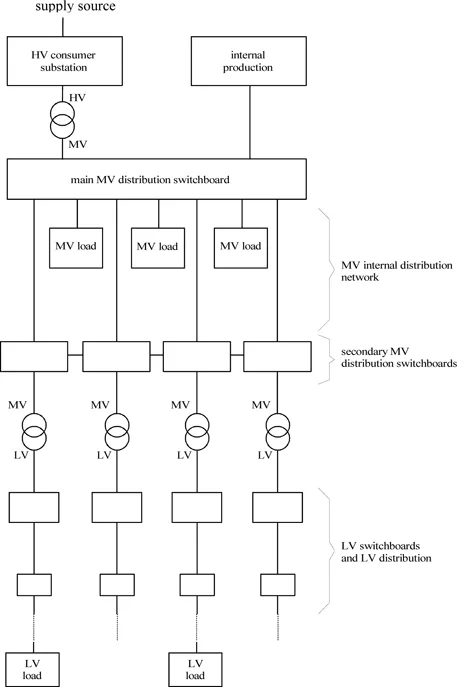
Figure 1-1: structure of a private distribution network
1.1. General structure of the private distribution network
Generally, with an HV power supply, a private distribution network comprises (see Figure 1-1):
– an HV consumer substation fed by one or more sources and made up of one or more busbars and circuit-breakers;
– an internal generation source;
– one or more HV/MV transformers;
– a main MV switchboard made up of one or more busbars;
– an internal MV network feeding secondary switchboards or MV/LV substations;
– MV loads;
– MV/LV transformers;
– low voltage switchboards and networks;
– low voltage loads.
1.2. The supply source
The power supply of industrial networks can be LV, MV or HV. The voltage rating of the supply source depends on the consumer supply power. The greater the power required, the higher the voltage must be.
1.3. HV consumer substations
The most usual supply arrangements adopted in HV consumer substations are:
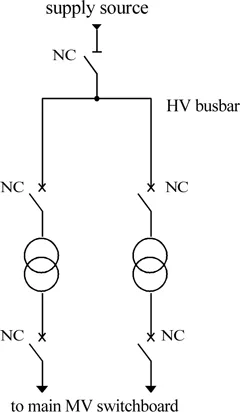
Single power supply (see Figure 1-2)
Advantage:
– reduced cost.
Disadvantage:
– low reliability.
Note: the isolators associated with the HV circuit-breakers have not been shown.
Figure 1-2: single fed HV consumer substation
Dual power supply (see Figure 1-3)
Figure 1-3: dual fed HV consumer substation
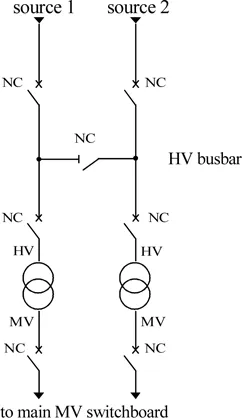
Operating mode:
– normal:
- Both incoming circuit-breakers are closed, as well as the coupler isolator.
- The transformers are thus simultaneously fed by two sources.
– disturbed:
- If one source is lost, the other provides the total power supply.
Advantages:
– Very reliable in that each source has a total network capacity.
– Maintenance of the busbar possible while it is still partially operating.
Disadvantages:
– More costly solution.
– Only allows partial operation of the busbar if maintenance is being carried out on it.
Note: the isolators associated with the HV circuit-breakers have not been shown.
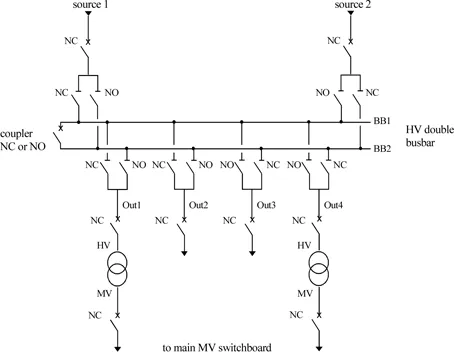
Dual fed double bus system (see Figure 1-4)
Operating mode:
– normal:
- Source 1 feeds busbar BB1 and feeders Out1 and Out2.
- Source 2 feeds busbar BB2 and feeders Out3 and Out4.
- The bus coupler circuit-breaker can be kept closed or open.
– disturbed:
- If one source is lost, the other provides the total power supply.
- If a fault occurs on a busbar (or maintenance is carried out on it), the bus coupler circuit-breaker is tripped and the other busbar feeds all the outgoing lines.
Advantages:
– Reliable power supply.
– Highly flexible use for the attribution of sources and loads and for busbar maintenance.
– Busbar transfer possible without interruption.
Disadvantage:
– More costly in relation to the single busbar system.
Note: the isolators associated with the HV circuit-breakers have not been shown.
Figure 1-4: dual fed double bus HV consumer substation
1.4. MV power supply
We shall first look at the different MV service connections and then at the MV consumer substation.
1.4.1. Different MV service connections
Depending on the type of MV network, the following supply arrangements are commonly adopted.
Single line service (see Figure 1-5)
The substation is fed by a single circuit tee-...
Table of contents
- Cover
- Title Page
- Copyright
- Chapter 1: Network Structures
- Chapter 2: Earthing Systems
- Chapter 3: Main Faults Occurring in Networks and Machines
- Chapter 4: Short-circuits
- Chapter 5: Consequences of Short-circuits
- Chapter 6: Instrument Transformers
- Chapter 7: Protection Functions and their Applications
- Chapter 8: Overcurrent Switching Devices
- Chapter 9: Different Selectivity Systems .
- Chapter 10: Protection of Network Elements
- Appendix A: Transient Current Calculation of Short-circuit Fed by Utility Network
- Appendix B: Calculation of Inrush Current During Capacitor Bank Energization
- Appendix C: Voltage Peak Value and Current r.m.s Value, at the Secondary of a Saturated Current Transformer
- Index
Trusted by 375,005 students
Access to over 1.5 million titles for a fair monthly price.
Study more efficiently using our study tools.
Frequently asked questions
Yes, you can cancel anytime from the Subscription tab in your account settings on the Perlego website. Your subscription will stay active until the end of your current billing period. Learn how to cancel your subscription
No, books cannot be downloaded as external files, such as PDFs, for use outside of Perlego. However, you can download books within the Perlego app for offline reading on mobile or tablet. Learn how to download books offline
We are an online textbook subscription service, where you can get access to an entire online library for less than the price of a single book per month. With over 1.5 million books across 990+ topics, we’ve got you covered! Learn about our mission
Look out for the read-aloud symbol on your next book to see if you can listen to it. The read-aloud tool reads text aloud for you, highlighting the text as it is being read. You can pause it, speed it up and slow it down. Learn more about Read Aloud
Yes! You can use the Perlego app on both iOS and Android devices to read anytime, anywhere — even offline. Perfect for commutes or when you’re on the go.
Please note we cannot support devices running on iOS 13 and Android 7 or earlier. Learn more about using the app
Please note we cannot support devices running on iOS 13 and Android 7 or earlier. Learn more about using the app
Yes, you can access Protection of Electrical Networks by Christophe Prévé in PDF and/or ePUB format, as well as other popular books in Technology & Engineering & Electrical Engineering & Telecommunications. We have over 1.5 million books available in our catalogue for you to explore.