- The only recent book to explicitly examine the philosophical issues surrounding hunting
- Shatters many of the stereotypes about hunting, forcing us to rethink the topic
- Features contributions from a wide range of academic and non-academic sources, including both hunters and non-hunters
eBook - ePub
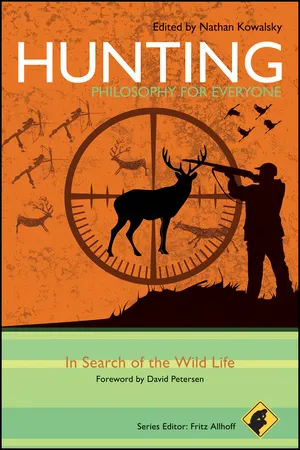
Hunting - Philosophy for Everyone
In Search of the Wild Life
- English
- ePUB (mobile friendly)
- Available on iOS & Android
eBook - ePub
About this book
Hunting - Philosophy for Everyone presents a collection of readings from academics and non-academics alike that move beyond the ethical justification of hunting to investigate less traditional topics and offer fresh perspectives on why we hunt.
Information
“To illustrate all this by a similar instance, I shall observe, that
there cannot be two passions more nearly resembling each other
than those of hunting and philosophy, whatever disproportion
may at first sight appear betwixt them.”
there cannot be two passions more nearly resembling each other
than those of hunting and philosophy, whatever disproportion
may at first sight appear betwixt them.”
David Hume, A Treatise of Human Nature,
book II, part III, section X
book II, part III, section X
FOREWORD
Hunting as Philosophy Professor
The out-of-doors is our true ancestral estate. For a mere few thousand years we have grubbed in the soil and laid brick upon brick to build the cities; but for millions of years before that we lived the leisurely, free, and adventurous life of hunters and gatherers. How can we pluck that deep root of feeling from the racial consciousness? Impossible!
Edward Abbey
In my long and shaggy life, I’ve known no better philosophy teacher than hunting. While non-hunters may initially scoff at the concept of “hunting as philosophy professor,” the thought-provoking essay collection to follow should broaden and deepen personal insights about life and death, and the interplay between the two, for all with open minds.
In my case, as one who examines life and death through the eyes of a self-styled neo-animist, many of the most useful lessons I’ve learned about the nature of human nature, including especially my own, have come through the practice, in both the practical and Zen meanings of the word, of hunting.
As hunters, much is revealed about us by the tools we choose to carry afield, the strategies we employ to bring game to bag, the ethics we embrace or ignore in seeking success, how we define hunting “success,” and how we talk about it all.
Yet, personal ethics aside, it’s entirely logical to ask, as so many non-hunters do, why anyone hunts today, when it’s no longer necessary for human physical survival. Put this question to the average hunter and he or she predictably will trot out such pragmatic motivations as meat, challenge, adventure, trophies (physical memorabilia), and companionship afield.
Yet in fact such “reasons” as these are merely enjoyable products of the hunt. Let’s take it another step and ask why we find wild meat, big antlers, personal challenge, outdoor adventure, campfire companionship, crisp autumn sunrises, and stinky elk wallows so viscerally exciting as to compel us to seek them fall after fall, often at considerable cost in money, time, and energy.
As Edward Abbey suggests, the tenacious human urge to hunt, which feels so much like instinct to those of us who know it, is instinct, arising from the deepest primitive core of our species’ memory; a genetic predisposition, often sublimated yet very much still with and within our opportunistic omnivorous species.
And the flip-side of this same coin, a self-evident biological fact that hunting’s harshest philosophical critics fail to grasp or at least to acknowledge, is that a complementary instinctive need to be hunted is built into all evolved prey species. Without the perpetual continuation of the precise sort of physical and mental exercise provided by predation and evasion, our spectacular prey species, so beautifully sculpted by the artful knife of natural selection, would soon devolve into mere thin shadows of their artful wild selves.
Predation and evasion comprise a sacred game, without which no living thing would be the same – without which no living thing would even be. In a world with no predation – where no living organism sucks its sustenance from other living organisms – there would be no food, no adaptive evolution, no quality control via culling of the least fit, and no you or me.
Unfortunately, many criticisms of contemporary hunting are valid. Outdoor catalogs clog the mails, all hawking flashy lethal toys, skill-crutches, and cheater technologies targeted at contemporary Wannabee hunters who don’t wannabee real hunters badly enough to invest the time, energy, and heart required to do it right.
Finding such traditional hunting values as woodsmanship too slow and unreliable, too many of today’s dilettante sportsmen are eagerly co-opted by advertising to take such ethically bankrupt shortcuts as motorized decoys, electronic game calls, map-friendly GPS units, cell and satellite telephones, night-vision optics, space-age compound arrow-launching devices and cross-guns posing as “archery equipment,” automatic game “feeders” (bait stations) that spray out showers of corn at preset times each day so that our “trophies” are conditioned to appear promptly, say at 8 a.m. and 4 p.m., thus relieving Bubba from the exhausting inconvenience of actually having to hunt.
To true hunters and the concerned non-hunting public, this stinky garbage – as grotesquely acted out on TV’s “outdoor” channels – is embarrassingly pathetic, leaving us to ask: “What’s the point? Why even bother doing a thing when there’s so much cheating and self-delusion involved that both goal and gain become transparent lies?”
Happily and hopefully, standing in staunch opposition to this “new generation” of “hunters in a hurry,” true, traditional-values hunters remain abundant, if far less visible – quietly thoughtful natural predators playing a proper, exacting, and essential role in the scheme of things. It is, after all (circling back to this essential key to comprehending hunting), predators, human and otherwise, who sculpted the sublime defensive tactics of their prey. Predator and prey: a quintessential symbiotic relationship and the engine that throughout life’s long history powered an upward-spiraling intellectual evolution among our own species, in team with a quest for survival perfection among all creatures great and small.
Consequently, if hunting were to be banned or even unwisely restricted, rather than gains in the welfare of wildlife, as animal rights zealots envision, we would see rapid increases in wildlife overpopulation and its horrific upshots – increased run-ins with automobiles, contagious disease, genetic decline, overgrazing leading to mass starvation, and general misery all around.
The essence of wildlife is wildness. And the heartbeat of wildness is predation.
To true hunters, the game, in both meanings of the term, remains sacred, to be approached with an attitude of process over product; doing more with less, a willful body/spirit immersion in a determined effort to reconnect as honestly and humbly as possible to our innate human/animal wildness, which is the human soul. Above all, the true hunter’s thoughts and actions are tempered by respect for our prey as expressed through self-restraint even when, as Aldo Leopold famously noted, no one is out there watching us (that’s the “sporting” part). For true hunters, the trip is the destination and “success” is measured not by quantity of game “harvested” (a simpering agricultural euphemism) but by the quality of the overall experience, start to finish.
No one grows stronger by always taking the easy trail. No one grows wiser by ditching school.
Apropos to the task at hand, Hunting – Philosophy for Everyone takes no shortcuts. Whether you approach this book with the biases of a hunter, a non-hunter, or an animal rights advocate, don’t be surprised to feel yourself, as I did, being gently jolted into having to rethink what you thought you knew about hunting all along. The innovative, deep-time revelations of Valerius Geist (“The Carnivorous Herbivore: Hunting and Culture in Human Evolution”), to flag but one chapter among many, are themselves worth the price of admission.
Not all hunting is the same.
Not all hunters are the same.
To blanket-brand hunting and hunters as either “bad” or “good” – black or white with no room for gray – is a trophy-class philosophical oversimplification.
We are both.
We are Homo sapiens.
ACKNOWLEDGMENTS
Wow, editing a book is not a one-man job! I must thank, first and foremost, Richard Kover, who started off as my editorial assistant, but who I now recognize, by rights, as my assistant editor. Richard has worked with me on this project from the beginning, kicking me in the pants to get moving with a proposal, helping to draft it and propose the subtitle that eventually stuck, going through hundreds of abstracts, providing extremely helpful first impressions of contributions, and generally hauling the load whenever necessary – in addition to his own research and writing responsibilities (including a piece for this volume). I am deeply indebted to him for his assistance.
Second, I cannot but thank the contributors themselves, who have dealt with unusually tight deadlines, to say nothing of their tolerance of my editorial pestering. I’m amazed that we all got along smashingly in spite of the incredibly volatile topic, but given everyone’s caliber, it’s no surprise to find myself thrilled by the quality of their finished essays. We’ve only communicated via the disembodied electronic media, yet it’s been an honor nonetheless. You feel like friends, and I can only hope that we can actually meet someday in person – and take each other up on the apple pies, muzzleloaders, cooking over a fire under the sky, bowmaking. . .
Third, I want to thank all the people who submitted abstracts in the hope of inclusion in this volume. It was truly overwhelming to have hundreds of abstracts arrive within the short space of a month in the middle of summer holidays, and I can only hope there will be other opportunities in the future for these insightful thinkers to showcase their ideas. We could have easily put together two volumes on this topic! Timothy, Jorge, Chuck, Leon, Baird, Jordan, Nathan, Keith, Samantha, Alexandria, John, Marc, Mary, Thomas, Richard, Don, Carla, Niall, Alastair . . . the list of awesome possibilities just keeps on going. I do hope we’ll get a chance to work together somehow, someday.
Fourth, I wish to thank the various persons and organizations who were so cooperative in helping me advertise the call for abstracts, including Larry Cahoone, Lee Foote and the Canadian Circumpolar Institute, Roger Brunt, Peter Flack and Gerhard Damm of African Indaba, T. J. Schwanky, Christine Roedlach of the Federation of Associations for Hunting and Conservation of the European Union (FACE), and more. Your support has been invaluable!
Fifth, my superiors at Wiley-Blackwell have been longsuffering and generous in their dealings with me, a newbie. Fritz Allhoff, Tiffany Mok, and Jeff Dean have provided me with advice, instruction, and other invaluable assistance at almost a moment’s notice. In this vein I also want to thank Margolee Horn, Tona Cota, Tracy Yurchak, and Ashley Blum at St. Joseph’s College, University of Alberta, for the administrative support they provided me throughout this process. Additionally, I am deeply indebted to Rique Edgar Brotherston, who proofread the entire manuscript, pro bono.
Finally (and sheepishly), I thank my loving wife Stephanie, who lived as a virtually single parent while I slaved away on this project, and our two dear daughters, Anya and Nina, who thought Daddy was sick because of all the time he spent holed up in the office. I love each of you more than I know how to say, and more than I know how to show.
Nathan Kowalsky
Edmonton, Alberta
Edmonton, Alberta
PICKING UP THE TRAIL
An Introduction to Hunting – Philosophy for Everyone
If I think about it, my earliest memories of hunting are with my Dad, and seeing . . . nothing. Well, not nothing, but no deer, anyway. I do remember lots of walking, lots of grass (or snow), lots of wind, and lots of Halloween candy in my pockets. But hunting as a child never involved seeing deer, let alone shooting them. However, for some odd reason, the day after I went hunting, I do recall Dad showing up at school with deer in the back of the van. That was a cool way to spend a lunch hour, checking out deer with your friends in the parking lot, but they were never my deer.
My luck changed for the better when I reached 14, which was the first time we went out hunting with a rifle and a license in my hands. Dad let me use his .30–30 lever action Marlin with open sights, and somehow or other we had managed to sneak into sight of a small whitetail buck browsing in some brush on the side of a hill, easily under 100 yards away. We were laying in prone position, and had all the time in the world to get a bead on that buck. It was my shot. I sat there with him in my sights, but I couldn’t pull the trigger! Nope, couldn’t do it. Not because I didn’t want to kill him, but because I wasn’t confident I’d kill him well. From my perspective, my gun sights were bigger than his body, so I had no idea if that bullet would hit him in the heart or in the legs. I was okay with killing the buck (so I thought), but I wasn’t okay with maiming him instead. This was nothing like shooting at a target.
So Dad took the shot instead. BANG! (Actually, all I heard was a loud, high-pitched “whee” sound that wouldn’t go away, my ears being in too much shock to register anything else.) The buck fell to his knees, and thrashed around in the brush for what seemed too long, and then lay still. I remember running like hell towards him, but probably only after Dad woke me up from my . . . well, you can’t call it a “reverie,” but it was a kind of mindlessness – as if there was only one thing that existed in the world, that buck, and my entire consciousness was nothing but a giant tube through which something else beyond me was able to look through the fabric of the universe and see that buck, right there, die. Whoosh.
After that, running. “Dad, is he dead? Dad, is he okay? Dad, did it hurt? Dad . . . ?” There was only one thing that mattered to me: that the buck was okay. And by okay, I meant that he was well dead. Death was always in the cards, but it had to be good. Weird, huh? I loved that buck, that one, right there. He deserved the right kind of death. And then I cried. Good God, I cried! I guess 14-year-old boys are allowed to. It’s always odd to consider why one cries. We cry when we’re happy, when we’re sad, when we’re relieved, and when we’re frustrated. We cry when we see beauty, and when we see horror. And yet neither of these things truly captured what I felt. I don’t know of any words that really could. But it was good to cry, and it was good that the buck died as he did (Dad was a good shot).
And then, it was good that I could touch him.
Hunting and philosophy? C’mon, don’t be ridiculous. The combination is almost an oxymoron! Everybody knows that philosophers don’t hunt, and that hunters don’t think, right? Elmer Fudd’s an idiot, and Socrates hung around downtown where all the interesting people are.
Well . . . yeah, not so much. But you know what I’m talking about, don’t you? It doesn’t matter if you’re a hunter, a non-hunter, or an anti-hunter, because we’re all familiar with the stereotype, and not without reason. We hear news stories about how many hunters accidentally shot their hunting companions this season, or we’ve heard of how hunters pull into a gas station (or a school, *cough-cough*) with a bunch of dead deer hanging out of the half-ton, and we all know that most hunters kill animals that are wild and free – even though they don’t have to. What kind of people do this? Surely not . . . philosophers.
Well let me just say this: I am a philosopher and a hunter, and I’m not the only one. In fact, I am an environmental philosopher because I’m a hunter. How’s that for a paradox? Here’s the thing about philosophy: if there isn’t a paradox to work with, there’s not much philosophy to be done. Hunting provides that paradox, and how! Life and death, together, right there in front of your face – and on your hands. How often do ...
Table of contents
- Cover
- Content
- Halftitle page
- Series page
- Title page
- Copyright
- Dedication
- Dedication-1
- Foreword
- Acknowledgments
- Introduction
- Part I The Good, the Bad, and the Hunter
- Part II The Hunter’s View of the World
- Part III Eating Nature Naturally
- Part IV The Antler Chandelier: Hunting in Culture, Politics, and Tradition
- Notes on Contributors
Trusted by 375,005 students
Access to over 1.5 million titles for a fair monthly price.
Study more efficiently using our study tools.
Frequently asked questions
Yes, you can cancel anytime from the Subscription tab in your account settings on the Perlego website. Your subscription will stay active until the end of your current billing period. Learn how to cancel your subscription
No, books cannot be downloaded as external files, such as PDFs, for use outside of Perlego. However, you can download books within the Perlego app for offline reading on mobile or tablet. Learn how to download books offline
We are an online textbook subscription service, where you can get access to an entire online library for less than the price of a single book per month. With over 1.5 million books across 990+ topics, we’ve got you covered! Learn about our mission
Look out for the read-aloud symbol on your next book to see if you can listen to it. The read-aloud tool reads text aloud for you, highlighting the text as it is being read. You can pause it, speed it up and slow it down. Learn more about Read Aloud
Yes! You can use the Perlego app on both iOS and Android devices to read anytime, anywhere — even offline. Perfect for commutes or when you’re on the go.
Please note we cannot support devices running on iOS 13 and Android 7 or earlier. Learn more about using the app
Please note we cannot support devices running on iOS 13 and Android 7 or earlier. Learn more about using the app
Yes, you can access Hunting - Philosophy for Everyone by Nathan Kowalsky, Fritz Allhoff in PDF and/or ePUB format, as well as other popular books in Philosophie & Geschichte & Theorie der Philosophie. We have over 1.5 million books available in our catalogue for you to explore.