![]()
Chapter 1
INTUITIVE MINDWARE
In this chapter I present the central idea of this book: that we each have two minds in one brain, an ‘intuitive mind’ and an ‘analytical mind’. The chapter goes on to describe four distinctive features of the intuitive mind, namely that it speaks in the language of feelings; it’s fast and spontaneous in its operation; it’s a holistic ‘pattern-recognition enabled system’; and it offers hypotheses rather than certainties.
Some years ago a man I’ll refer to as ‘Joe’ featured in a BBC TV documentary called ‘Brain Story’. Joe suffered from severe epilepsy which led to surgeons severing the connections between the left and the right hemispheres of his brain in order to treat his condition. After the surgery it soon became apparent that there had been an unintended consequence: as well as the beneficial outcome of his surgery Joe ended up, literally, with two separate brains. His party trick was to visualise two different shapes independently with each of his brains, for example a circle and a square, and draw one with each hand at the same time. Studies of Joe and hundreds more like him in a programme of scientific research that spanned half a century has revealed that the brain’s two hemispheres control vastly different aspects of thought and action: for example, the left hemisphere is dominant for language and speech, while the right specialises in spatial tasks. 1
The evidence for Homo sapiens’ ‘two brains’ design is unequivocal: but what about mind ? Is there more than one mind lurking inside our skulls? Can the ‘two minds model’ explain why reason (‘head’) and feeling (‘heart’) pull us in different directions, why we’re often ‘in two minds’ and unable to ‘make up our mind’? How can we reconcile and integrate these two systems of thinking and reasoning in a world where we can’t prevaricate forever, in which options have to be narrowed down, and where decisions have to be taken?
In Two Minds
The idea of the human psyche (which is taken from a Greek word meaning ‘soul’) as having two sides isn’t new. For example in ancient Greece - the god Apollo signified order, rationality and self-discipline alongside Dionysus - who represented the chaotic, instinctive and frenzied side of human nature. In ancient as well as modern-day Chinese wisdom the mental force of Yin signifies a ‘front-of-the-mind’ intellect which coexists alongside Yang - a ‘back-of-the-mind’ intuition.
2 Not only was this duality important to the ancient Greeks and Chinese, it also recurs throughout history. Humanity has witnessed the light and dark sides of political and business leadership and the two minds concept is a duality that’s reflected in many of our cultural icons, for example Shakespeare’s ‘thing of darkness’
3 or R.L. Stevenson’s
Dr. Jekyll and Mr. Hyde. It’s as relevant today as ever because:
1. it says something fundamental about the two-sidedness of human nature;
2. we can profit by balancing these two sides of our nature both in our professional and personal lives;
3. the analytical mind is no longer sufficient by itself in the face of the challenges that managers and business leaders are faced with.
The idea of two minds (‘intuitive’ and ‘analytical’4) in one brain is a dominant theme in modern psychology. Apollo/Dionysus and Yin/Yang, not to mention the dark and mysterious sub-consciousnesses in the works of Sigmund Freud and Carl Gustav Jung, are old ideas that contain undoubted insights, but from the perspective of the 21st century they’re the prehistory of the intuitive mind. Modern ideas about the two-sidedness of human consciousness draw on concepts ranging from evolutionary biology through to ‘dual-mind’ models from cognitive and social psychology; moreover for those interested in the micro-world of the intuitive mind the latest brain imaging techniques are beginning to pinpoint the neural geography of some of these processes. The modern view of Homo sapiens’ two minds is summarised below:
Key Facts No. 1: The Modern View of the Two Minds
We’re aware of the analytical mind not only because it’s under conscious control, but also because it ‘talks’ to us as inner speech in the language we’re most familiar with - words. We associate the idea of ‘the mind’ itself with logic and rational thought. Its workings are the epitome of human ‘intellect’ and reason. We’re perhaps not so familiar with the idea of an intuitive mind because it’s not under our conscious control (we’re not aware of the processes that lead up to an intuitive moment); it works effortlessly (having an intuition is easy, we don’t will it to happen) and it hasn’t got a voice (it can’t speak to us in the language of words, but it uses ‘hunch’ and ‘gut feeling’ instead). Some go as far as to imbue intuition with a ‘sixth sense’ of magic and mystery, but these ideas are dismissed by many in the scientific community as naïve and fanciful. We associate the idea of ‘intuition’ with the heart rather than the head, and in management ‘going with your gut’ is seen in many circles as the antithesis of rationality and, for that reason, undesirable and to be avoided if at all possible.
As Homo sapiens, literally ‘wise man’, we pride ourselves on our distinctive capacity to be rational - whether we are in practice is a different matter. As many political psychologists will vouch for, when it comes to choosing a Prime Minister or President the heart often wins out over the head. In elections people tend to vote by going with their judgement of how a candidate makes them feel (in other words their ‘gut’), and to many a candidate’s cost the slightest slip of the tongue can undermine voters’ feelings of trust. For example, in 1984 only a few months before the US elections President Ronald Regan was bidding for re-election. With an open microphone he prepared for a weekly radio address by doing a sound check with the following tongue-in-cheek assertion: ‘My fellow Americans, I’m pleased to tell you today that I’ve signed legislation that will outlaw Russia forever. We begin bombing in five minutes’. Millions heard his words including the Russians who, not unreasonably, demanded an apology. Reagan’s popularity plummeted; he won in the November election, but with a much-reduced margin of victory. Evolution has hard-wired human beings to gravitate to potential leaders who bring ‘emotional dividends’, those who inspire our hopes or assuage our fears.5 Nowhere was this more apparent than in post-George W. Bush America with the election of Barack Obama.
From a purely practical point of view we need an analytical and an intuitive mind to get by day-in day-out. Without two minds life would be so effortful and demanding that we’d end up being unable to function, overwhelmed by the number, range and complexity of the tasks we face. For example, on a quite basic level the intuitive mind makes it possible to do fairly complex, but everyday, tasks in personal and professional life on ‘auto-pilot’. Getting home from work by walking, driving the car, or taking train or bus is quite a complex activity done without much conscious thought at all (think about the first time you made what is now a familiar home to work journey). Giving over some of the basic ‘housekeeping’ of our lives to the lower reaches of the intuitive mind means we can devote our precious analytical thinking resources to other less mundane issues. But this is not to say that tasks completed on ‘auto-pilot’ use intuition as such; they don’t, they’re purely habituated responses that share some of the features of the type of intuition that is the focus of this book (for example, they don’t take up much conscious thinking power).
It’s the complex, informed intuitions which form the basis of managers’ and leaders’ business instincts and these work best when managers and leaders have the requisite amount of experience to draw on in order to be able to make judgements or come to decisions based on what worked well in the past. These judgements can manifest themselves in everything from how to close a sales deal or knowing when and where to invest on the stock market, to what’s the right direction in which to take a business. The analytical mind is (re-)engaged:
1. when there’s an unexpected turn of events, for example when an intuitive entrepreneur has to re-think when a business opportunity has suddenly become closed off;
2. if a manager needs to take decisions that haven’t been encountered before, for example when moving into overseas markets where culture-specific intuitions may not work.
The intuitive mind comes into its own when we need to make complex personal and social judgements in all walks of life. Often the most complex decisions we face are people-related or job-related and many of these don’t have a clear right or wrong answer at the time when they have to be taken. For example, what could be more important, or speculative, than deciding where to live, who to marry, who to hire, whether or not to take a job offer, or which business to invest in?
The Two Minds Model
The two minds model, which has been a dominant theme in psychology for several decades, has been given renewed impetus by scientific developments in a variety of areas, including evolutionary biology and cognitive neuroscience.
1. The analytical mind is a recently evolved powerful, general purpose system with the power to monitor, intervene and over-ride the intuitive mind - it’s a cognitive heavyweight that can solve some of life’s most demanding intellectual and computational problems.
2. The intuitive mind is a more ancient much nimbler, fleet-of-foot set of systems that operates effortlessly alongside the analytical mind. It’s especially potent when we’re faced with important social, aesthetic, creative and moral judgements - all of which are crucial aspects of decision-making in businesses that aspire to be people-centred, sustainable, responsible and ethical.
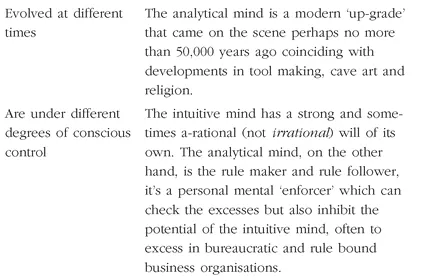
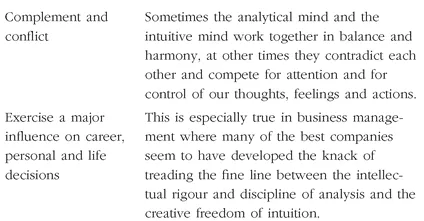
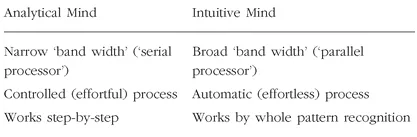
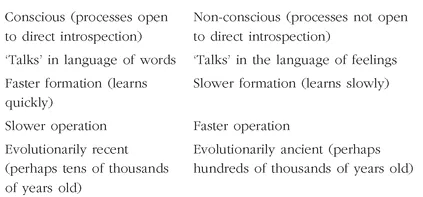
Research conducted by psychologists and others over the past decade and a half suggests that the differences between the intuitive and analytical minds can be summarised as follows: 6
Key Facts No. 2: The Two Minds Model
The interplay between the analytical and the intuitive mind is an inherent tension in the human psyche. My experience of being ‘me’ is that my thoughts and actions are things which the conscious analytical ‘me’ determines and which I control. However, if I stick to this restricted view of ‘me’ I may in fact be fooling myself and operating under an illusion of control in spite of the fact that my non-conscious, intuitive mind may have its hand on the tiller guiding my thoughts, feelings and actions in ways that are unknowable to me. 7 The analytical mind operates on the assumption, or perhaps under the delusion, that it’s in charge, when actually the intuitive mind may have a greater say in what goes on than we prefer to think.
THE SCIENCE OF THE INTUITIVE MIND - WHO’S IN CHARGE?
Researchers working at the Max Planck Institute in Leipzig found that by monitoring people’s brain signals in decision-making experiments they could predict which button-pressing option they’d take a full seven seconds before they consciously took the decision. Normally researchers are interested in what happens when a decision is made or shortly after, the Leipzig scientists were interested in what happens immediately before a conscious choice is arrived at...