![]()
Chapter 1
Introduction
About This Book
This book is designed to help make A Guide to the Project Management Body of Knowledge (PMBOK ® Guide)—Fourth Edition more accessible to project managers. The PMBOK ® Guide is a standard, therefore it defines what is considered to be a good practice on most projects most of the time. Notice it does not define best practices, it defines good practices. Best practices tend to be industry and organization specific. Because the PMBOK ® Guide is a standard it is not descriptive. In other words, it doesn’t tell you how to implement those practices, it merely identifies them.
The PMBOK ® Guide also promotes a common vocabulary for project management, thereby enabling effective communication about project management between project managers, their sponsors, and their team members.
Many project managers, PMOs, and organizations mistake the PMBOK ® Guide as a project management methodology. It is not. A project management methodology is a set of practices, policies, procedures, guidelines, tools, techniques, etc. that are used to manage projects. This book is not a methodology. This book takes the information in the PMBOK ® Guide and describes it in easily understandable language and explains how to apply the various tools and techniques. In short, it makes the PMBOK ® Guide easier to understand and helps you implement the practices described therein.
The information in this book is based solely on information from the PMBOK ® Guide—Fourth Edition. Therefore you will find identical definitions and some of the same tables and figures.
To help make this book easier to read we are using various features such as definitions, examples, tips, and sample forms. At the beginning of each process we describe the process and then show a data flow diagram from the PMBOK ® Guide so you can see how information flows through the process, where it comes from, and where it goes to next. We have presented the inputs, tools and techniques, and outputs in a table at the appropriate place in the discussion for each of the processes. In some instances, we provide a list of elements typically found in a particular document. Sometimes we include sections of forms that show how you can use a form or template to record the information in the document. These forms can be found in The Project Manager’s Book of Forms, published by PMI and John Wiley & Sons.
Project Management Process Groups
The project management standard is presented as 42 discrete processes. A process is a set of interrelated actions and activities performed to achieve a pre-specified product, result, or service. Processes are comprised of inputs, tools and techniques, and outputs. Therefore, this book will follow that structure of presenting a process and then discussing the individual inputs, tools and techniques, and outputs that comprise the process.
Input. Any item, whether internal or external to the project, that is required by a process before that process proceeds. May be an output from a predecessor process.
Tool. Something tangible, such as a template or software program, used in performing an activity to produce a product or result.
Technique. A defined systematic procedure employed by a human resource to perform an activity to produce a product or result or deliver a service, and that may employ one or more tools.
Output. A product, result, or service generated by a process. May be an input to a successor process.
To facilitate understanding of the processes, PMI has identified five Process Groups. These groups are: Initiating Process Group, Planning Process Group, Executing Process Group, Monitoring and Controlling Process Group, and the Closing Process Group.
Initiating Process Group. Those processes performed to define a new project or new phase of an existing project by obtaining authorization to start the project or phase.
Planning Process Group. Those processes required to establish the scope of the project, refine the objectives, and define the course of action required to attain the objectives that the project was undertaken to achieve.
Executing Process Group. Those processes performed to complete the work defined in the project management plan to satisfy the project specifications.
Monitoring and Controlling Process Group. Those processes required to track, review, and regulate the progress and performance of the project; identify any areas in which changes to the plan are required; and initiate the corresponding changes.
Closing Process Group. Those processes performed to finalize all activities across all process groups to formally close the project or phase.
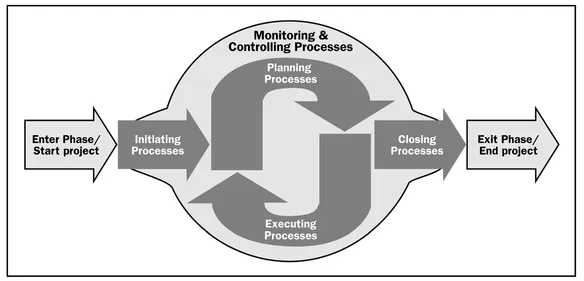
Note in the following figure how the Process Groups interact with each other in each phase of the project and for the project overall. The processes in the Initiating Process Group are used to identify the high-level definition of the project or phase and obtain authorization to proceed. Once this is accomplished the high-level information can be further elaborated in the Planning Process Group. Of course, we don’t only plan at the start of the project. We spend much of the first part of our project planning, but as we get into the Executing Process Group, where we are actually creating and developing the work of the project, we will need to plan in finer levels of detail and re-plan when things do not go as expected. In fact, the Monitoring and Controlling Process Group is used to compare our planned progress to our actual progress. If the two are acceptably consistent, we continue on with the project work. If they are not, we will need to plan corrective or preventive actions to get our performance aligned with our plan. Finally, we will use the Closing Process Group to finalize the work and archive the phase or project information.
Figure 1-1
Project Management Process Groups
Source: PMBOK ® Guide—Fourth Edition, page 40.
Project Management Knowledge Areas
Another way to categorize the project management processes is by Knowledge Area. PMI identifies nine Knowledge Areas:
• Project Integration Management
• Project Scope Management
• Project Time Management
• Project Cost Management
• Project Quality Management
• Project Human Resource Management
• Project Communications Management
• Project Risk Management
• Project Procurement Management
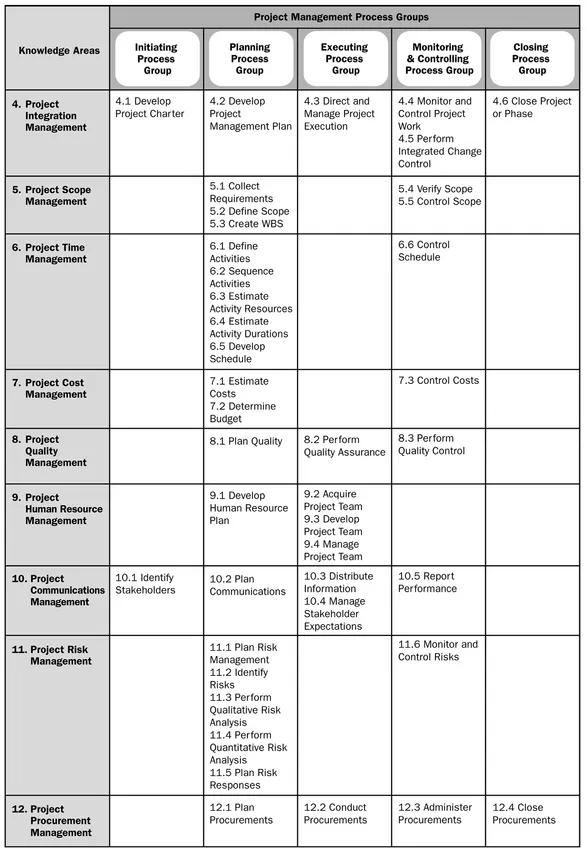
The following figure shows how each of the 42 project management processes aligns with the Project Management Process Groups and the Project Management Knowledge Areas.
This book will use the Process Groups rather than the Knowledge Areas to present information. In Chapter 2 we will review some of the key concepts in project management; then in Chapter 3 we will discuss the Initiating Processes. The next several chapters will discuss the Planning Processes. This will be followed by chapters on the Executing Processes, Monitoring and Controlling Processes, and finally, the Closing Processes.
Figure 1-2
Project Management Process Groups and Knowledge Areas Mapping
Source: PMBOK ® Guide—Fourth Edition, page 43.
Project Integration Management includes the processes and activities needed to identify, define, combine, unify and coordinate the various processes and project management activities within ...