"This book is like a good tour guide.It doesn't just describe the major attractions; you share in the history, spirit, language, and culture of the place."
--Henning Schulzrinne, Professor, Columbia University
Since its birth in 1996, Session Initiation Protocol (SIP) has grown up. As a richer, much more robust technology, SIP today is fully capable of supporting the communication systems that power our twenty-first century work and life.
This second edition handbook has been revamped to cover the newest standards, services, and products. You'll find the latest on SIP usage beyond VoIP, including Presence, instant messaging (IM), mobility, and emergency services, as well as peer-to-peer SIP applications, quality-of-service, and security issues--everything you need to build and deploy today's SIP services.
This book will help you
* Work with SIP in Presence and event-based communications
* Handle SIP-based application-level mobility issues
* Develop applications to facilitate communications access for users with disabilities
* Set up Internet-based emergency services
* Explore how peer-to-peer SIP systems may change VoIP
* Understand the critical importance of Internet transparency
* Identify relevant standards and specifications
* Handle potential quality-of-service and security problems
eBook - ePub
Internet Communications Using SIP
Delivering VoIP and Multimedia Services with Session Initiation Protocol
- English
- ePUB (mobile friendly)
- Available on iOS & Android
eBook - ePub
Internet Communications Using SIP
Delivering VoIP and Multimedia Services with Session Initiation Protocol
About this book
Information
Chapter 1
Introduction
The telecommunications, television, and information technology (IT) network industries are all transformed by the Internet. The transformation is driven by the need for growth based on new services, more complete global coverage, and consolidation. In this chapter, we will explore some of the problems and solutions for end users and every type of business because of the profound disruptions caused by the Internet.
Problem: Too Many Public Networks
Before the emergence of the Internet, users and service providers were generally accustomed to thinking in terms of four distinct network types: Networks for IT (data), networks for voice, mobile networks, and networks for television. Each of these dedicated network types could, in turn, be divided into many incompatible regional and even country-specific flavors with different protocol variants.
Thus, we find many types of telephony numbering plans, signaling, and audio encodings; several TV standards; and various types and flavors of what the telecom industry calls data networks—all of them incompatible and impossible to integrate into one single global network.
The mobile telephone networks have converged on a smaller number of standards in the second generation (2G) networks and in the emerging third generation (3G) mobile networks. It may turn out, however, that with the proliferation of new radio technologies for the so-called 4th generation (4G), such as Wi-Fi and WiMAX, all modern mobile networks will become just a wireless access mechanism to the Internet, where all public communications, entertainment, and applications will reside anyhow.
Data networks that originated in the telecom industry came in many forms, such as digital private lines, X.25, Integrated Services Digital Network (ISDN), Switched Multimegabit Data Service (SMDS), Frame Relay, and Asynchronous Transfer Mode (ATM) networks. These so-called data networks were mostly inspired by circuit-switched telephony concepts. Their names are meant to suggest that they were not designed primarily to carry voice.
Voice networks are still used for data and fax because of their general availability, though less and less so. However, these networks have come to the end of their evolution, since they are fundamentally optimized for voice only. TV networks were designed and optimized for the distribution of entertainment video streams.
Needless to say, all network types (data, voice, TV, and mobile) have specific end-user devices that cannot be ported to other service providers or network types, and most often cannot be globally deployed.
The impact of the Internet has made the wired and wireless phone companies and the TV cable companies look for new business models that can take advantage of Internet technologies and protocols, among them the Session Initiation Protocol (SIP) for real-time communications, such as Voice over IP (VoIP), instant messaging (IM), video, conferencing/collaboration, and others. Examples of the various categories and their business models are illustrated in Table 1.1. We assume that most readers are familiar with the acronyms used in the table, and we also explain these acronyms and terms in the book. They can also be found in the index.
Table 1.1 Internet Communications in 2005 with Examples from North America
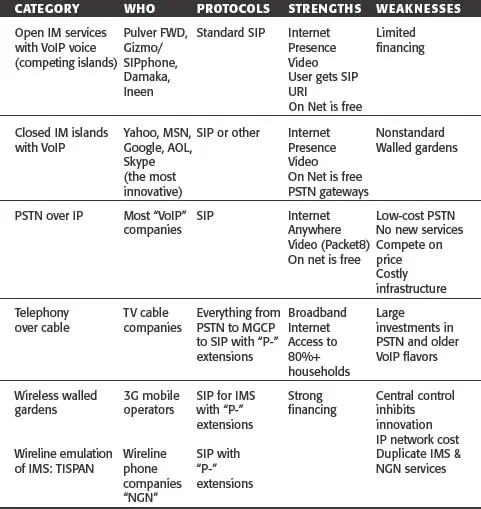
The proliferation of isolated communication islands as shown in Table 1.1 makes them less useful as their number keeps increasing (think of many more communication islands all over the world). Building communication islands (also called “walled gardens”) is in conflict with Metcalfe’s law that the value of the network increases by the square of the number of connected endpoints. Last, but not least, in case of an emergency, having many networks that cannot communicate directly is not very helpful.
Closed networks are an impediment for innovation, since innovators must work (technology and legal agreements) with every closed network separately to bring a new service or product to market. By contrast, the Internet extends the reach for new applications and services instantly to the whole world.
Another observation from Table 1.1 is that the strongest financing available is at present for closed networks (walled gardens), the ones that are most limited in reach and usefulness. This raises business issues and regulatory questions (what are the public interest obligations, if any?) that are beyond the scope of this book.
Incompatible Enterprise Communications
Enterprise communication systems are often an even greater mix of incompatible and disjoint systems and devices:
- Proprietary PBX and their phones. Phones from one PBX cannot be used by another.
- Instant messaging is a separate system from the PBX.
- Various IM systems don’t talk to each other.
- Voice conferencing and web-based collaboration use yet other systems.
Maintaining various incompatible and nonintegrated proprietary enterprise systems is quite costly and reduces the overall productivity of the workforce.
Network Consolidation: The Internet
The Internet has benefited from a number of different fundamentals compared to legacy networks, such as the tremendous progress of computing technology and the open standard Internet protocols that define it. This progress can be attributed to the expertise of the research, academic, and engineering communities whose dedication to excellence and open collaboration on a global basis have surpassed the usual commercial pressure for time-to-market and competitive secrecy.
The result is an Internet that uses consistent protocols on a global basis, and is equally well suited to carry data, transactions, and real-time communications, such as instant messaging (IM), voice, video, and conferencing/collaboration. Actually, the Internet is the “dumb network,” designed for any application, even those not yet invented. This is in stark contrast to the isolated “walled gardens” with central control of all services illustrated in Table 1.1.
Voice over IP
Although the Internet has quickly established itself as the preeminent network for data, commercial transactions, and audio-video distribution, the use of voice over the Internet has been slower to develop. This has less to do with the capability of the Internet to carry voice with equal or higher quality than the telephone network but rather with the complex nature of signaling in voice services, as you will see in Chapter 6, “SIP Overview.”
There are various approaches for voice services over the Internet, based on different signaling and control design. Some examples include the following:
- Use signaling concepts from the telephone industry—H.323, MGCP, MEGACO/H.248.
- Use control concepts from the telephone industry—central control and softswitches.
- Use the Internet-centric protocol—Session Initiation Protocol (SIP), the topic of this book.
The movement from such concepts as telephony call models to discovery/rendezvous and session setup between any processes on any platform anywhere on the Internet is opening up completely new types of communication services.
The use of SIP for establishing voice, video, and data sessions places telephony as just another application on the Internet, using similar addressing, data types, software, protocols, and security as found, for example, on the World Wide Web or e-mail.
Separate networks for voice are no longer necessary, and this is of great consequence for all wired and wireless telephone companies.
Complete integration of voice with all other Internet services and applications probably provides the greatest opportunity for innovation. The open and distributed nature of this service and the “dumb” network model will empower many innovators, similar to what has happened with other indust...
Table of contents
- Cover
- Contents
- Title
- Copyright
- Dedication
- Foreword
- Acknowledgments
- Introduction
- Chapter 1: Introduction
- Chapter 2: Internet Communications Enabled by SIP
- Chapter 3: Architectural Principles of the Internet
- Chapter 4: DNS and ENUM
- Chapter 5: Real-Time Internet Multimedia
- Chapter 6: SIP Overview
- Chapter 7: SIP Service Creation
- Chapter 8: User Preferences
- Chapter 9: SIP Security
- Chapter 10: NAT and Firewall Traversal
- Chapter 11: SIP Telephony
- Chapter 12: Voicemail and Universal Messaging
- Chapter 13: Presence and Instant Messaging
- Chapter 14: SIP Conferencing
- Chapter 15: SIP Application Level Mobility
- Chapter 16: Emergency and Preemption Communication Services
- Chapter 17: Accessibility for the Disabled
- Chapter 18: Quality of Service for Real-Time Internet Communications
- Chapter 19: SIP Component Services
- Chapter 20: Peer-to-Peer SIP
- Chapter 21: Conclusions and Future Directions
- Index
Trusted by 375,005 students
Access to over 1.5 million titles for a fair monthly price.
Study more efficiently using our study tools.
Frequently asked questions
Yes, you can cancel anytime from the Subscription tab in your account settings on the Perlego website. Your subscription will stay active until the end of your current billing period. Learn how to cancel your subscription
No, books cannot be downloaded as external files, such as PDFs, for use outside of Perlego. However, you can download books within the Perlego app for offline reading on mobile or tablet. Learn how to download books offline
We are an online textbook subscription service, where you can get access to an entire online library for less than the price of a single book per month. With over 1.5 million books across 990+ topics, we’ve got you covered! Learn about our mission
Look out for the read-aloud symbol on your next book to see if you can listen to it. The read-aloud tool reads text aloud for you, highlighting the text as it is being read. You can pause it, speed it up and slow it down. Learn more about Read Aloud
Yes! You can use the Perlego app on both iOS and Android devices to read anytime, anywhere — even offline. Perfect for commutes or when you’re on the go.
Please note we cannot support devices running on iOS 13 and Android 7 or earlier. Learn more about using the app
Please note we cannot support devices running on iOS 13 and Android 7 or earlier. Learn more about using the app
Yes, you can access Internet Communications Using SIP by Henry Sinnreich,Alan B. Johnston in PDF and/or ePUB format, as well as other popular books in Computer Science & Computer Networking. We have over 1.5 million books available in our catalogue for you to explore.