The ultimate Canadian guide to prescription medication
Over half of all Canadians take at least one prescription drug, but most of us know very little about the medication we're taking, including why we've been prescribed anything in the first place. Understanding Prescription Drugs Canadians For Dummies will answer many of the questions Canadians have about prescription drugs, but were afraid ask our doctors and pharmacists. Topics covered include:
* What a prescription drug is
* Common concerns
* Side effects
* Ailments and drugs used to treat them
* Prescribing practices
Understanding Prescription Drugs For Canadians For Dummies will go beyond the encyclopedic and often overwhelming information offered in massive pill books on the Web. It will empower readers, providing them with the knowledge they need as responsible consumers.
eBook - ePub
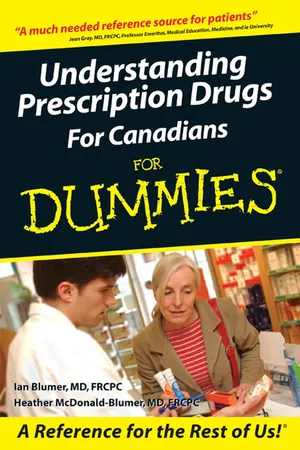
Understanding Prescription Drugs For Canadians For Dummies
- English
- ePUB (mobile friendly)
- Available on iOS & Android
eBook - ePub
Understanding Prescription Drugs For Canadians For Dummies
About this book
Information
Part I
A Healthy Look at Prescription Drugs
In this part . . .
We look at what prescription drugs are, how they differ from non-prescription medicines, how they work, and how they are taken. We discuss how you can work with your pharmacist and doctor to get the best possible results from your therapy. Lastly, we look at warning labels, package inserts, and information sheets and the information they convey — and, just as important, what critical information they may leave out.
Chapter 1
Prescription Drugs and You
In This Chapter
Appreciating what prescription drugs can — and can’t — do for you
Understanding how you can work with your doctor and pharmacist
Considering the best ways to treat what ails you
Becoming familiar with your prescription drugs
Making common concerns less concerning
Checking out all your options
If you’re like most people we know, the only thing you’d rather do less than take a prescription drug is not take one when you should have. Or, to (woefully) paraphrase Prime Minister William Lyon Mackenzie King, “Prescription if necessary, but not necessarily prescription.” Medicines are something never to take lightly, but thank goodness they are there to help us when we need them. And that reality of life is why we’ve created this book to assist you.
In Understanding Prescription Drugs For Canadians For Dummies, we look at how you can work with your physician and pharmacist to most safely and effectively manage your medicines. We discuss the best medicines to treat what ails you, and how they work. We look at how your medicines can help you, and how your medicines can harm you. We share, to quote Sergio Leone, the good, the bad, and the ugly — even if you’ve paid handsomely for that ugly medicine. (Speaking of which, one of the things we talk about is how you can pay less handsomely for your drugs: see Chapter 10.)
Prescription Drugs: The Basics
Prescription drugs are brilliant. They can reach every nook and cranny of your body to help you overcome infections, fight cancer, control diabetes, avoid heart attacks, and quell arthritis.
Prescription drugs are dumb. They often are unable to cure a disease, may cause unpleasant side-effects, frequently are costly, and typically are a nuisance to remember.
And how do Canadians deal with this paradox? Well, Canadians are clearly believers in prescription drugs, seeing as, in 2005, $20 billion was spent in this country on 400 million prescriptions. Yet, Canadians often are not very happy believers; at least judging by the comments (“Doctor, I feel like a walking drugstore”) that physicians so often hear as their patients walk into the office, shopping bag full of medicines in hand.
And yes, having to take prescription medicines might make you feel hard done by. And if you feel that way, we don’t blame you one little bit. But what wonderful health benefits so many people can get from these same medicines. So, sure — if you want to curse that bag full of drugs, we understand. But we also understand if you look at your medicines and say to yourself, “Hey, these medicines aren’t an anchor pulling me down, they’re a helping hand lifting me up.” It’s your call.
Prescription drugs may be yin and yang, good and bad, but whichever way we look at them we’ve got to, well, look at them. Swallowing a pill, putting on an ointment, or inserting a suppository isn’t the end of the story — heck, it’s not even the beginning. If you’re going to safely and effectively take your medicine, you need to know some key things about it such as how to take your drug. Do you swallow it on an empty stomach, or take it with food? Do you need to avoid grapefruit (yes, grapefruit) or alcohol? What side-effects should you watch for? What should you do if side-effects occur?
Millions of Canadians benefit from taking prescription medicines. But many thousands of Canadians suffer from taking them. And some, tragically, even die from them. We’ve written Understanding Prescription Drugs For Canadians For Dummies to provide you with the information you need to do everything possible to benefit from your prescription medicines and to minimize the likelihood you’ll be harmed by them.
You may well have enough on your plate, and feel that having to educate yourself about your medication is simply one more nuisance you don’t have time for. Truth be told, however, effectively and safely taking prescription drugs requires a team effort, and the more people you have working together for the common goal of keeping you healthy, the more likely your goal will be reached. Hassle? You bet. Worthwhile? You bet!
Your Doctor, Your Pharmacist, and You
Understanding Prescription Drugs For Canadians For Dummies provides you with the tools to effectively work with your health care team. You’ll discover the different roles that your doctor, your pharmacist, and you have in this partnership. You’ll find out what to make sure your doctor tells you before you leave her office, and what to find out from your pharmacist before you walk away from the counter (such as who will provide refills for your medicine and, for that matter, how you’ll know if you even need a refill). Who do you need to call if you’re having side-effects from your drug? How should you store your medicine? In the first four chapters, we address these topics and more, including how you can help your health care providers avoid making prescribing and dispensing errors.
Your doctor and your pharmacist not only care for you, but also care about you. (And if they don’t, change health care providers, and fast!) Caring about you means they’ll be thrilled if you work with them in the cause of safe drug-taking. We’d bet dollars to donuts your pharmacist checks, double-checks, and possibly even triple-checks your prescription medicine before he hands it to you. (We’re so sure, we’d even bet dollars to Timbits. Not that we’ve ever had Timbits, of course — we’ve especially never had the double chocolate ones … you know, the glazed ones with the cake-like centre? Hmm, mmm.) So, if your doctor has written a prescription that clearly says “metoprolol” on it, you can be awfully certain your pharmacist will dispense “metoprolol” to you.
But what if the medicine you are prescribed has a name that is very similar to another, unrelated drug and your doctor’s handwriting is stereotypically poor? Might the pharmacist misinterpret it? Well, stuff happens. For instance, clozapine has been mistakenly dispensed instead of olanzapine. Lamisil has been mistakenly dispensed instead of Lomotil. Losec has been mistakenly dispensed instead of Lasix. And the list goes on . . .
The likelihood of these sorts of errors is very small. But you can make the likelihood that much smaller by using the information in this book to inform yourself about your medicines. That way, if your doctor hands you a prescription for, say, Lasix to treat ankle swelling and you discover your pill bottle says the medicine is Losec, you’ll be able to see if these are simply different names for the same medicine or if they are different drugs altogether (which, by the way, they are). With the help of this book, you can more readily recognize something ...
Table of contents
- Cover
- Table of Contents
- Title Page
- Introduction
- Part I: A Healthy Look at Prescription Drugs
- Part II: Ailments A to Z
- Part III: Medications A to Z
- Part IV: Common Concerns
- Part V: The Part of Tens
Trusted by 375,005 students
Access to over 1.5 million titles for a fair monthly price.
Study more efficiently using our study tools.
Frequently asked questions
Yes, you can cancel anytime from the Subscription tab in your account settings on the Perlego website. Your subscription will stay active until the end of your current billing period. Learn how to cancel your subscription
No, books cannot be downloaded as external files, such as PDFs, for use outside of Perlego. However, you can download books within the Perlego app for offline reading on mobile or tablet. Learn how to download books offline
Perlego offers two plans: Essential and Complete
- Essential is ideal for learners and professionals who enjoy exploring a wide range of subjects. Access the Essential Library with 800,000+ trusted titles and best-sellers across business, personal growth, and the humanities. Includes unlimited reading time and Standard Read Aloud voice.
- Complete: Perfect for advanced learners and researchers needing full, unrestricted access. Unlock 1.5M+ books across hundreds of subjects, including academic and specialized titles. The Complete Plan also includes advanced features like Premium Read Aloud and Research Assistant.
We are an online textbook subscription service, where you can get access to an entire online library for less than the price of a single book per month. With over 1.5 million books across 990+ topics, we’ve got you covered! Learn about our mission
Look out for the read-aloud symbol on your next book to see if you can listen to it. The read-aloud tool reads text aloud for you, highlighting the text as it is being read. You can pause it, speed it up and slow it down. Learn more about Read Aloud
Yes! You can use the Perlego app on both iOS and Android devices to read anytime, anywhere — even offline. Perfect for commutes or when you’re on the go.
Please note we cannot support devices running on iOS 13 and Android 7 or earlier. Learn more about using the app
Please note we cannot support devices running on iOS 13 and Android 7 or earlier. Learn more about using the app
Yes, you can access Understanding Prescription Drugs For Canadians For Dummies by Ian Blumer,Heather McDonald-Blumer, MD in PDF and/or ePUB format, as well as other popular books in Medicine & Pharmacology. We have over 1.5 million books available in our catalogue for you to explore.