- English
- ePUB (mobile friendly)
- Available on iOS & Android
eBook - ePub
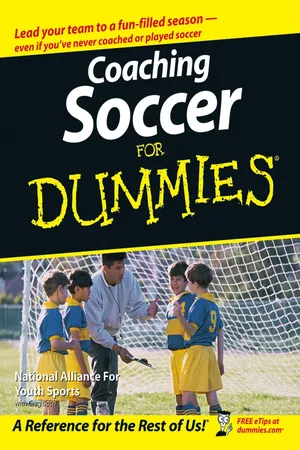
Coaching Soccer For Dummies
About this book
Packed with drills and tips for practice and game days
The fun and easy way(r) to kick-start your soccer coaching skills
Volunteering as a youth soccer coach can be a great experience, both for you and your squad. But what if you've never coached before? Don't worry! This friendly guide explains soccer rules, shows you how to approach coaching, and gives you practical pointers on improving your team's soccer skills and encouraging good sportsmanship.
Discover how to
- Understand soccer rules
- Develop a coaching philosophy
- Teach soccer fundamentals
- Run great practices
- Lead your team during a game
- Communicate effectively with parents
Frequently asked questions
Yes, you can cancel anytime from the Subscription tab in your account settings on the Perlego website. Your subscription will stay active until the end of your current billing period. Learn how to cancel your subscription.
No, books cannot be downloaded as external files, such as PDFs, for use outside of Perlego. However, you can download books within the Perlego app for offline reading on mobile or tablet. Learn more here.
Perlego offers two plans: Essential and Complete
- Essential is ideal for learners and professionals who enjoy exploring a wide range of subjects. Access the Essential Library with 800,000+ trusted titles and best-sellers across business, personal growth, and the humanities. Includes unlimited reading time and Standard Read Aloud voice.
- Complete: Perfect for advanced learners and researchers needing full, unrestricted access. Unlock 1.4M+ books across hundreds of subjects, including academic and specialized titles. The Complete Plan also includes advanced features like Premium Read Aloud and Research Assistant.
We are an online textbook subscription service, where you can get access to an entire online library for less than the price of a single book per month. With over 1 million books across 1000+ topics, we’ve got you covered! Learn more here.
Look out for the read-aloud symbol on your next book to see if you can listen to it. The read-aloud tool reads text aloud for you, highlighting the text as it is being read. You can pause it, speed it up and slow it down. Learn more here.
Yes! You can use the Perlego app on both iOS or Android devices to read anytime, anywhere — even offline. Perfect for commutes or when you’re on the go.
Please note we cannot support devices running on iOS 13 and Android 7 or earlier. Learn more about using the app.
Please note we cannot support devices running on iOS 13 and Android 7 or earlier. Learn more about using the app.
Yes, you can access Coaching Soccer For Dummies by Greg Bach in PDF and/or ePUB format, as well as other popular books in Biological Sciences & Sport & Exercise Science. We have over one million books available in our catalogue for you to explore.
Information
Part I
Getting Started Coaching Soccer

In this part . . .
B efore you take the field with your young troops for the first time, do yourself, and your team, a big favor by diving into some behind-the-scenes homework that will lay the foundation for a smooth-running season. The homework includes outlining your coaching philosophy, understanding how your league operates, and learning the basic rules of the sport. You find all the information to get your season headed in the right direction in this part.
Chapter 1
Teaching Soccer to Children
In This Chapter

Congratulations on your decision to coach a youth soccer team this season. You’re embarking on a wonderful journey that will be filled with many special moments that both you and your players — regardless of their age or skill level — will remember for the rest of your lives.
Before you step on the field, you need to be aware that you’re taking on a very important role. How you manage the youngsters on your team, and the way you interact with them during practices and games, affects how they feel about the sport and even themselves for years to come. How you handle the lengthy list of responsibilities that comes with the job either helps them develop an unquenchable passion for the game or drains their interest in ever participating again.
All you need — besides a whistle and clipboard — is some good information to guide you through the season. In this chapter, you find useful, straightforward insight and tips to help you and your team have a safe, fun, and rewarding season.
Doing Your Homework
Whether you volunteered to coach youth soccer this season because you want to spend more time with your child or because the league has a shortage of coaches and you’re willing to step forward, you’re accepting a responsibility that you can’t take lightly. Before you roll out the soccer balls at your first practice, you have plenty of work to do behind the scenes to ensure that the season gets off to a smooth start.
Working with — and not against — parents
The overwhelming majority of parents with children involved in organized youth soccer programs are a supportive and caring group who want only the best for their children. Of course, parents in the minority can turn out to be a source of season-long aggravation that you may be forced to deal with. You can head off many potential problems by gathering the parents together before you begin the season and laying the ground rules on what you expect in terms of behavior during games, as well as their roles and responsibilities.
Coaches and parents finding ways to work together — the adult form of teamwork — is a formula that produces tremendous benefits for the youngsters. Coaches and parents who clash over everything from playing time to why Junior isn’t getting to play sweeper spoil the experience for that child, and quite possibly others as well, when the negativity seeps into the team’s practice sessions and envelops game day.


Despite your best efforts, problems may arise with parents. Our advice is to remain calm and in control of your emotions, and never allow situations to escalate. Check out Chapter 19, where we help you troubleshoot this issue and other problems coaches are most likely to face throughout the season.
Deciphering rules and mastering terminology
You’ve taken the job of teaching kids the world’s most popular sport, and if you’re like many volunteer coaches today, chances are pretty good that you never played soccer growing up. Therefore, to fulfill your responsibilities, you have to get a good handle on the basics of the game and be able to explain rules, introduce terminology, and teach strategies to your young players. Sound complicated? It isn’t; it just takes a little time and effort on your part to learn some of the quirky rules (like offside) and some of the terms (like corner kicks and indirect free kicks) that are at the heart of this great game. We open up the rulebook in Chapter 3 and cover all the terms that you need to know. And we concentrate on the skills, techniques, and strategies that you need to pass along to your kids throughout Parts II and III of this book. Whether you need to brush up on fundamental skills for a beginning team or work out a defensive formation when you play against that high-octane older squad, we have you covered.

Taking the Field
Coaching youth soccer is all about the kids, their smiles, and their eagerness to get started learning from you and developing skills under you. What you say and do from day one through the course of...
Table of contents
- Title
- Contents
- Introduction
- Part I : Getting Started Coaching Soccer
- Chapter 1: Teaching Soccer to Children
- Chapter 2: Getting Organized
- Chapter 3: Getting Up to Speed with the Basics
- Part II : Building Your Coaching Skills
- Chapter 4: Meet the Parents
- Chapter 5: Getting to Know Your Team
- Chapter 6: Running a Great Practice
- Chapter 7: Getting Your Game On
- Chapter 8: Refining Your Approach at Midseason
- Part III : Beginning and Intermediate Soccer
- Chapter 9: Teaching the Fundamentals
- Chapter 10: Fundamental Drills
- Chapter 11: Coaching Offense 101
- Chapter 12: Coaching Defense 101
- Chapter 13: Coaching Restarts
- Chapter 14: Taking Practice Drills to the Next Level
- Part IV : Advanced Soccer Strategies
- Chapter 15: Coaching Offense 201
- Chapter 16: Coaching Defense 201
- Chapter 17: Implementing Advanced Drills
- Part V : The Extra Points
- Chapter 18: Keeping Kids Healthy and Injury Free
- Chapter 19: Dealing with Common Coaching Challenges
- Chapter 20: Taking Your Show on the Road
- Part VI : The Part of Tens
- Chapter 21: Ten Ways to Make the Season Memorable
- Chapter 22: Ten Ways to End the Season on a High Note