Over the last 50 years, the methods of investigating dynamic properties have resulted in significant advances. This book explores dynamic testing, the methods used, and the experiments performed, placing a particular emphasis on the context of bounded medium elastodynamics. Dynamic tests have proven to be as efficient as static tests and are often easier to use at lower frequency. The discussion is divided into four parts. Part A focuses on the complements of continuum mechanics. Part B concerns the various types of rod vibrations: extensional, bending, and torsional. Part C is devoted to mechanical and electronic instrumentation, and guidelines for which experimental set-up should be used are given. Part D concentrates on experiments and experimental interpretations of elastic or viscolelastic moduli. In addition, several chapters contain practical examples alongside theoretical discussion to facilitate the readers understanding. The results presented are the culmination of over 30 years of research by the authors and as such will be of great interest to anyone involved in this field.
Trusted by 375,005 students
Access to over 1.5 million titles for a fair monthly price.
From an experimental point of view, the elastic and/or viscoelastic characterization of materials is not necessarily achieved simply by using an existing piece of industrial apparatus.
To begin with, the researcher has to choose the experimental set-up, taking the following items into account:
– the type of wave, whether progressive or stationary;
– the measurement technique;
– the numerical method to calculate the elastic (or viscoelastic) modulus or stiffness coefficient.
In this chapter, choice criteria as well as selection guidelines are presented. The following topics will be discussed in turn:
– choice of matrix coefficient(s) (stiffness or compliance matrix) to be evaluated;
– frequency range in which tests are to be conducted;
– shape and dimensions of the sample;
– temperature range to be adopted;
– viscoelastic properties of the material frequency dependence, damping capacity, etc.
– available previsional calculations (for composite materials) which enable the order, or the range, of elastic constants to be obtained.
1.1. Choice of matrix coefficient to be evaluated and type of wave to be adopted
1.1.1. For isotropic materials
The number of elastic constants is reduced to two, chosen from five available elastic constants: Young's modulus, E; shear modulus, G; Poisson's number, ν; volumic dilatation, K; and the stiffness coefficient Ciiii related to an extensional wave. For mechanical applications at low and medium frequency range (f ≤ 10,000 Hz), a compliance matrix [S] is preferred.
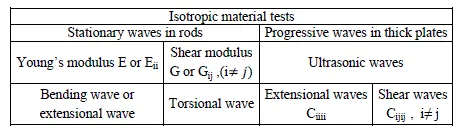
Table 1.1. The two classes of tests to be selected when the text material is isotropic
In Table 1.1 the two classes of tests1 permitting the evaluation of a compliance matrix [S] and a stiffness matrix [C] are presented. A bending wave enables the Young's modulus to be obtained, and a torsional wave, the shear modulus. A bending wave is preferred to an extensional wave for many practical reasons2:
– the ease with which measurements are effected;
– a bending wave dispersion is completely portrayed by the fourth order equation of motion (Mindlin–Timoshenko's equation or, with restriction at lower a frequency range, Bernoulli–Euler's equation);
– an extensional wave is the other possibility. However, at medium and higher frequency ranges, a sixth order equation of motion is referred to and consequently it is more difficult to handle the characteristic functions.
The ultrasonic method is easy to carry out. A thick plate sample must be chosen so as to produce, with some care, progressive waves (extensional or shear) in the samples. The wavelength Λ through thickness h satisfies the following inequality:
[1.1]
1.1.2. For anisotropic materials
The number of elastic constants depends on the degree of symmetry of the material. Remember that the number of different constants required for various materials is as follows:
– transverse isotropic material (long fibers regularly distributed in resin matrix): 5 constants;
– quasi-isotropic (cubic) material: 3 constants.
If preliminary information about the material is known (for example the degree of material symmetry [CHE 10]), the samples (number and shape) can be tailored with respect to the symmetry axis of the material. For a rod sample, its axis can be chosen to be coincident or different from the axis of symmetry of the material. For plates in ultrasonic tests, the material axis of symmetry may be collinear (or not) with the plate axis along the thickness, and the propagation direction of waves in any direction is obtained by transducer orientations.
1.1.2.1. Orthotropic material
Figure 1.1 shows three rods (of rectangular or square section) which are fabricated with a rod axis collinear with one material axis. From these three samples, six compliance matrix coefficients can be obtained:
[1.2]
[1.3]
Three remaining non-diagonal coefficients are to be evaluated. For this purpose, three other rod samples are fabricated. These samples are off-axis rods. The angles formed by the rod axis and the reference axis related to the material must be optimized, as in Figure 1.1(b).
The three off-axis samples permit the three non-diagonal compliance coefficients to be evaluated.
Fi...
Table of contents
Cover
Title Page
Copyright
Preface
Acknowledgements
PART I: Mechanical and Electronic Instrumentation
PART II: Realization of Experimental Set-ups and Interpretation of Measurements
List of Authors
Index
Frequently asked questions
Yes, you can cancel anytime from the Subscription tab in your account settings on the Perlego website. Your subscription will stay active until the end of your current billing period. Learn how to cancel your subscription
No, books cannot be downloaded as external files, such as PDFs, for use outside of Perlego. However, you can download books within the Perlego app for offline reading on mobile or tablet. Learn how to download books offline
Perlego offers two plans: Essential and Complete
Essential is ideal for learners and professionals who enjoy exploring a wide range of subjects. Access the Essential Library with 800,000+ trusted titles and best-sellers across business, personal growth, and the humanities. Includes unlimited reading time and Standard Read Aloud voice.
Complete: Perfect for advanced learners and researchers needing full, unrestricted access. Unlock 1.5M+ books across hundreds of subjects, including academic and specialized titles. The Complete Plan also includes advanced features like Premium Read Aloud and Research Assistant.
Both plans are available with monthly, semester, or annual billing cycles.
We are an online textbook subscription service, where you can get access to an entire online library for less than the price of a single book per month. With over 1.5 million books across 990+ topics, we’ve got you covered! Learn about our mission
Look out for the read-aloud symbol on your next book to see if you can listen to it. The read-aloud tool reads text aloud for you, highlighting the text as it is being read. You can pause it, speed it up and slow it down. Learn more about Read Aloud
Yes! You can use the Perlego app on both iOS and Android devices to read anytime, anywhere — even offline. Perfect for commutes or when you’re on the go. Please note we cannot support devices running on iOS 13 and Android 7 or earlier. Learn more about using the app
Yes, you can access Mechanical Characterization of Materials and Wave Dispersion by Yvon Chevalier, Jean Vinh Tuong, Yvon Chevalier,Jean Vinh Tuong in PDF and/or ePUB format, as well as other popular books in Technology & Engineering & Materials Science. We have over 1.5 million books available in our catalogue for you to explore.