The depiction of the content with diagrams aids the process of quick reference and ease of understanding. The tools and techniques can be utilised across the whole range of organisational sectors, both private and public. The purpose is not to short cut formal learning, but to provide easy access to a 'toolbox' of tried and tested management approaches through a collection of models, tools and occasional brief notes which consultants, managers and scholars can use in a practical way.
eBook - ePub
The Essential Management Toolbox
Tools, Models and Notes for Managers and Consultants
- English
- ePUB (mobile friendly)
- Available on iOS & Android
eBook - ePub
The Essential Management Toolbox
Tools, Models and Notes for Managers and Consultants
About this book
A must have for all practising and aspiring consultants and strategists, this book covers a wide range of consultancy tools and techniques that are well displayed, well described and well referenced. The tools and techniques are helpfully divided in to twenty recognisable skills sectors within management consultancy fields and specialisms.
CHAPTER 1
BUSINESS PLANNING
This chapter covers the task of business planning which is applicable to all businesses whether a sole trader or a multinational conglomerate. The production of a business plan is needed to describe the business, its objectives, its strategies, the market it is in and its financial forecasts. It is often used as a tool for measuring the performance of the organization against that intended over a short- or medium-term period, typically three to five years. For many new businesses the business plan may be used as a tool to promote an interest in the business and to secure external funding and as such needs to be undertaken as a serious task. In addition to this, a business plan has several other purposes as it:
• Prompts management to logically examine the business in a structured way and consider what it currently does and what it wishes to do in the future.
• Encourages management to set future business objectives and then monitor progress against the plan.
• Identifies the resources and time needed to implement the business plan.
• Can be used to communicate the key features of the business plan to employees and provide them with an awareness of the business’s direction.
• Provides links to the detailed, short-term functional strategies.
This chapter also shows the basic stages in producing a business plan and the planning cycle which also looks at past performance and what needs to be addressed as new targets and objectives. Indeed the focus on the business plan is likely to be on three areas: setting realistic goals for the business to aim for, demonstrating how its objectives will be met and finally identifying what resources in terms of people, plant and investment will be required by the organization to achieve the plan.
Although there is no set formula for the contents of a business plan, a typical layout is provided in this chapter as a good starting model for those embarking on its production. For those who do so with an external reader in mind - bank, shareholders, etc. - then adopting a common format is likely to convince the lender that the organization at least knows how to portray its business and ambitions in a professional and recognizable way. On completion of the task a checklist on the business plan feasibility is also included, this covers the key questions on the management, marketing and financial aspects of the plan which need to be addressed either directly or indirectly in the plan.
For new businesses the business plan should also describe how the company will operate from its launch until it has established itself in the market. In practice there should be a detailed narrative on the first six months as this is when costs in establishing the business are being incurred - in developing a market, recruiting staff, negotiating with suppliers, etc. - contrasted with no or low income, particularly if part of a supply chain, when customers’ terms of payment are unlikely to be favourable in terms of timescale and hence the subject of cash flow needs to be described. Having invested time, effort and some cost in producing the business plan with its objectives clearly articulated, this should not be limited to senior management or shareholders but should be used in the business and updated as new environmental opportunities and threats arise. This tool will help to keep track of current performance and development plans. The final point to consider is that business planning is not a on/off isolated event; it needs to be used, reviewed and periodically repeated to ensure that the business is achieving its desired level of performance.
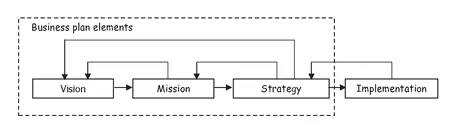
TRADITIONAL APPROACH TO STRATEGIC IMPLEMENTATION AND BUSINESS PLANNING
While this model presents the ideal approach, in practical terms this is a much more inter-related process; however, the benefit of the model is to illustrate that determining the Vision and Mission are important steps in strategy formulation and in setting the business plan.
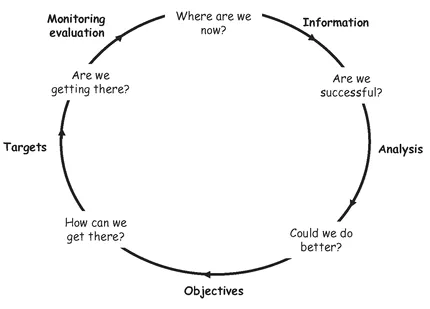
THE PLANNING CYCLE
This simple model has links into research and data gathering, analysis and options studies, strategic management in the form of setting objectives and finally in performance management often related to people performance objectives. While this is shown here in a business planning context it also has applications at an individual level as part of career appraisal and personal development and in training needs identification.
UNDERSTANDING THE PRODUCT/SERVICE
This is a typical approach which can be used to understand a product or service business with a client organization to demonstrate and promote the planning process.
The questions shown below, together with establishing a view of the future for the organization and...
Table of contents
- Title Page
- Copyright Page
- Dedication
- Foreword
- Introduction
- Acknowledgements
- CHAPTER 1 - BUSINESS PLANNING
- CHAPTER 2 - CHANGE MANAGEMENT
- CHAPTER 3 - CUSTOMER RELATIONSHIP MANAGEMENT
- CHAPTER 4 - DECISION MAKING AND PROBLEM RESOLUTION
- CHAPTER 5 - FINANCIAL MANAGEMENT
- CHAPTER 6 - INTERNATIONAL MANAGEMENT
- CHAPTER 7 - MARKETING MANAGEMENT
- CHAPTER 8 - ORGANIZATIONAL DEVELOPMENT
- CHAPTER 9 - PEOPLE-FOCUSED PERFORMANCE MANAGEMENT
- CHAPTER 10 - PROCESS IMPROVEMENT
- CHAPTER 11 - PRODUCT MANAGEMENT
- CHAPTER 12 - PROJECT MANAGEMENT
- CHAPTER 13 - QUALITY MANAGEMENT
- CHAPTER 14 - RISK MANAGEMENT
- CHAPTER 15 - STRATEGIC MANAGEMENT
- CHAPTER 16 - SUPPLY CHAIN MANAGEMENT
- CHAPTER 17 - TIME MANAGEMENT
- CHAPTER 18 - UNDERTAKING RESEARCH
- CHAPTER 19 - WORKING AS A MANAGEMENT CONSULTANT
- CHAPTER 20 - WORKSHOP FACILITATION
- REFERENCES
- INDEX
Trusted by 375,005 students
Access to over 1.5 million titles for a fair monthly price.
Study more efficiently using our study tools.
Frequently asked questions
Yes, you can cancel anytime from the Subscription tab in your account settings on the Perlego website. Your subscription will stay active until the end of your current billing period. Learn how to cancel your subscription
No, books cannot be downloaded as external files, such as PDFs, for use outside of Perlego. However, you can download books within the Perlego app for offline reading on mobile or tablet. Learn how to download books offline
Perlego offers two plans: Essential and Complete
- Essential is ideal for learners and professionals who enjoy exploring a wide range of subjects. Access the Essential Library with 800,000+ trusted titles and best-sellers across business, personal growth, and the humanities. Includes unlimited reading time and Standard Read Aloud voice.
- Complete: Perfect for advanced learners and researchers needing full, unrestricted access. Unlock 1.5M+ books across hundreds of subjects, including academic and specialized titles. The Complete Plan also includes advanced features like Premium Read Aloud and Research Assistant.
We are an online textbook subscription service, where you can get access to an entire online library for less than the price of a single book per month. With over 1.5 million books across 990+ topics, we’ve got you covered! Learn about our mission
Look out for the read-aloud symbol on your next book to see if you can listen to it. The read-aloud tool reads text aloud for you, highlighting the text as it is being read. You can pause it, speed it up and slow it down. Learn more about Read Aloud
Yes! You can use the Perlego app on both iOS and Android devices to read anytime, anywhere — even offline. Perfect for commutes or when you’re on the go.
Please note we cannot support devices running on iOS 13 and Android 7 or earlier. Learn more about using the app
Please note we cannot support devices running on iOS 13 and Android 7 or earlier. Learn more about using the app
Yes, you can access The Essential Management Toolbox by Simon Burtonshaw-Gunn in PDF and/or ePUB format, as well as other popular books in Business & Decision Making. We have over 1.5 million books available in our catalogue for you to explore.