At last, a more inspired approach to business. Business Genius describes how to grow your business more effectively through intelligent strategy and imaginative leadership, radical innovation and sustained change. Combining the entrepreneurial passion of a start-up with the commercial rigour of large enterprises... this is for everyone who seeks the inspiration to think and act differently.
Business Genius helps you drive more profitable, sustainable growth in today's fast changing and connected markets. It explores the challenges of strategy and innovation, leadership and change as you grow your business, and yourself, in order to achieve high performance.
From the craze for Crocs to the cool of Diesel, the secrets of Kikkoman and energy of Red Bull, the vision of Google and disruption of Current TV, the revolution of P&G and the phenomenon of Umpqua – the book captures the best insights from around the world, and a new agenda for today's business.
Seeing things differently is the foundation of genius. Connecting your left and right brain to think more holistically, exploring opportunities from the future back as well as now forward – then doing business from the outside in rather than the inside out, in order to turn radical ideas into practical action.
TRACK 1: FAST GROWTH Driving and accelerating business growth
‘You either step forward into growth or you will step back into safety’
Abraham Maslow
Growth is easy, isn’t it?
Discount your prices and your revenue goes up. Recognizing that you also need to make a profit, you cut your costs and the margins quickly improve. Wanting to drive even more dramatic growth, you acquire another company and you can double your size in no time. But it doesn’t last.
Sustaining growth is not easy. Sustaining profitable growth is hard. Creating significant and sustainable growth is the imperative for every small business, and indeed the challenge for every large business today.
Achieving great results creates the expectation that you can do it again and again. You need to sustain it. Investors want to see evidence of the future profit streams that will give them a decent long-term return on their investments. Customers recognize that growing companies are doing something right and want to be part of it. Employees know that growth creates a bigger pie in which they can take a thicker slice.
Yet few companies manage to sustain profitable growth. They appear to reach a stumbling block when they reach the perceived limits of their current world, their existing markets and models, capabilities and ambitions, energy or inspiration.
With their heads down and spreadsheets buzzing, they seek to squeeze more out of their existing markets – an extra point of market share, another derivative product development or a more efficient process, that might secure a slightly greater margin. These things matter, but they don’t create growth that is significant and sustainable.
The obsession with doing more of the same, through optimization or small improvements, is a significant obstacle growth. Fractions of market share or profit margins will help, but won’t make the real difference. The danger is that we plough the same furrow, exploiting what we know best, delivering the same products, doing what we have always done slightly better.
We lose sight of the changing world outside.
We end up playing the old game, whilst oblivious to a new game – a new market, a new customer desire, a new business model. And because we prefer to make the most of what we have, we become hindered by our existing business, locked in our past and current success. The real danger is that incrementalism leads to irrelevance.
So how does a business, large or small, create and sustain profitable growth?
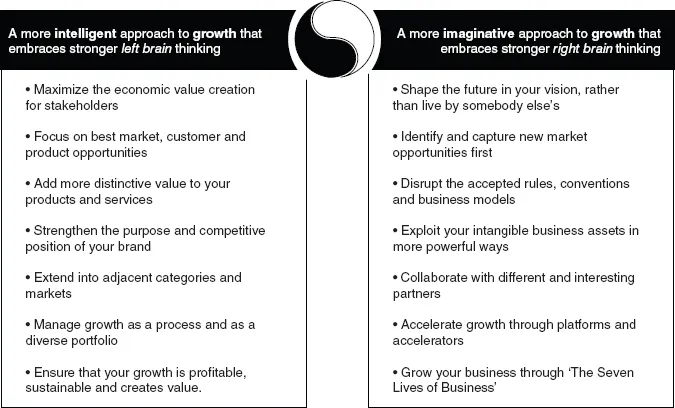
The answer is already in our heads. As human beings we have an enormous capacity to think, to sense and respond, to innovate and change. We each have 100 trillion brain cells, and probably use about 1% of them at any time. At an incredibly simple level we can categorize our brains into left and right sides – reflecting our ability to think intelligently and imaginatively, analytically and intuitively, sequentially and holistically.
Yet it is the connections between these that really matters. In Einstein’s case, his brain remained the object of fascination and research for many years, scientists concluding that it was in some ways different – not simply bigger, but better connected. The grey matter in our heads is connected by white matter. So it is perhaps this white stuff, the connective tissue, that holds more clues to our own genius, and the best opportunities for personal and business growth.
The successful growth business is firstly an imaginative business. It then intelligently focuses on the best opportunities. Whilst most of today’s businesses are dominated by left-brain thinking, it is the right-brain thoughts that unlocks newness and enables them to start new things, and make the leaps forward.
Growth businesses succeed by thinking more broadly – seeing a bigger picture, a more holistic view of the market challenges and opportunities. They see a broader context, and by doing so they see more opportunities to exploit, more ways to be different, more sources of future profit.
And the more you have to choose from, the richer your options, the more likely you are to find the best, and the more sustainable you can be in exploiting them.
This might seem overly ambitious, particularly for a small business struggling to survive. Yet, even a few people with dedicated time can apply enormous brainpower to thinking more broadly, deeply and clearly – new thinking that could deliver extraordinary results.
Large businesses need a mix of people with left- and right-brain preferences, or ideally both. Small businesses must choose their colleagues with even more care. The visionary, creative, intuitive entrepreneur – from Richard Branson to Bill Gates – has always sought a more focused, analytical manager to be their side-kick.
More intuitive, more divergent, more holistic thinking enables us to see things differently, and thereby to think and do different things – to challenge conventions, to explore new possibilities, to hypothesize alternatives. More logical, more convergent, more focused thinking then enables you to choose the best markets, products, customers and approaches to focus your resources to be successful in this wider world.
Today’s high growth business is an inspired business, fusing imaginative stretch and intelligent focus in order to deliver extraordinary results.
Imaginative with your right brain. Intelligent with your left brain. Inspired whole brain thinking.
1.1 THE SEVEN LIVES OF BUSINESS The challenge of growth, the challenge of change
The origins of business thinking go far back. Three thousand years ago, the Chinese developed their word for ‘business’, based on two ancient symbols – the first refers to ‘birth’ and ‘life’ and the second to ‘meaning’. It seems that the Chinese recognised that growth, sustained with an enduring purpose, is fundamental to business success back then, just like we do today.
Growing businesses have different characteristics, challenges and opportunities, as they evolve from start-ups into much larger organizations. Most companies don’t recognize the growth phases that they move through; they suffer from the growing pains without recognizing what to do, and they miss the best opportunities which each phase uniquely offers.
What is required to sustain a growing business?
What are the biggest challenges and opportunities at each phase?
What are the most appropriate styles of leadership and management as it grows?
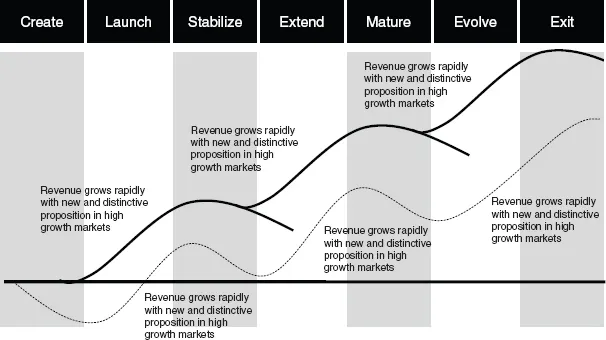
There are typically seven stages in the life of a business. Of course, every organization and market is different, and some companies will choose to stay small, whilst others will grow huge, and may well be split up to become small businesses that can grow again. Just like the mountaineer setting out from base camp, the gentle foothills will require very different skills, different clothing and a different pace from climbing the icy peaks.
THE SEVEN LIVES OF BUSINESSES
While each life-stage is partly a result of the business’s age, size and performance, it is also distinguished by its structure and sophistication. Some companies will evolve rapidly and others slowly, some will leap through life. Some evolved companies will still be small, maybe virtual, whilst some large companies might still be quite primitive. You can probably think of a few.
Their challenges are different. Small businesses want to get noticed, capture a new market, gain customers, and ensure that they drive enough cash flow to survive, and hopefully thrive. Large companies have an equally tough challenge in seeking to remain innovative, find new markets and to take their organizations with them.
The objectives of each life-stage are different and, therefore, the approach is too. Unlike the natural world, this is rarely a natural evolution. It requires deliberate thought and desire, hard choices and decisive management. Moving from one phase to the next will require change – in strategy, people, activities, leadership and even ownership.
Some of the changes as companies seek to evolve will be painful.
Entrepreneurs love their small, chaotic, personal worlds. Small teams don’t like being torn apart or having more structures and...
Table of contents
Cover
Contents
Title Page
Copyright
Credits
About The Author
Inspiration
PART: 1: Right Brain, Left Brain
PART: 2 Future Back, Now Forward
PART: 3 Outside In, Inside Out
PART: 4 Radical Ideas, Practical Action
The Genius Lab
Index
End User License Agreement
Trusted by 375,005 students
Access to over 1.5 million titles for a fair monthly price.
Study more efficiently using our study tools.
Frequently asked questions
Yes, you can cancel anytime from the Subscription tab in your account settings on the Perlego website. Your subscription will stay active until the end of your current billing period. Learn how to cancel your subscription
No, books cannot be downloaded as external files, such as PDFs, for use outside of Perlego. However, you can download books within the Perlego app for offline reading on mobile or tablet. Learn how to download books offline
Perlego offers two plans: Essential and Complete
Essential is ideal for learners and professionals who enjoy exploring a wide range of subjects. Access the Essential Library with 800,000+ trusted titles and best-sellers across business, personal growth, and the humanities. Includes unlimited reading time and Standard Read Aloud voice.
Complete: Perfect for advanced learners and researchers needing full, unrestricted access. Unlock 1.5M+ books across hundreds of subjects, including academic and specialized titles. The Complete Plan also includes advanced features like Premium Read Aloud and Research Assistant.
Both plans are available with monthly, semester, or annual billing cycles.
We are an online textbook subscription service, where you can get access to an entire online library for less than the price of a single book per month. With over 1.5 million books across 990+ topics, we’ve got you covered! Learn about our mission
Look out for the read-aloud symbol on your next book to see if you can listen to it. The read-aloud tool reads text aloud for you, highlighting the text as it is being read. You can pause it, speed it up and slow it down. Learn more about Read Aloud
Yes! You can use the Perlego app on both iOS and Android devices to read anytime, anywhere — even offline. Perfect for commutes or when you’re on the go. Please note we cannot support devices running on iOS 13 and Android 7 or earlier. Learn more about using the app
Yes, you can access Business Genius by Peter Fisk in PDF and/or ePUB format, as well as other popular books in Business & Decision Making. We have over 1.5 million books available in our catalogue for you to explore.