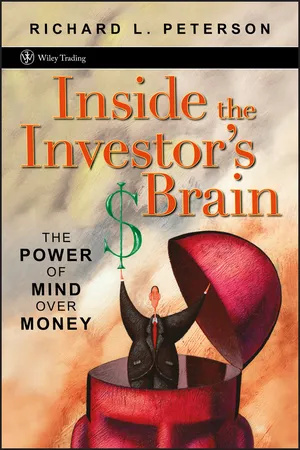
Inside the Investor's Brain provides readers with specific techniques for understanding their financial psychology, so that they can improve their own performance and learn how to outsmart other investors. Chapter by chapter, author Richard Peterson addresses various mental traps and how they play a role in investing. Through examples, such as a gambling experiment with playing cards, the author shows readers how being aware of the subconscious can separate the smart investors from the average ones. This book also contains descriptions of the work of neuroscientists, financial practitioners, and psychologists, offering an expert's view into the mind of the market. Innovative and accessible, Inside the Investor's Brain gives investors the tools they need to better understand how emotions and mental biases affect the way they manage money and react to market moves.
- English
- ePUB (mobile friendly)
- Available on iOS & Android
eBook - ePub
About this book
Unique insights into how the mind of an investor operates and how developing emotional awareness leads to long-term success
Key takeaways
AI-Generated Insights
Insight 1
Explain the fundamental neural and chemical processes that underpin investor behavior and decision-making in financial markets.
Insight 2
Analyze how specific emotions, cognitive biases, and psychological factors influence individual investment choices and contribute to broader market dynamics.
Insight 3
Apply behavioral finance techniques to manage emotional responses, mitigate cognitive biases, and develop strategies for improved long-term investment performance.
PART I
Foundations
The Intersection of Mind and Money
CHAPTER 1
Markets on the Mind
The Challenge of Finding an Edge
—Warren Buffett
Even though trillions of dollars change hands in the financial markets every day, most active investors cannot find an edge over their competition. They are vulnerable to psychological biases that impair their investment decisions, and their profitability is eroded. Consider the fate of Internet-era day traders.
Day traders typically aim to earn money from small intraday price movements and trends. Most are not financial professionals by training or experience. Often, they enter day trading from other occupations, encouraged by the independence and high expected financial returns of trading.
A 1998 study sponsored by the North American Securities Administrators Association (NASAA) analyzed 26 randomly selected day-trading accounts. The year 1998 should have been an excellent year for day trading, with the S&P 500 up over 26 percent that year. However, the report’s conclusions were pessimistic. “Eighteen (18) of the twenty-six accounts (70 percent) lost money. More importantly, all 18 accounts were traded in a manner that realized a Risk of Ruin of 100 percent.” The “risk of ruin” is the statistical likelihood, based on swings in value, that the account will go bankrupt over the next year. The report noted that “Only three (3) of twenty-six (26) accounts (11.5 percent of the sample) evidenced the ability to conduct profitable short-term trading.”1 The report observed that most traders were limiting their profits and letting their losses ride, and “that’s a surefire way of going broke.”2
It wasn’t only American day traders who lost money in the late 1990s. In an analysis of Taiwanese day traders on the Taipei Stock Exchange, most traders’ profits were not sufficient to cover their transaction costs. “In the typical six month period, more than eight out of ten day traders lose money.”
Short-term currency traders lose with similar consistency to day traders. One of the largest retail foreign exchange dealers in the United States is Foreign Exchange Capital Markets (FXCM). In 2005, Drew Niv, chief executive of FXCM, remarked to the Wall Street Journal “If 15 percent of [currency] day traders are profitable, I’d be surprised.”3
While short-term trading looks like a losing proposition on average, in both the United States and Taiwan a small percentage of day traders were consistently profitable. Among the Taiwanese, “Traders with strong past performance continue to earn strong returns. The stocks they buy outperform those they sell by 62 basis points [0.62 percent] per day.”4 Most day traders aspire to be as successful as this small minority, but they find themselves held back by poor decision making.
What are the underlying reasons for the poor performance of most day traders? Researchers analyzed the daily trading records and monthly positions of investors at a large discount brokerage. They examined 10 years of trading records for 66,465 households, including over two million common stock trades. They divided the accounts into five groups based on the level of turnover in the stock portfolios. The 20 percent of investors who traded most actively earned an average net annual return 7.7 percent lower than the average household.5 Based on this study, it appears that excessive stock turnover and the attendant transaction costs contribute to poor performance.
It is not simply overtrading, but choosing the wrong stocks to buy and sell, that reduces profitability. Individual investors underperform because psychological biases interfere with their investment decision making. In a different study, researchers analyzed the trading records of 10,000 brokerage accounts over six years, including 162,000 common stock trades. 6,7 They compared the performance of losing stocks held to that of the winning stocks sold. One year after the sale, the losing stocks investors clung to had underperformed the winners they sold by an average of 3.2 percent.8 Most investors sold winning stocks too early and held losing stocks too long.
In a broad study of mutual fund returns, Vanguard founder John Bogle calculated that while the stock market rose 13 percent annually from 1983 through 2003, the average mutual fund returned 10 percent and the average mutual fund investor gained only 6.3 percent.9 Other researchers have found that the average mutual fund investor underperforms inflation.10
Mutual fund managers’ decisions are impaired by psychological biases. In a study of mutual fund performance from 1975 to 1994, on a net-return level, the studied funds underperformed broad market indexes by one percent per year.11 Mutual fund underperformance is due, in part, to fund manager overtrading. 12 Furthermore, the higher a mutual fund’s management fee, the lower its performance. Mutual funds look like a lose-lose proposition. Even if you can control your own overtrading, your mutual fund manager may not be able to manage himself.
While the vast majority of mutual funds underperform their benchmarks over time, about 3 to 4 percent earn consistently high returns, year after year.13 The persistent success of these star funds suggests that a small minority of portfolio managers have “the right stuff.” Chapter 12 discusses the psychological characteristics of such star performers.
On average, both mutual fund managers and individual investors significantly underperform the markets due to psychological biases. Overtrading and its high associated transaction costs are one cause of poor performance. Other mistakes, such as holding losers too long and failing to stick to a prearranged risk management plan, are behind the “celebrity” mishaps of LTCM, Newton, and Clemens described in the introduction. Yet biases are not fated for most investors. With experience, bias severity declines (or the nonbiased preferentially survive) and as a result, returns increase. 14 Furthermore, biases are less prevalent if nothing of value is at stake in the decision. Some of the best-performing financial professionals are those who don’t have to make actual trading decisions: stock analysts.
ANALYSTS AND DART BOARDS
While most mutual fund managers and individual investors struggle to keep up with the market, stock analysts’ buy and sell recommendations are generally quite accurate. In 1967, Nobel Prize winning economist Paul Samuelson declared to a U.S. Senate committee: “A typical mutual fund is providing nothing for the mutual fund owner that they could not get by throwing a dart at a dartboard.” Samuelson’s assertion prompted a series of competitions between stocks selected randomly by throwing darts at the stock tables of a newspaper and stocks selected by professional stock analysts. Several major business news publications featured these contests, including a Swedish newspaper that trained a chimpanzee to throw the darts. The most highly regarded contest was that of the Wall Street Journal (WSJ), which ran from 1982 to 2002.
In the WSJ results from 142 six-month contests, professionals came out significantly ahead of the darts with a six-month average return of 10.2 percent. The darts averaged a 3.5 percent semiannual return, while the Dow Jones average climbed 5.6 percent.15, 16 It appeared that stock analysts’ recommendations contained a great deal of value to investors. However, the pros’ recommendations could not be acted on by individual investors to beat the markets. The stocks recommended by the analysts opened up an average of 4 percent from the prior day’s close. 17 The advantage of analysts’ expertise was eliminated by dissemination.
In general, professional stock analysts’ strong buy recommendations outperform their strong sell recommendations by almost 9 percent annually.18 However, because of frequent turnover and high transaction costs when investing based on analysts’ advice, the excess return of such a strategy is not significantly above the market return. Analysts’ forecasts are quickly priced into stocks, and the transaction costs accrued by following their frequent changes in opinion prevent excess returns for the general public.
Many funds employ analysts in-house so they can have instant access to their insights, and some hedge funds pay high trading commissions, which entitle them to “first-mover” insights from the best analysts at major brokerages. Due to much higher compensation, many excellent analysts work at hedge funds where their opinions are kept a closely guarded secret.
What does this mean for the individual investor? In the end, if you want an advantage, you’ve got to learn to be your own stock analyst. The first step toward that goal is to learn how analysts think.
DEVELOPING BETTER EXPECTATIONS
Analysts have better forecasts than others because they have superior expectations of likely stock price moves. Russ Fuller is a portfolio manager for the mutual fund group Fuller and Thaler Asset Management, based in San Mateo, California. Fuller has written that “having better expectations than the market is the mother of all alphas.”19 Alpha is the amount by which a portfolio manager outperforms his benchmark. The benchmark is usually a stock index of similar size, growth, or value characteristics to the stocks the fund is buying.
So how can investors develop better expectations to increase their alpha? According to Fuller, they can develop one of three advantages. First, they can have superior private information about company fundamentals or markets. Superior private information is often obtained through a better research process, such as through an in-depth examination of a company’s growth prospects, earnings quality, product viability, or management team.
The second method for generating superior expectations, according to Fuller, is by processing information better. It is possible to find mathematically predictive relationships within fundamental and financial data based on quantitative, computerized information processing. Additionally, some expert human analysts can perceive predictive relationships in corporate data.
The third technique for developing better expectations is to understand investors’ behavioral biases. Behavioral biases are caused both by (1) investors who are not wealth maximizing and (2) investors who make systematic mental mistakes. 20 Finding the impact of behavioral biases on stock prices requires psychological savvy, but it can be quite profitable. Fuller and Thaler’s portfolios have returned average alphas of almost 4 percent since their inception,21 a track record that has prompted the creation of many copycat “behavioral finance” funds.
This book will address each technique for developing superior expectations. In particular, it will help readers to identify and eliminate errors in analysis and modeling. The discussion of corporate management biases, particularly overconfidence in Chapter 8, should be useful for readers who are fundamental analysts. The description of data-interpretation errors (self-deception) in Chapter 20 is helpful for quantitative and technical analysts. The majority of the book is devoted to behavioral biases. To use behavioral biases in investment strategy, one should find where such biases affect the majority of investors and show up in characteristic market price patterns.
“THE WISDOM OF THE COLLECTIVE”
“Markets can still be rational when investors are individually irrational. Sufficient diversity is the essential feature in efficient price formation. Provided the decision rules of investors are diverse—even if they are suboptimal—errors tend to cancel out and markets arrive at appropriate prices.”
—Michael Mauboussin, More Than You Know22
Michael Mauboussin is chief investment strategist at Legg-Mason Capital Management and a professor of finance at the Columbia Business School. He is also a polymath who has integrated elements of complex adaptive systems theory and behavioral finance into his investment philosophy. One aspect of his philosophy he calls “The Wisdom of the Collective.” Mauboussin has found abundant literature indicating that individuals (even experts) can estimate “correct” stock valuations no better than the consensus market price.
When people are asked to guess answers to problems as diverse as the number of jelly beans in ajar, the precise weight of an ox, or the location of a bomb, individual guesses (even guesses by experts) are relatively poor. Averaging the participants’ guesses often produces a consensus average estimate that is the most reliable and accurate solution to the problem. In many ways, the stock market is a collective estimation about the future of the economy.
Mauboussin explains that humans are not rational agents in the markets, there is no steady-state market price equilibrium, and price changes are not normally distributed, thus the markets are a complex adaptive system. Using the assumption of complexity, one can account for real-world considerations: the markets are composed of boundedly rational agents (individuals driven somewhat by psychology), they have states of disequilibrium (prices are unstable even without new information), and they exhibit “fat-tailed” price change distributions (large price changes occur much more frequently than expected by chance).
As Mauboussin points out, the stock market has no defined outcome and no defined time horizon. Prices in the financial markets both inform and influence participants about the future. Diversity (or efficiency) is lost in the markets when investors imitate one another or when they rely on the same “information cascades.” Information c...
Table of contents
- Title Page
- Copyright Page
- Dedication
- Preface
- Acknowledgments
- About the Author
- Introduction
- PART I - Foundations
- PART II - Feelings and Finances
- PART III - Thinking about Money
- PART IV - In Practice
- Notes
- Glossary
- Index
Trusted by 375,005 students
Access to over 1.5 million titles for a fair monthly price.
Study more efficiently using our study tools.
Frequently asked questions
Yes, you can cancel anytime from the Subscription tab in your account settings on the Perlego website. Your subscription will stay active until the end of your current billing period. Learn how to cancel your subscription
No, books cannot be downloaded as external files, such as PDFs, for use outside of Perlego. However, you can download books within the Perlego app for offline reading on mobile or tablet. Learn how to download books offline
Perlego offers two plans: Essential and Complete
- Essential is ideal for learners and professionals who enjoy exploring a wide range of subjects. Access the Essential Library with 800,000+ trusted titles and best-sellers across business, personal growth, and the humanities. Includes unlimited reading time and Standard Read Aloud voice.
- Complete: Perfect for advanced learners and researchers needing full, unrestricted access. Unlock 1.5M+ books across hundreds of subjects, including academic and specialized titles. The Complete Plan also includes advanced features like Premium Read Aloud and Research Assistant.
We are an online textbook subscription service, where you can get access to an entire online library for less than the price of a single book per month. With over 1.5 million books across 990+ topics, we’ve got you covered! Learn about our mission
Look out for the read-aloud symbol on your next book to see if you can listen to it. The read-aloud tool reads text aloud for you, highlighting the text as it is being read. You can pause it, speed it up and slow it down. Learn more about Read Aloud
Yes! You can use the Perlego app on both iOS and Android devices to read anytime, anywhere — even offline. Perfect for commutes or when you’re on the go.
Please note we cannot support devices running on iOS 13 and Android 7 or earlier. Learn more about using the app
Please note we cannot support devices running on iOS 13 and Android 7 or earlier. Learn more about using the app
Yes, you can access Inside the Investor's Brain by Richard L. Peterson in PDF and/or ePUB format, as well as other popular books in Business & Finance. We have over 1.5 million books available in our catalogue for you to explore.