Praise for MAVERICK REAL ESTATE FINANCING
"Once you start reading, you won't be able to put the book down. You will feel you are part of the deals that industry leaders have put together. This is a real book about real people and how they address risk and reward."
--Bruce S. Schonbraun, Managing Partner The Schonbraun McCann Group LLP
"Bergsman applies a journalist's logic to the complex world of commercial real estate, making it easier for outsiders to understand. He writes with the authority of a true insider."
--Brannon Boswell, Managing Editor Shopping Centers Today
"Congratulations. Finally, someone has written a book that reflects real estate finance in the twenty-first century. With the growing proliferation of real estate education in university business schools today, this book should be required reading!"
--James D. Kuhn, President Newmark Knight Frank
In Maverick Real Estate Financing, Steve Bergsman--author of the widely acclaimed Maverick Real Estate Investing--describes the various financing methods you can use to achieve real estate investment success. Maverick Real Estate Financing also introduces you to an innovative group of real estate professionals who have used these methods to build substantial fortunes.
By listening to some of the world's most successful real estate Mavericks--includingWilliam Sanders, W. P. Carey, and Stephen Ross--you'll discover what sets them apart from the rest of the pack and learn how to apply their proven principles to your own real estate deals.
Each chapter examines a different real estate financing technique and the Maverick who best exemplifies it. Some of the strategies and products discussed include:
* Equity financing
* Public and private REITs
* Agency loans
* UPREITs
* Commingled capital
* Retail site arbitrage
* Conduit loans
* Sale-leasebacks
* Distressed mortgages
* Low-income housing tax credits (LIHTCs)
eBook - ePub
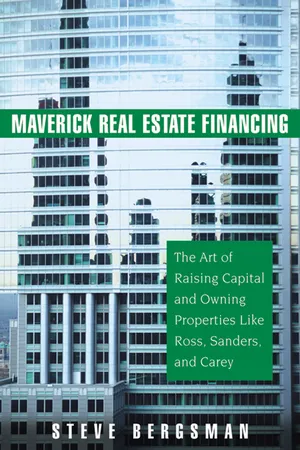
Maverick Real Estate Financing
The Art of Raising Capital and Owning Properties Like Ross, Sanders and Carey
- English
- ePUB (mobile friendly)
- Available on iOS & Android
eBook - ePub
Maverick Real Estate Financing
The Art of Raising Capital and Owning Properties Like Ross, Sanders and Carey
Chapter 1
The Most Amazing Real Estate Company Ever—Again!
William Sanders isn’t as well known as Donald Trump or Sam Zell, but no single person has created as many important real estate companies as Sanders. Now in his sixties, Sanders is attempting to build one more great dynamo. For better or worse, his new venture won’t be anything like Security Capital Group, his fantastic but flawed real estate company that tried to be all things real estate.
When I stepped outside the airport terminal and into the white light of an El Paso morning, I looked around for my ride, which hadn’t yet arrived. I must have stood on the curb for a long time, because I drifted into a sunlight-induced somnambulant state of waiting and didn’t see the man approach me. “Steve Bergsman?” he asked. I nodded and shook hands, I guess somewhat reluctantly, because he laughed and said, “Don’t worry I’m not the FBI.”
He easily could have been, because arranging an interview with William Sanders took a lot of work, a lot of time, and probably a full body scan and scrutiny of my personnel records as kept by some secretive governmental organization.
While researching Sanders before my meeting with him, I came across an old story written during his heyday as chief executive of Security Capital Group. It read: “In a business dominated by unabashed self-promoters, Sanders is an oddity. His name doesn’t even hang on his small office buildings. There is not a single color photo of him available. He is said to make anyone who works with him—inside the company or out—sign confidentiality agreements. ‘We don’t want anyone to make off with our ideas. I am shocked at what my competitors say publicly,’ he says in a polite phone conversation to explain why he won’t be interviewed.”1
The unheralded and selectively secretive Sanders, who next to the legendary Sam Zell stands as probably the most influential and storied real estate investor in the country, is hard at work on his next project, which has been rumored about in the business press. I was going to get a first peek, which is why I was invited down to El Paso.
While Sanders is more of an investor than a finance wizard, this book is not only about raising capital, but also about corporation formation. Sanders, more than any other real estate maven, has wrestled with choosing the best type of corporate format to hold real estate. His firm, Security Capital Group, a company that was actually a holding company for investments in private real estate companies and other REITs, was neither liked by Wall Street nor understood by the investment public. As efficient as Security Capital might have been in regard to ownership, it turned out that it was much too complicated for outside investors.
After numerous attempts at simplification, Sanders eventually folded his tent. The last of the company was sold to GE Capital, but that wasn’t exactly a giveaway: The deal closed at $5.4 billion.
Even if Sanders had then retired, he still would be one of the great men of modern real estate history because of the number of companies he founded and impacted through investments.
The global real estate firm, Jones Lang LaSalle, had part of its beginnings in LaSalle Partners, Ltd., an innovative company founded by Sanders in El Paso, Texas, in 1968, which moved to Chicago in 1970. Then there was, of course, Security Capital, and in creating Security Capital, Sanders also formed the huge multifamily REIT, Archstone-Smith Trust. Soon afterward, in a de novo development, he created the company that would become ProLogis, the largest industrial REIT in the world.
That alone would make a real estate man famous, but it was only a piece of Security Capital’s immenseness. Through Security Capital, Sanders created, expanded, or invested in more than a dozen other companies, including CarrAmerica Realty Corp., Storage USA, Inc., Regency Centers Corp., Homestead Village, and BelmontCorp.
All that may eventually pale next to his latest corporate challenge, Verde Realty, based in El Paso.
GETTING ABOUT
The man who tapped me on the shoulder at the El Paso airport was Christopher Lyons, a former Lehman Brothers guy who was now serving as a vice president with Verde Realty. I opened the car door and climbed into the front seat. The driver, a trim, distinguished-looking man, greeted me with an enthusiastic handshake, “Steve, how are you doing?” My driver for the day was going to be William Sanders himself.
As we wheeled into the streets of El Paso, I reached for the bag holding my tape recorders. Whoops. Ground rule number one. I could take notes during our car ride, which was going to be extensive, but I could not record the interview. Hours later, when we were back at his offices I was finally able to turn on the recorder and get Sanders on record.
One of the first questions I asked as I looked around El Paso—it didn’t appear much more appealing to me than the first couple of times I visited the city—was why the heck he was there. This would be revealed to me in the course of the car ride, but the simple answer was “lack of,” as in lack of competition, lack of capital, lack of REITs. As explained by Sanders, El Paso and Juárez, its sister city on the other side of border, constituted an international metropolitan area of more than 3 million people. Roughly two-thirds of those people were on the Mexican side, but it was obvious that El Paso was showing significant growth as well.
What Sanders meant was that, despite the growth and the significance of the population, El Paso was relatively off the map for national developers. In addition, all that capital currently lubricating the real estate market rarely washed into El Paso. And finally, most of the big REITs didn’t have investments in El Paso. The exception being ProLogis, an industrial REIT, but that was to be understood, because the company’s first development was in El Paso.
As Sanders saw it, El Paso was almost virgin territory for what he wanted to do with his new Verde Realty, the first hint of which came as we passed a number of what I thought to be handsome-looking ProLogis industrial buildings (some of them were probably constructed when Sanders controlled the company). This day, however, he was somewhat dismissive of them. “These are good buildings, but they are not where I want to be,” he said. “Where’s that?” I asked. The answer was, not just near the border with Mexico, but right on the border. That’s where Verde Realty was going to be.
You have to understand, if there was ever a real estate investment intellectual, it is Sanders. None of his great creations has simply been about making money. They all fulfilled a purpose or need. LaSalle Partners was started to capture the real estate business corporations needed but didn’t want to do. This was outsourcing before outsourcing existed. Security Capital was an experiment in real estate ownership. All that might pale in regard to the latest venture, Verde Realty, which was poised to invest in the most unrealized trendline in real estate.
Here’s a quick version of what Sanders explained: For many decades, the Midwest reigned as the country’s industrial heartland. And although much production has been shipped overseas, the remaining industrial base has been gradually relocating to the southern states near Mexico because of the inexpensive labor on both sides of the border. This, of course, is the old maquiladora concept.
The classic meaning of maquiladora is a factory located in a Mexican border town that imports materials and equipment on a duty-and tariff-free basis for assembly or manufacturing.
The maquiladora programs were weakened by the rise of China and its even cheaper labor, but there is something to be said for proximity. As Sanders pointed out, a number of companies that had shifted manufacturing to China were already coming back to the U.S.-Mexico border area to be closer to their North American customer base. On my tour of the outskirts of Juárez, a very large manufacturing facility was being constructed for a company that was moving some operations back to North America from China. This company wasn’t closing its China operations, because the shear size of that market demanded a presence there. But some time-sensitive operations and heavy-weight-to-value products destined for the North American marketplace were better suited for the U.S.-Mexico border region.
Sanders contends the U.S. manufacturing that remains in the country will shift more to the border in a great swath stretching from San Diego on the west to Brownsville, Texas, on the east. In between will be some important nodes, such as El Paso–Juárez.
“In U.S. industrial parks, most of the buildings are for bulk distribution,” Sanders maintains, “but down here only about 20 percent fall into that category. The rest are incubator, supplier, manufacturing, and customer service centers.”
He prophesies that El Paso will become the epicenter for Hispanic business in the country.
After lunch we headed east of the twin cities. The El Paso–Juárez area was tied together by just four border crossings: two within the city, one to the west, and the fourth, called the Zaragoza point of entry, on the outskirts of the population to the east. It was here we encountered the first of Verde Realty’s holdings, a number of industrial buildings and land right against the border crossing to be built out for incubator, supplier, distribution, and manufacturing development.
On the U.S. side of the border, Sanders explained once more to me that the most prime land is close to the actual border and as close as possible to an international crossing, which certainly included the Verde Realty holdings. The reasoning was there was much shipping of goods between related facilities on each side of the border. If assembly was done in Juárez, then suppliers and distribution would be out of El Paso. The twin-plant concept has been a feature of maquiladora almost from the beginning because the U.S. “twin” is often used for such tasks as procurement, distribution, marketing, and some high-tech manufacturing.2
Sanders believes in the development potential for the whole corridor of border lands, and that means on the Mexico side as well, so as one travels around central Juárez to the east and south where development begins to scatter into the desert landscape, much of the land is undeveloped. However, one can see the expansion already happening as new residential, retail, and industrial developments pop up madly. It’s here where Verde Realty has taken a stand, acquiring six tracts, one of which is designated retail, another housing, and the rest (including a tract closer to Juárez Airport) industrial. As we drove along Juárez’s International Beltway, through the heart of Verde’s holdings, Sanders spread out his left arm, “Within four miles of here, 20,000 to 25,000 homes are being built.”
Even closer are the new industrial complexes. Two Verde properties surround the new manufacturing campus, which itself is near a very large Electrolux campus nearing completion.
HUGE DEVELOPMENT: VERDE MICROCOSM
All this is just small potatoes compared to Verde’s immense project to the west of El Paso. It’s here that Sanders’s vision will play out in full. Verde Realty now controls more than 21,000 acres of land surrounding the Santa Teresa port of entry, which was formally dedicated in 1998. The company’s land is actually in New Mexico, not Texas, abutting Verde’s land to the south in Mexico, a 46,500-acre, to-be-developed project called San Jeronimo, which is owned by Eloy Vallina, a Verde Group director. Verde is coordinating plans for a binational project of enormous scale and importance for both countries.
Santa Teresa was first envisioned as a transpo...
Table of contents
- Cover
- Contents
- Title
- Copyright
- Dedication
- Introduction
- Chapter 1: The Most Amazing Real Estate Company Ever—Again!
- Chapter 2: Real Estate Loans
- Chapter 3: Advantages and Disadvantages of Conduit Loans
- Chapter 4: Agency Loans: An Easy Way to Finance Multifamily
- Chapter 5: Giving It Up for Equity Financing
- Chapter 6: A Very Useful Subsidy
- Chapter 7: Turning Real Estate into Capital
- Chapter 8: Retail Site Arbitrage
- Chapter 9: De-stressing Distressed Mortgages
- Chapter 10: Commingled Capital
- Chapter 11: Of REITs and UPREITs
- Chapter 12: The REITs That Don’t Trade Publicly
- Index
Trusted by 375,005 students
Access to over 1.5 million titles for a fair monthly price.
Study more efficiently using our study tools.
Frequently asked questions
Yes, you can cancel anytime from the Subscription tab in your account settings on the Perlego website. Your subscription will stay active until the end of your current billing period. Learn how to cancel your subscription
No, books cannot be downloaded as external files, such as PDFs, for use outside of Perlego. However, you can download books within the Perlego app for offline reading on mobile or tablet. Learn how to download books offline
Perlego offers two plans: Essential and Complete
- Essential is ideal for learners and professionals who enjoy exploring a wide range of subjects. Access the Essential Library with 800,000+ trusted titles and best-sellers across business, personal growth, and the humanities. Includes unlimited reading time and Standard Read Aloud voice.
- Complete: Perfect for advanced learners and researchers needing full, unrestricted access. Unlock 1.5M+ books across hundreds of subjects, including academic and specialized titles. The Complete Plan also includes advanced features like Premium Read Aloud and Research Assistant.
We are an online textbook subscription service, where you can get access to an entire online library for less than the price of a single book per month. With over 1.5 million books across 990+ topics, we’ve got you covered! Learn about our mission
Look out for the read-aloud symbol on your next book to see if you can listen to it. The read-aloud tool reads text aloud for you, highlighting the text as it is being read. You can pause it, speed it up and slow it down. Learn more about Read Aloud
Yes! You can use the Perlego app on both iOS and Android devices to read anytime, anywhere — even offline. Perfect for commutes or when you’re on the go.
Please note we cannot support devices running on iOS 13 and Android 7 or earlier. Learn more about using the app
Please note we cannot support devices running on iOS 13 and Android 7 or earlier. Learn more about using the app
Yes, you can access Maverick Real Estate Financing by Steve Bergsman in PDF and/or ePUB format, as well as other popular books in Business & Real Estate. We have over 1.5 million books available in our catalogue for you to explore.