- Offers the most complete and current coverage of control and mitigation techniques for chemical emergencies.
- Provides extensive treatment of transportation and storage vessels.
- Helps users comply with all relevant government regulations and standards, including OSHA and NFPA training requirements.
- English
- ePUB (mobile friendly)
- Available on iOS & Android
eBook - ePub
About this book
Hazardous Materials Handbook for Emergency Responders breaks down the hazards and response priorities according to the nine classes of hazardous chemicals defined by the U.N. and the U.S. Department of Transportation. Designed to prepare HazMat professionals for all three levels of response, as defined by OSHA, the Handbook:
Information
Chapter 1
INTRODUCTION TO HAZARDOUS MATERIALS
OBJECTIVES
After studying the material in this chapter, you will be able to:
- identify the agency responsible for regulating hazardous materials
- define the various types of hazardous materials
- list hazardous material incident types
- state how to recognize and identify hazardous materials
- list information resources regarding hazardous materials
INTRODUCTION
Responding to hazardous materials incidents has been one of the most exciting and demanding areas of emergency response in the past 20 years. About 100 years ago, a tank car consisted of wooden vats on a flatbed car. The vats were filled with commodities that were in high demand, such as kerosene or animal fat oil. Today, however, tank cars and trucks are sophisticated pieces of equipment that carry complex and often dangerous materials. Thousands of new chemicals are being created yearly because of the technological advances of our time.
Emergency response agencies must effectively respond to complicated incidents. They must properly handle a variety of hazardous materials. They must have a haz-mat response plan. It is both exciting and demanding work, yet it requires training, planning, readiness, and financial backing. There are three major problems that affect hazardous materials response:
Training is the primary factor in successfully handling a haz-mat incident.
- Until the introduction of NFPA 472 and OSHA 29 CFR 1910, there were no real recognized national standards for hazardous materials response.
- The costs of responding to and alleviating such incidents can be overwhelming. Most departments simply don’t have the necessary money to gear up for haz-mat emergencies.
- Recent changes in federal, state, and local legislation, as well as increased response dangers, demand that response methods be altered.
The goal of this reference manual is to clearly present valid information for responding to haz-mat emergencies. Whether yon are a firefighter, law enforcement officer, haz-mat specialist, EMS provider, municipal worker, state employee, dispatcher, or city official, the need for excellent and consistent training is critical if haz-mat incidents are to be effectively handled. It is your job as responders to bring a hazardous situation under control. Do not become part of the problem through inadequate training. Rather, work to provide effective service to your communities.
REGULATION OF HAZARDOUS MATERIALS
The Department of Transportation (DOT) is responsible for issuing and enforcing regulations for all ground-based transportation in the nation. Ground-based transportation can be by rail, road, or highway. The DOT also regulates air transportation through the FAA. These regulations cover all hazardous and non-hazardous materials and products, and are found in the Code of Federal Regulations, Title 49 (49 CFR).
“Hazardous materials are the great equalizer.”
– Mike Callan
HAZARDOUS MATERIAL DEFINED
DOT has legally defined a hazardous material as:
A substance or material, including a hazardous substance, which has been determined by the Secretary of Transportation to be capable of posing an unreasonable risk to health, safety, and property when transported in commerce, and which has been so designated (49 CFR 171.8).
Other definitions include:
Extremely hazardous materials – Those chemicals determined by the Environmental Protection Agency (EPA) to be extremely hazardous during a spill or release as a result of their toxicities and physical/chemical properties. Initially the EPA listed 402 chemicals in this category.
Dangerous goods – Any product, substance, or organism included by its nature or by regulation in any of the nine hazard classes listed in the United Nations schedule of hazardous materials.
Materials that fall under DOT regulations and are designated as hazardous are required to be placarded, with the exception of ORMs (Other Regulated Materials). There are, however, many materials that are not defined by the DOT as hazardous, but they can adversely affect health, safety, and property when released into the environment. One such example is milk. Milk is not considered a hazardous material, but it can severely harm many forms of life if accidentally induced into waterways.
We would like to suggest a more specific definition for hazardous material that can be applied on all responses:
A material or materials accidentally released from the original Container and used in a manner not originally intended. Hazardous materials include materials that are unintentionally contaminated or mixed with other chemicals, or involve some outside reactive source such as heat, light, liquids, shock, or pressure.
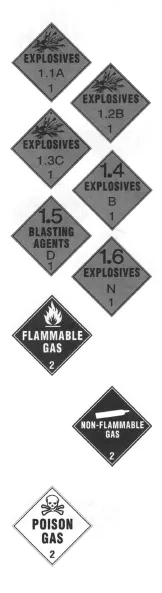
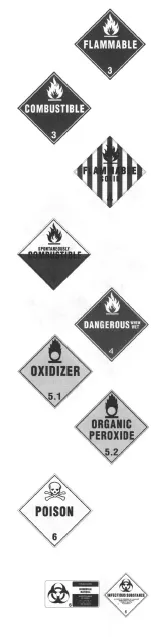
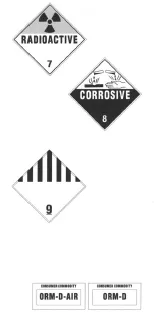
DOT Hazard Class Definitions
Explosive – Any substance, article, or device which is designed or is able to function by explosion, with extremely rapid release of gas and heat, unless the substance, article, or device is otherwise classed in 49 CFR 171-177. Explosives are divided into six divisions (49 CFR 173.50(b)):
- Division 1.1 – Explosives that have a mass explosion hazard. A mass explosion is one which affects almost the entire load instantaneously.
- Division 1.2 – Explosives that have a projection hazard but not a mass explosion hazard.
- Division 1.3 – Explosives that have a fire hazard and either a minor blast hazard or a minor projection hazard or both, but not a mass explosion hazard.
- Division 1.4 – Explosives that present a minor explosion hazard.
- Division 1.5 – Explosives which have a mass explosion hazard but are so insensitive that there is very little probability of initiation or of transition from burning to detonation under normal conditions of transport.
- Division 1.6 – Extremely insensitive articles which do not have a mass explosion hazard.
Flammable Gas – Any material which is a gas at 68°F (20°C) or less and 14.7 psi (101.3 kPa) of pressure and which (1) is ignitable when in a mixture of 13% or less by volume with air at atmospheric pressure, or (2) has a flammable range with air at atmospheric pressure of at least 12% regardless of the lower flammable limit (49 CFR 173.115(a)).
Non-Flammable, Non-Poisonous, Compressed Gas – Any material or mixture which exerts in the packaging an absolute pressure of at least 41 psia (280 kPa) at 68°F (20°C) and does not meet the definition of a flammable gas or a poisonous gas. This category includes compressed gas, liquefied gas, pressurized cryogenic gas, and compressed gas in solution (49 CFR 173.115(b)).
Gas Poisonous by Inhalation – A material which is a gas at 68°F (20°C) or less and a pressure of 14.7 psi (101.3 kPa) which (1) is known to be so toxic to humans as to pose a hazard to health ...
Table of contents
- COVER
- CONTENTS
- TITLE PAGE
- COPYRIGHT
- FOREWORD
- ACKNOWLEDGMENTS
- Chapter 1: INTRODUCTION TO HAZARDOUS MATERIALS
- Chapter 2: BASICS OF TOXICOLOGY AND PERSONAL PROTECTIVE EQUIPMENT
- Chapter 3: MANAGING THE HAZARDOUS MATERIALS INCIDENT
- Chapter 4: EXPLOSIVE EMERGENCIES
- Chapter 5: GAS EMERGENCIES
- Chapter 6: FLAMMABLE AND COMBUSTIBLE LIQUID EMERGENCIES
- Chapter 7: FLAMMABLE SOLID EMERGENCIES
- Chapter 8: OXIDIZER EMERGENCIES
- Chapter 9: POISON EMERGENCIES
- Chapter 10: RADIOACTIVE EMERGENCIES
- Chapter 11: CORROSIVE EMERGENCIES
- Chapter 12: MISCELLANEOUS HAZARDOUS MATERIAL EMERGENCIES
- Appendix A: GLOSSARY OF COMMON HAZ-MAT TERMS
- Appendix B: MATERIAL SAFETY DATA SHEETS (MSDS) AND SHIPPING PAPERS
- Appendix C: HAZARDOUS MATERIALS INFORMATION RESOURCES
- Appendix D: COMMON COMPRESSED AND LIQUEFIED GASES
- Appendix E: FLAMMABLE AND COMBUSTIBLE LIQUIDS
- Appendix F: HAZARDOUS MATERIALS CLASSIFICATION
- Appendix G: HAZ-MAT RESPONSE CHECKLISTS
- BIBLIOGRAPHY
- INDEX
Trusted by 375,005 students
Access to over 1.5 million titles for a fair monthly price.
Study more efficiently using our study tools.
Frequently asked questions
Yes, you can cancel anytime from the Subscription tab in your account settings on the Perlego website. Your subscription will stay active until the end of your current billing period. Learn how to cancel your subscription
No, books cannot be downloaded as external files, such as PDFs, for use outside of Perlego. However, you can download books within the Perlego app for offline reading on mobile or tablet. Learn how to download books offline
Perlego offers two plans: Essential and Complete
- Essential is ideal for learners and professionals who enjoy exploring a wide range of subjects. Access the Essential Library with 800,000+ trusted titles and best-sellers across business, personal growth, and the humanities. Includes unlimited reading time and Standard Read Aloud voice.
- Complete: Perfect for advanced learners and researchers needing full, unrestricted access. Unlock 1.5M+ books across hundreds of subjects, including academic and specialized titles. The Complete Plan also includes advanced features like Premium Read Aloud and Research Assistant.
We are an online textbook subscription service, where you can get access to an entire online library for less than the price of a single book per month. With over 1.5 million books across 990+ topics, we’ve got you covered! Learn about our mission
Look out for the read-aloud symbol on your next book to see if you can listen to it. The read-aloud tool reads text aloud for you, highlighting the text as it is being read. You can pause it, speed it up and slow it down. Learn more about Read Aloud
Yes! You can use the Perlego app on both iOS and Android devices to read anytime, anywhere — even offline. Perfect for commutes or when you’re on the go.
Please note we cannot support devices running on iOS 13 and Android 7 or earlier. Learn more about using the app
Please note we cannot support devices running on iOS 13 and Android 7 or earlier. Learn more about using the app
Yes, you can access Hazardous Materials by Joe Varela in PDF and/or ePUB format, as well as other popular books in Technology & Engineering & Environmental Management. We have over 1.5 million books available in our catalogue for you to explore.