—St. Bernard of Clairvaux, In Praise of the New Knighthood (1136)
The Templars became the darlings of the papacy and the most renowned knights on the battlefields of the Crusades. They grew in wealth and influence and became the bankers of Europe. They were advisors, diplomats, and treasurers. And then, after an existence of just 200 years, they were destroyed, not by infidel warriors on a plain in Palestine, but by a French king and a pliant pope. In the great timeline of history, the Templars came and went in an astonishingly brief blink of an eye. Yet, the mysteries that have always surrounded them have done nothing but circulate and grow for nine centuries.
In this chapter, we give you a quick tour of who the Knights Templar were, and the two seemingly contradictory traditions of war and religion they brought together to create the first Christian order of warrior monks. We also discuss the meanings of the codes they lived by, both the code of behavior that governed their daily lives and the secret codes that became part of their way of doing business.
Knights, Grails, Codes, Leonardo da Vinci, and How They All Collide
Everyone loves a mystery. Agatha Christie wrote 75 successful novels in a career that spanned decades, with estimated total sales of over 100 million. Her stories remain a fixture in the bookstore, as well as in film and television. But Agatha Christie always neatly wrapped up the mystery by the end of the story. The historical mysteries examined in the tale of the Templars are far more complex, and it’s rarely possible to tie them up with a ribbon and pronounce them solved.
Interest in the Templars, the Holy Grail, and various mysteries of the Bible have something in common with lace on dresses or double-breasted suits; over the course of the last couple of centuries, the mania will climb, reach a peak, then recede into the background, consigned to the cutout bin of life, to be picked up, brushed off, and brought to rousing life once more by a new generation with a fresh perspective.
The bare facts are simple. After two centuries of pride and power, the Templars went head to head with the dual forces that would destroy them — the Inquisition, and the man who used it as his chief weapon, Phillip IV, called Phillip the Fair, king of France, whose nickname definitely described his looks and not his ethics.
In the heresy trials that followed, the Templars were often accused of being Cathars, a form of Gnostic Christianity that was deemed a heresy by the Catholic Church. We explain Gnosticism in greater detail in Chapter 14, but speaking simply, the Gnostics were dualists, believing that the world was a place of tension between good and evil, light and darkness. The Templar Code may best be defined in the same way — a dual ethic, with two meanings: the decidedly unspiritual violence of the warrior knights on the one side, contrasted with the devoutly spiritual nature of religious life as monks on the other. The most common image signifying the Templar Knights was that of two Templars, armed for battle and riding the same horse together (see Figure 1-1). It was the perfect shorthand for both their fierceness in fighting, and the vow of poverty they lived by.
| Figure 1-1: A statue outside of the London Temple church depicting two Templar Knights on the same horse — symbolizing both poverty and fierceness. | |
Christopher Hodapp
You’d be hard pressed to find a more important and enduring myth in the Christian West than that of King Arthur, his Table Round, and the quest of his knights for the Holy Grail. The Templars were always another pillar of Western mythology, side by side with the Holy Grail legends. The two fables cross constantly along the way, and the many parallels between the Templars and the story of Arthur and the Grail, the parable of a man’s reach exceeding his grasp, may explain, at least in part, the continuing hold of the noble Templar legend on the Western imagination, seven centuries after the destruction of the Order.
And then Dan Brown wrote a book called The Da Vinci Code, and people’s perceptions of the Knights Templar, and just about everything in their world, changed almost overnight. The Templars were described as sinister gray eminences, dark powers behind the throne, keepers of the true Grail, the most dangerous secret of Christianity. Nowadays, truth can be almost anticlimactic. Yet the truth of the Templars is anything but a bore. It’s a story of the highest in the land brought low by greed and envy, of Crusader knights and Islamic warlords, of secret rituals, torture and self-sacrifice, and mysteries that still beguile the historians of the Middle Ages and beyond.
Right now, we’re living in a time when interest in the Templars is at an all-time high, and the reason for it is the intriguing way that all these mysteries, and many more, weave in and out of one another, touching, drifting apart, and then coming together again: Templars, the Grail, the Gnostic Gospels, the Dead Sea Scrolls, the Spear of Destiny, the heresy of Mary Magdalene as the wife of Jesus — they’re all tied to one another, with all the same players, in all the same events. The Templar story begins 900 years ago.
The Temple of Solomon
The origin of the temple that makes up the name of the Templars is King Solomon’s Temple, described in the Old Testament books of 2 Chronicles and 1 Kings. It was believed to have been constructed in approximately 1,000 B.C. by the wise Solomon, son of King David.
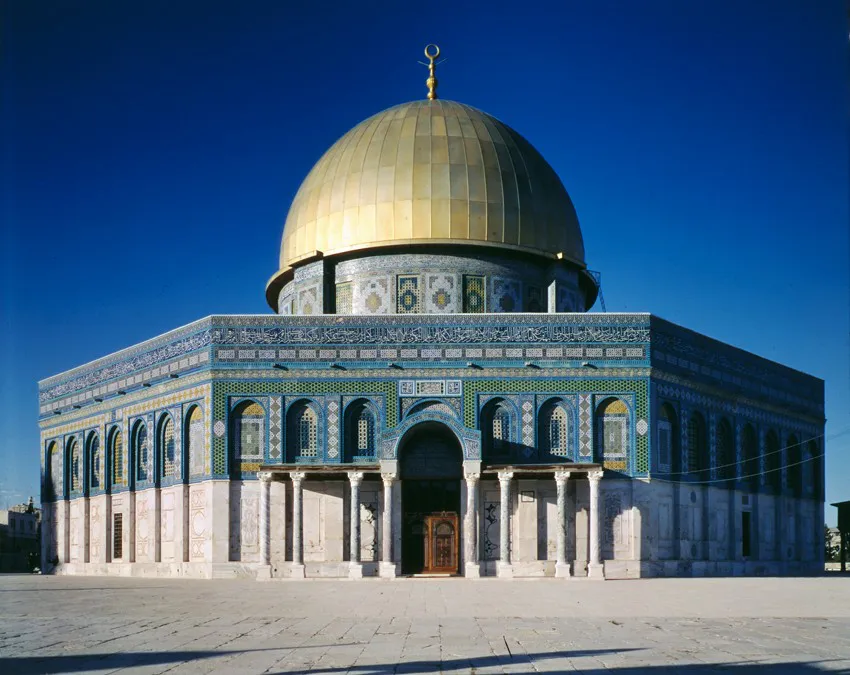
The temple was the most magnificent monument to man’s faith constructed during the biblical era. Its innermost sanctuary, the Sanctum Sanctorum, was built to hold the Ark of the Covenant, which contained the sacred words of God — the tablets Moses was given that contained the Ten Commandments. (The temple complex occupied what is known as the Temple Mount in Jerusalem, dominated by the Islamic Dome of the Rock; see the first image in this sidebar). It was destroyed by the Babylonians in 586 B.C.
A second temple (see the second image in this sidebar) was rebuilt on the same spot by Zerubbabel in 516 B.C. after the Jews had been released by the Babylonians 70 years before. This Temple was of a slightly different design and was extensively renovated and enlarged by King Herod the Great in 19 B.C. (This is the temple that Jesus threw the moneylenders out of, described in Matthew 21.) The Second Temple was destroyed by the Romans in A.D. 70 during the Jewish rebellion.
Israel images / AlamyScala / Art Resource, NY
The Poor Fellow-Soldiers of Christ and of the Temple of Solomon
Yep, that’s the full name of the Knights Templar. This name changes here and there, depending on the translation. Obviously, St. Bernard and the others who gave the order this final moniker wanted to make sure that everything about them but their shoe size was reflected in their title.
The Templars were granted the area of Jerusalem’s Temple Mount, former site of King Solomon’s Temple (see the nearby sidebar “The Temple of Solomon”) as their Holy Land headquarters. This is where the term Templar originated.
The Templars soon had a nickname, simply the Order of the Temple. Then later came Knights Templar, as well as White Knights, Poor Knights, and just plain Templars.
Defining knighthood
Templar Knights started life simply as knights. The word knight carries with it so much mythological baggage that it may seem a ridiculous question, but just what is a knight, anyway?
You probably think you know all about knighthood, because you’ve seen Sean Connery, Orlando Bloom, and Heath Ledger each play one. Well, actually, if you have, then you do already know quite a lot. The Hollywood treatment of knighthood and its rituals has been right more often than it’s been wrong, which is an amazing thing from an industry known the world over for its cavalier contempt for historical accuracy.
Roman origins
The concept of knighthood is an old one. The word itself — whether it was knight in English, chevalier in French, or ritter in German — simply means a cavalry warrior, one who did battle from the back of a horse instead of clomping along in the mud with the infantry. In the beginning, this didn’t necessarily make him a person of higher rank than an infantryman. The cavalry warriors of the Roman army were called equitatae, a pretty squishy word that just means “mounted.”
The medieval knight
The cavalry knight of the Middle Ages grew into a powerful force as the centuries passed. And the knight was inseparable from the feudal system in which he lived. As with everything else in Europe, Rome had a hand in the creation of the feudal system. This feudalism, from its very inception, was essentially a contract. The knight and his own vassals made various promises to their lord, to pay taxes or to serve him in wartime for a certain number of days each year, often 40 days, while the lord also made various promises.
Knights were proud and powerful men, with squires and servants, and so on, but their influence shouldn’t be overstated. Where the feudal chain of power w...